
Determining Angular Scale - Help w/ Microsteps
- notJamesLee
- Offline
- Senior Member
-

Less
More
- Posts: 60
- Thank you received: 5
14 Apr 2025 03:44 #326241
by notJamesLee
Determining Angular Scale - Help w/ Microsteps was created by notJamesLee
Hi Friends,
I am pulling my hair out trying to determine how many steps it take for my angular C axis to make one full revolution. I recently had to redesign the tangential cutting head so while I had it off the machine I wanted to tune it as much as possible with the tools i had available (scale, min max jog speed, etc)
So i set out to determine how many steps it would take the motor to rotate the output shaft one full revolution. After a few days of doing what I thought was simple calculations to little to no success I tried to go bottom up. That is, hard coding the number of steps and adjusting based on behavior. this took like 5 minutes to get it pretty close.. However, its not perfect and I'd like it to be close i don't understand why it is the number it is. I don't think i understand the 'Pulse/rev' table on the driver.
The bottom up number i got for steps per revolution was around 540.
Current settings:
Pulse/rev (dip switches) 1600
Motor Step Angle 1.8
Pulley Ratio :3.12
No matter how i combine those numbers i cannot seem to get anywhere close to the 540, the number that actually produces somewhat close to a full revolution.
Any help or explanation is greatly appreciated. My end goal is a precise calculated steps per revolution.
Ps. i am ignoring that this is a servo motor and capable of closed loop control, not sure if this logic holds but i would like it the be as close to correct as possible then use the PID controls to correct error and not lean on it due to sloppy setup work.
I am pulling my hair out trying to determine how many steps it take for my angular C axis to make one full revolution. I recently had to redesign the tangential cutting head so while I had it off the machine I wanted to tune it as much as possible with the tools i had available (scale, min max jog speed, etc)
So i set out to determine how many steps it would take the motor to rotate the output shaft one full revolution. After a few days of doing what I thought was simple calculations to little to no success I tried to go bottom up. That is, hard coding the number of steps and adjusting based on behavior. this took like 5 minutes to get it pretty close.. However, its not perfect and I'd like it to be close i don't understand why it is the number it is. I don't think i understand the 'Pulse/rev' table on the driver.
The bottom up number i got for steps per revolution was around 540.
Current settings:
Pulse/rev (dip switches) 1600
Motor Step Angle 1.8
Pulley Ratio :3.12
No matter how i combine those numbers i cannot seem to get anywhere close to the 540, the number that actually produces somewhat close to a full revolution.
Any help or explanation is greatly appreciated. My end goal is a precise calculated steps per revolution.
Ps. i am ignoring that this is a servo motor and capable of closed loop control, not sure if this logic holds but i would like it the be as close to correct as possible then use the PID controls to correct error and not lean on it due to sloppy setup work.
Please Log in or Create an account to join the conversation.
- notJamesLee
- Offline
- Senior Member
-
Less
More
- Posts: 60
- Thank you received: 5
14 Apr 2025 15:26 - 14 Apr 2025 15:27 #326289
by notJamesLee
Replied by notJamesLee on topic Determining Angular Scale - Help w/ Microsteps
Hi Friends,
- yes its a hybrid stepper, sorry for the misnomer, i've attached the data sheet of the motor and the drive.
I am using a GT2 timing belt and timing pulleys i got off amazon. The pulley ratio expressed as a fraction is 37.49/11.99. I just realized i should probably use the number of teeth instead which brings that fraction to 60/20 or 3, but this still doesnt get me to the 540 number any easier. How would one measure the pulley ratio with the actual belt?
I was hoping that the belt system i designed wouldn't slip THAT much. I only have it rotating one way, as belts are good pullers not so good when it comes to pushing. I mean i even have a custom tensioner in there. I can upload cad photos if necessary.
So because i took the head off to redesign it i haven't put it back up on the machine and reset up the drive, all the numbers i am sharing are coming from the little Arduino script i wrote to test this.
- yes its a hybrid stepper, sorry for the misnomer, i've attached the data sheet of the motor and the drive.
I am using a GT2 timing belt and timing pulleys i got off amazon. The pulley ratio expressed as a fraction is 37.49/11.99. I just realized i should probably use the number of teeth instead which brings that fraction to 60/20 or 3, but this still doesnt get me to the 540 number any easier. How would one measure the pulley ratio with the actual belt?
I was hoping that the belt system i designed wouldn't slip THAT much. I only have it rotating one way, as belts are good pullers not so good when it comes to pushing. I mean i even have a custom tensioner in there. I can upload cad photos if necessary.
So because i took the head off to redesign it i haven't put it back up on the machine and reset up the drive, all the numbers i am sharing are coming from the little Arduino script i wrote to test this.
Last edit: 14 Apr 2025 15:27 by notJamesLee.
Please Log in or Create an account to join the conversation.
- notJamesLee
- Offline
- Senior Member
-
Less
More
- Posts: 60
- Thank you received: 5
14 Apr 2025 16:08 #326295
by notJamesLee
Replied by notJamesLee on topic Determining Angular Scale - Help w/ Microsteps
I currently have it on my test bench with a DC power supply set at 24v. Depending on what is doing it typically is drawing around 0.25A. if i turn the current knobs on the power supply it doesnt increase at all.
I have the switch on the driver set to D which according to the data sheet is 2.8 peak or 2 RMS which is alot more than its pulling. Should i switch this to 0-4 according to the datasheet thats about where my current draw is.
I just tried plugging 625 into the arduino code (its not on the machine yet) and its about 1.125 spins.
I have the switch on the driver set to D which according to the data sheet is 2.8 peak or 2 RMS which is alot more than its pulling. Should i switch this to 0-4 according to the datasheet thats about where my current draw is.
I just tried plugging 625 into the arduino code (its not on the machine yet) and its about 1.125 spins.
Please Log in or Create an account to join the conversation.
- notJamesLee
- Offline
- Senior Member
-
Less
More
- Posts: 60
- Thank you received: 5
14 Apr 2025 16:37 #326300
by notJamesLee
Replied by notJamesLee on topic Determining Angular Scale - Help w/ Microsteps
before i do this, should i modify the 'steps per revolution' in the arduino code?
For the capacitor, are we just trying to smooth the input?
For the capacitor, are we just trying to smooth the input?
Please Log in or Create an account to join the conversation.
- notJamesLee
- Offline
- Senior Member
-
Less
More
- Posts: 60
- Thank you received: 5
14 Apr 2025 22:04 #326322
by notJamesLee
Replied by notJamesLee on topic Determining Angular Scale - Help w/ Microsteps
okay quick update:
setting steps per revolution to 600 and set all the driver drip switches to on, which on the table is default, so i assume no micro stepping. I ran into the same issue.
I then tried to modify the turn switchA-F,0-9 and the motor doesnt turn the output shaft on 0-7, it only starts from 8 on and all the letters. maybe this can give us a clue as to what is happening.
overall, still about 1.125 turns and pulling 0.25a
setting steps per revolution to 600 and set all the driver drip switches to on, which on the table is default, so i assume no micro stepping. I ran into the same issue.
I then tried to modify the turn switchA-F,0-9 and the motor doesnt turn the output shaft on 0-7, it only starts from 8 on and all the letters. maybe this can give us a clue as to what is happening.
overall, still about 1.125 turns and pulling 0.25a
Please Log in or Create an account to join the conversation.
- notJamesLee
- Offline
- Senior Member
-
Less
More
- Posts: 60
- Thank you received: 5
15 Apr 2025 02:47 #326334
by notJamesLee
Replied by notJamesLee on topic Determining Angular Scale - Help w/ Microsteps
okay maybe i am missing something.
I turned the switch to C, cranked up the voltage (my desktop power supply goes only up to 31 for some reason) and there is no change in the amount it spins for 'one' revolution. Still about 1.125 and pulling .25a.
The control method dip switch (6) is set to open control mode.
one thing that dawned on me, and maybe this speaks to me not quite understanding what is meant by pulse/rev, is that if the driver is set to default, all switches 1-4 set to on, there is not difference between the behavior when its set to 1600.. Even though the steps the arudino is sending are the same. this confused me even more.
I turned the switch to C, cranked up the voltage (my desktop power supply goes only up to 31 for some reason) and there is no change in the amount it spins for 'one' revolution. Still about 1.125 and pulling .25a.
The control method dip switch (6) is set to open control mode.
one thing that dawned on me, and maybe this speaks to me not quite understanding what is meant by pulse/rev, is that if the driver is set to default, all switches 1-4 set to on, there is not difference between the behavior when its set to 1600.. Even though the steps the arudino is sending are the same. this confused me even more.
Please Log in or Create an account to join the conversation.
- notJamesLee
- Offline
- Senior Member
-
Less
More
- Posts: 60
- Thank you received: 5
15 Apr 2025 14:59 #326378
by notJamesLee
Replied by notJamesLee on topic Determining Angular Scale - Help w/ Microsteps
Changing from F to 0 the output changes. The motor shaft is shaking as it doesnt have enough torque to spin the pulley. This is true until i get to 8. On 8 it comes alive and spins as it has been. The output seems to improve as i move past 8 but i have no data to confirm this.
I have the debug cord but once i get into the menus i have no idea what i am looking for.
I have the debug cord but once i get into the menus i have no idea what i am looking for.
Please Log in or Create an account to join the conversation.
- notJamesLee
- Offline
- Senior Member
-
Less
More
- Posts: 60
- Thank you received: 5
15 Apr 2025 15:18 #326379
by notJamesLee
Replied by notJamesLee on topic Determining Angular Scale - Help w/ Microsteps
update.
I took the motor out just to see if i could get it to reliably spin one revolution. With all the dip switches set to default that number is 1600. And i think i just had a brain blast because switching to the 1600 doesn't change it.
Also conveniently 1600 / 3.12 (the pulley ratio) is 533.3333 pretty close to the 540 number,.
I am going to throw it back together and verify.
I took the motor out just to see if i could get it to reliably spin one revolution. With all the dip switches set to default that number is 1600. And i think i just had a brain blast because switching to the 1600 doesn't change it.
Also conveniently 1600 / 3.12 (the pulley ratio) is 533.3333 pretty close to the 540 number,.
I am going to throw it back together and verify.
Please Log in or Create an account to join the conversation.
- notJamesLee
- Offline
- Senior Member
-
Less
More
- Posts: 60
- Thank you received: 5
15 Apr 2025 17:58 #326390
by notJamesLee
Replied by notJamesLee on topic Determining Angular Scale - Help w/ Microsteps
Big pulley count - 60 and 20 for the small one.
The point about the micro steps is messing with me too.
I put everything back together, changed the value to 533, the closest i could get with an integer and it works. It does a full revolution but after 5+ you can see the error propagation. Same behavior with dip switches on default and set to 1600..
is this just something i'm forced to deal with using the PID once i move it to LCNC?
Th
The point about the micro steps is messing with me too.
I put everything back together, changed the value to 533, the closest i could get with an integer and it works. It does a full revolution but after 5+ you can see the error propagation. Same behavior with dip switches on default and set to 1600..
is this just something i'm forced to deal with using the PID once i move it to LCNC?
Th
Please Log in or Create an account to join the conversation.
- notJamesLee
- Offline
- Senior Member
-
Less
More
- Posts: 60
- Thank you received: 5
16 Apr 2025 04:40 #326427
by notJamesLee
Replied by notJamesLee on topic Determining Angular Scale - Help w/ Microsteps
youre 100% right, not sure where i got 533 from.
I set it to 600 and its still over shooting. Probably about 1.125 rotations again.
I am having trouble believing its the driver because with the 1600 it works perfectly and repeatable (not sure that's a word).
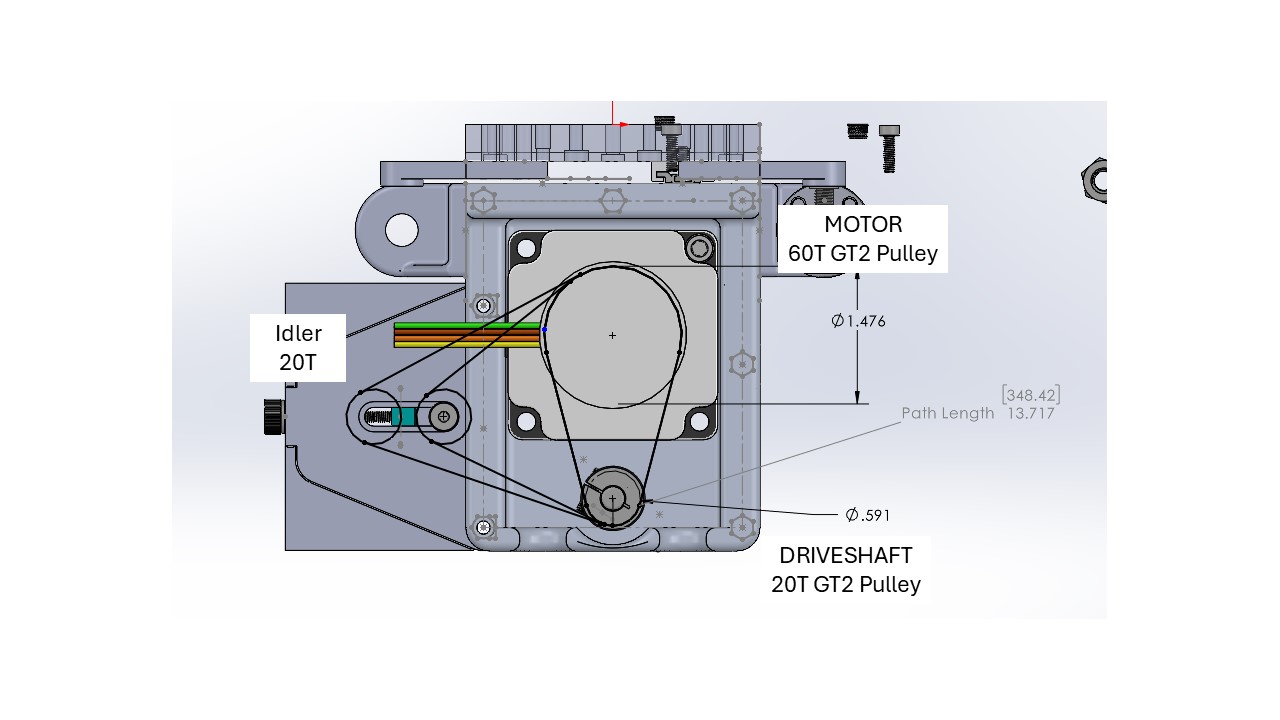
Maybe i need a sanity check on the layout of the belt system (simple diagram) attached. I dont think the tensioner (idler gear) makes any difference in the belt ratio calc (shout out uni for that one)
I set it to 600 and its still over shooting. Probably about 1.125 rotations again.
I am having trouble believing its the driver because with the 1600 it works perfectly and repeatable (not sure that's a word).
Maybe i need a sanity check on the layout of the belt system (simple diagram) attached. I dont think the tensioner (idler gear) makes any difference in the belt ratio calc (shout out uni for that one)
Please Log in or Create an account to join the conversation.
Time to create page: 0.998 seconds