

- Posts: 377
- Thank you received: 0
Arc OK intermitent issues on torch fire
5 years 6 months ago #204585
by txtrone
Replied by txtrone on topic Arc OK intermitent issues on torch fire
Thank you
Please Log in to join the conversation.
5 years 6 months ago #204698
by txtrone
Would this FNQ-1 fuse be adequate?
Replied by txtrone on topic Arc OK intermitent issues on torch fire
PCW wrote: The fuses are to protect the sense wires from fault currents so they
should be as close to plasma machine as possible. 1A should be fine
(It should be rate to interrupt the plasma voltage and current)
Would this FNQ-1 fuse be adequate?
Attachment not found
Please Log in to join the conversation.
- tommylight
-

- Away
- Administrator
-

Less
More
- Posts: 22012
- Thank you received: 3
5 years 6 months ago #204734
by tommylight
Replied by tommylight on topic Arc OK intermitent issues on torch fire
Notice the "time delay" in the pdf, those are slow acting fuses, for electronics use always fast acting ones, they are usually made of see through glass with a very thin wire inside.
Please Log in to join the conversation.
5 years 6 months ago #204748
by txtrone
What voltage should the fuse be rated for? 250?
Replied by txtrone on topic Arc OK intermitent issues on torch fire
tommylight wrote: Notice the "time delay" in the pdf, those are slow acting fuses, for electronics use always fast acting ones, they are usually made of see through glass with a very thin wire inside.
What voltage should the fuse be rated for? 250?
Please Log in to join the conversation.
5 years 6 months ago #204758
by PCW
Replied by PCW on topic Arc OK intermitent issues on torch fire
0ADAC0600-BE might be a better choice as it's cheaper, has a DC rating
and will fit in a standard 3AG inline fuseholder
and will fit in a standard 3AG inline fuseholder
Please Log in to join the conversation.
5 years 6 months ago #204788
by txtrone
I like that price point! Sorry to beat this to death, but earlier you suggested a 1A... this model is 0.6A ... I assume that anything over a half amp on the sense or torch wires is too much and this fuse will break the circuit before anything or anyone gets hurt. Does that sound correct-ish? thx again PCW!
Replied by txtrone on topic Arc OK intermitent issues on torch fire
PCW wrote: 0ADAC0600-BE might be a better choice as it's cheaper, has a DC rating
and will fit in a standard 3AG inline fuseholder
I like that price point! Sorry to beat this to death, but earlier you suggested a 1A... this model is 0.6A ... I assume that anything over a half amp on the sense or torch wires is too much and this fuse will break the circuit before anything or anyone gets hurt. Does that sound correct-ish? thx again PCW!
Please Log in to join the conversation.
5 years 6 months ago #204835
by txtrone
Tommylight do you think the ArcOk signaling method created by using 'three turns around the reed relay' is actually a better (or as good as) method than what comes built into many machines today? When I first read about this (your?) method I thought it sounded quite MacGyver-esque... and not the new MacGyver either... the real mid-1980s-OG-MacGyver. Just curious.
Replied by txtrone on topic Arc OK intermitent issues on torch fire
rodw wrote:
tommylight wrote: And i do agree on not using any resistor or capacitor, try it without it. I never used any of those on several (count more than 20) and never had issues, but i am pretty sure it might be needed sometimes.
To be fair Tommy, from what you've written over the years, many of the machines you have built did not have a builtin AcOK relay so it was a non issue for them. At least you know to look for the issue if it ever bites you!
Tommylight do you think the ArcOk signaling method created by using 'three turns around the reed relay' is actually a better (or as good as) method than what comes built into many machines today? When I first read about this (your?) method I thought it sounded quite MacGyver-esque... and not the new MacGyver either... the real mid-1980s-OG-MacGyver. Just curious.
Please Log in to join the conversation.
- tommylight
-
- Away
- Administrator
-
Less
More
- Posts: 22012
- Thank you received: 3
5 years 6 months ago #204839
by tommylight
Replied by tommylight on topic Arc OK intermitent issues on torch fire
The derived arcok from THCAD works perfectly although i am sure there might be situations where it might fail but not due the the way it works but due to how plasma sources work.
The reed version has no way of failing if done right as it relies on a big amount of current passing through that wire.
By now i have 4 machines using the derived arcok from thcad and they never failed, but that needs a bit of tweaking, roughly setting the low limit to 60-80V and the high limit to 250V and then gradually lowering it till it starts failing or till it reaches 140-160V and leaving it there. That will prevent the machine getting the arcok in case the torch has fired and it is to high so the current passing through it will be low and the subsequent voltage will be anything from 180 to 280 or more V, causing the plasma to fail the arc as it can not be transferred to cutting power.
Or to put it simpler it MIGHT give arcok even when not cutting at full power in such case. The above tweaking prevents that.
The low side is less important as that would be the case when the torch is very low or touching the material hence the voltage will be low but it will not impede the cutting process, it will just mess up the nozzle.
Please Log in to join the conversation.
5 years 6 months ago #204857
by rodw
Replied by rodw on topic Arc OK intermitent issues on torch fire
My take is that if you have an arcok output on your plasma cutter be sure to use it.
This plot I shared on another thread shows the voltage fluctuation on piercing before the ArcOK is turned on.
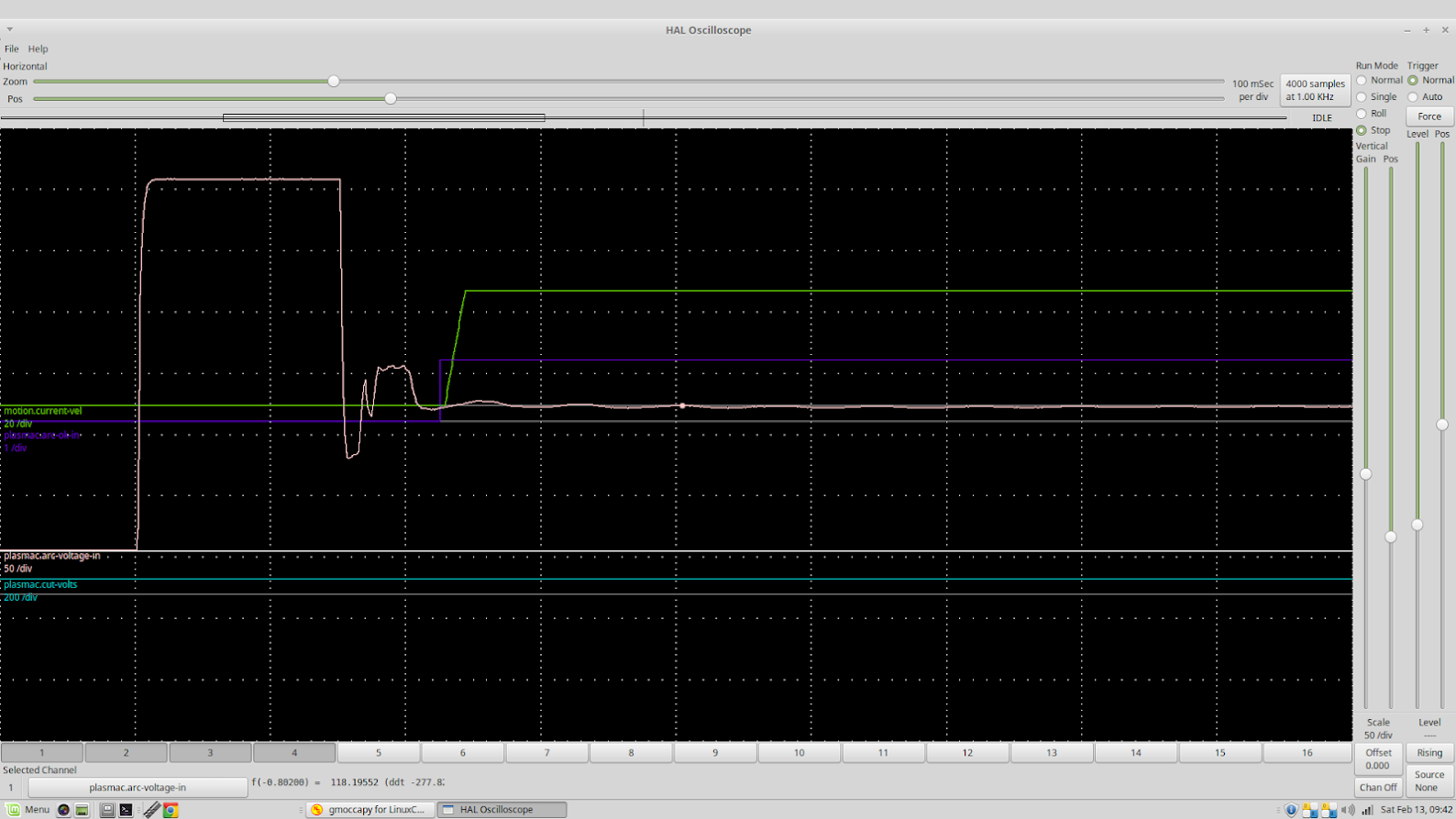
See: forum.linuxcnc.org/plasma-laser/41420-arc-voltage-on-piercing
You can see there is quite some fluctuations in the voltage and the risk is that Plasmac's low threshold could force the ArcOK to drop out. The current synthesised ArcOK algorithm is a little simplistic for my liking. The plasma cutter does more work than just looking at the torch voltage before enabling ArcOK. I'd like to see an algorithm based on tracking the arc behaviour shown in the plot.
This plot I shared on another thread shows the voltage fluctuation on piercing before the ArcOK is turned on.
See: forum.linuxcnc.org/plasma-laser/41420-arc-voltage-on-piercing
You can see there is quite some fluctuations in the voltage and the risk is that Plasmac's low threshold could force the ArcOK to drop out. The current synthesised ArcOK algorithm is a little simplistic for my liking. The plasma cutter does more work than just looking at the torch voltage before enabling ArcOK. I'd like to see an algorithm based on tracking the arc behaviour shown in the plot.
Please Log in to join the conversation.
Time to create page: 0.149 seconds