
- Hardware & Machines
- CNC Machines
- Milling Machines
- Machine choice for composite panel CNC + probe-driven XY/Z G-code compensation
Machine choice for composite panel CNC + probe-driven XY/Z G-code compensation
- LucaGiorcelli
- Offline
- New Member
-

Less
More
- Posts: 2
- Thank you received: 0
10 Mar 2026 21:31 #344109
by LucaGiorcelli
Machine choice for composite panel CNC + probe-driven XY/Z G-code compensation was created by LucaGiorcelli
Hi all,
I'm planning a gantry router build for machining composite panels into cabinet components. Looking for advice on machine choice and stack.
Material
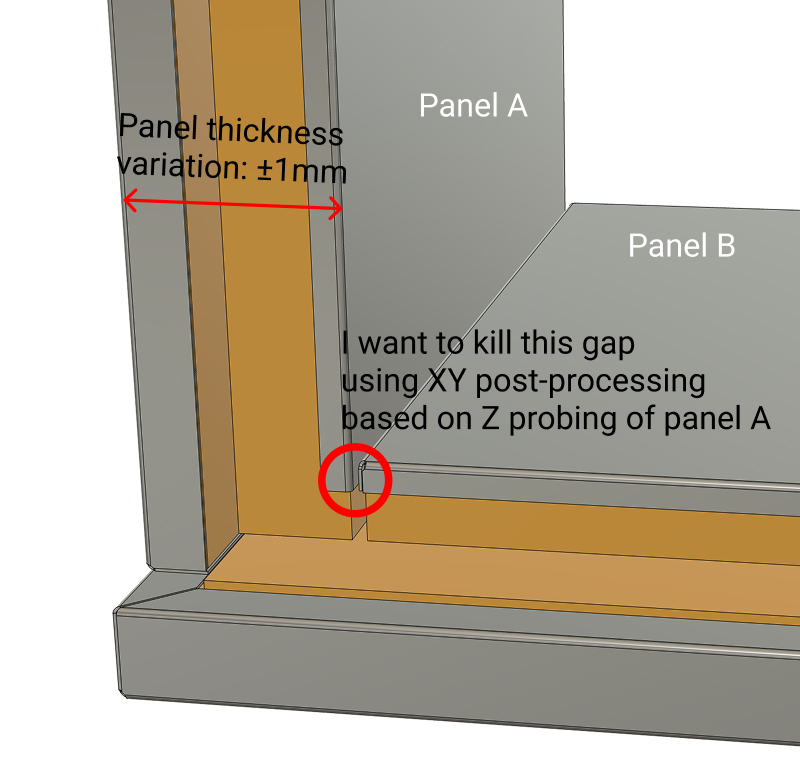
- Sandwich panels: 1mm aluminium skins on both faces, polyurethane foam core
- Total thickness: ~60mm nominal, but varies ±1mm across a batch
- Panel size: up to 1500x3000mm
Parts and operations

- Cutting outlines
- Pockets and step joints on panel face
- V-scoring the aluminium skin to create precise fold lines (score-and-fold)
These operations require multiple tools in a single job (end mills for pockets and joints, V-bit for scoring), so automatic tool change (ATC) is a hard requirement.
The step joints are the critical operation: they create mechanical overlap between mating panels so cabinets assemble with tight joints. A 1mm thickness variation in the stock translates directly into a gap.
Workflow
probing → generate Z map → process map (Python) → adjust G-code geometry (XY and Z) → send corrected G-code → machining
- Fusion 360 CAM produces nominal G-code
- Before cutting, I probe a grid of Z points across the panel surface
- A Python script reads the probe map and rewrites the G-code: step depths and joint profiles are adjusted to the actual measured local thickness — for both the panel being cut and its mating counterpart
- This is not just Z surface compensation: XY profiles are modified based on the probe map so that mating joints match regardless of thickness variation
Why LinuxCNC
- Workflow already tested with LinuxCNC + MESA cards (7i96/7i77) on an entry level router.
- Plan to use the Python socket interface for probe data collection and G-code rewriting — tight integration between probing and post-processing is central to the workflow
My questions
1. Are there manufacturers selling new gantry routers with these specs who ship with LinuxCNC, or sell mechanics separately from the controller?
- Working envelope: ~1600x3200mm
- HF spindle: 18k+ RPM
- Integrated vacuum table with independently switchable zones
- ATC (tool magazine or rack)
- Probe input
2. For a retrofit path: which used industrial gantry platforms have the best LinuxCNC community experience?
- Main concerns: ATC integration and vacuum zone management via MESA I/O
3. Any experience with probe-map-driven G-code modification beyond simple Z surface mapping?
- Currently planning G38.x + Python
- Is there a better pattern for this use case?
Thanks
I'm planning a gantry router build for machining composite panels into cabinet components. Looking for advice on machine choice and stack.
Material
- Sandwich panels: 1mm aluminium skins on both faces, polyurethane foam core
- Total thickness: ~60mm nominal, but varies ±1mm across a batch
- Panel size: up to 1500x3000mm
Parts and operations
- Cutting outlines
- Pockets and step joints on panel face
- V-scoring the aluminium skin to create precise fold lines (score-and-fold)
These operations require multiple tools in a single job (end mills for pockets and joints, V-bit for scoring), so automatic tool change (ATC) is a hard requirement.
The step joints are the critical operation: they create mechanical overlap between mating panels so cabinets assemble with tight joints. A 1mm thickness variation in the stock translates directly into a gap.
Workflow
probing → generate Z map → process map (Python) → adjust G-code geometry (XY and Z) → send corrected G-code → machining
- Fusion 360 CAM produces nominal G-code
- Before cutting, I probe a grid of Z points across the panel surface
- A Python script reads the probe map and rewrites the G-code: step depths and joint profiles are adjusted to the actual measured local thickness — for both the panel being cut and its mating counterpart
- This is not just Z surface compensation: XY profiles are modified based on the probe map so that mating joints match regardless of thickness variation
Why LinuxCNC
- Workflow already tested with LinuxCNC + MESA cards (7i96/7i77) on an entry level router.
- Plan to use the Python socket interface for probe data collection and G-code rewriting — tight integration between probing and post-processing is central to the workflow
My questions
1. Are there manufacturers selling new gantry routers with these specs who ship with LinuxCNC, or sell mechanics separately from the controller?
- Working envelope: ~1600x3200mm
- HF spindle: 18k+ RPM
- Integrated vacuum table with independently switchable zones
- ATC (tool magazine or rack)
- Probe input
2. For a retrofit path: which used industrial gantry platforms have the best LinuxCNC community experience?
- Main concerns: ATC integration and vacuum zone management via MESA I/O
3. Any experience with probe-map-driven G-code modification beyond simple Z surface mapping?
- Currently planning G38.x + Python
- Is there a better pattern for this use case?
Thanks
Please Log in or Create an account to join the conversation.
- tommylight
-

- Away
- Moderator
-

Less
More
- Posts: 21958
- Thank you received: 7478
10 Mar 2026 22:27 #344115
by tommylight
Replied by tommylight on topic Machine choice for composite panel CNC + probe-driven XY/Z G-code compensation
1. yes, industrial ones are very expensive and very heavy, also fully equipped for any task. I would steer clear of china ones for under 20K as those are "projects", not tools.
2. Biesse, SMC, etc can be found for cheap and retrofitted, not easy and a lot of work, but definitely worth it as you end up with a machine built like a tank with controls that never fail.
3. There are some examples around here and a nice little piece of software for it, but i never used it so i'll leave that to others.
2. Biesse, SMC, etc can be found for cheap and retrofitted, not easy and a lot of work, but definitely worth it as you end up with a machine built like a tank with controls that never fail.
3. There are some examples around here and a nice little piece of software for it, but i never used it so i'll leave that to others.
The following user(s) said Thank You: LucaGiorcelli
Please Log in or Create an account to join the conversation.
- LucaGiorcelli
- Offline
- New Member
-
Less
More
- Posts: 2
- Thank you received: 0
11 Mar 2026 06:58 - 11 Mar 2026 06:59 #344128
by LucaGiorcelli
Replied by LucaGiorcelli on topic Machine choice for composite panel CNC + probe-driven XY/Z G-code compensation
Thanks for the response — this is helpful context.
I understand retrofit is a valid path and the point about ending up with a tank-built machine is well taken. My hesitation is mainly about the time investment: I'd rather spend that energy on the application layer (custom probe-driven post-processing workflow) than on commissioning the machine itself.
That said, I'm open to both paths if the retrofit is well-documented for a specific platform.
So to refine my question:
1. For **new machines**: I've been told some smaller European builders sell gantry routers either pre-configured with LinuxCNC or as bare mechanics without a controller. Can anyone confirm this and point to specific manufacturers with real-world experience?
2. For **retrofit**: which specific platforms (Biesse, SCM, other) have the best-documented LinuxCNC retrofit in this community? Ideally something where ATC and vacuum zone management via MESA I/O are already solved problems with existing examples.
I understand retrofit is a valid path and the point about ending up with a tank-built machine is well taken. My hesitation is mainly about the time investment: I'd rather spend that energy on the application layer (custom probe-driven post-processing workflow) than on commissioning the machine itself.
That said, I'm open to both paths if the retrofit is well-documented for a specific platform.
So to refine my question:
1. For **new machines**: I've been told some smaller European builders sell gantry routers either pre-configured with LinuxCNC or as bare mechanics without a controller. Can anyone confirm this and point to specific manufacturers with real-world experience?
2. For **retrofit**: which specific platforms (Biesse, SCM, other) have the best-documented LinuxCNC retrofit in this community? Ideally something where ATC and vacuum zone management via MESA I/O are already solved problems with existing examples.
Last edit: 11 Mar 2026 06:59 by LucaGiorcelli.
Please Log in or Create an account to join the conversation.
- tommylight
-
- Away
- Moderator
-
Less
More
- Posts: 21958
- Thank you received: 7478
11 Mar 2026 21:04 #344156
by tommylight
Replied by tommylight on topic Machine choice for composite panel CNC + probe-driven XY/Z G-code compensation
1. had good and bad experience with some of those companies, and almost (almost) always the machines are made in china.
-Some German companies have smaller machines that are good and do what they advertise, cant recall company names
-i know of a German company that sells machines made in 2024 using RS232 communication to PC (to damn old controller, still being made), it works, i would not sell nor buy such a machine because of that, although mechanically it is nice:
forum.linuxcnc.org/show-your-stuff/55825...ial-connection-to-pc
-Some German companies have smaller machines that are good and do what they advertise, cant recall company names
-i know of a German company that sells machines made in 2024 using RS232 communication to PC (to damn old controller, still being made), it works, i would not sell nor buy such a machine because of that, although mechanically it is nice:
forum.linuxcnc.org/show-your-stuff/55825...ial-connection-to-pc
The following user(s) said Thank You: LucaGiorcelli
Please Log in or Create an account to join the conversation.
- rodw
-

- Offline
- Platinum Member
-

Less
More
- Posts: 12156
- Thank you received: 4149
11 Mar 2026 22:12 #344160
by rodw
Replied by rodw on topic Machine choice for composite panel CNC + probe-driven XY/Z G-code compensation
In Europe, try Grotius Machine Tools, the owner is well known on this forum
The following user(s) said Thank You: tommylight, LucaGiorcelli
Please Log in or Create an account to join the conversation.
Moderators: piasdom
- Hardware & Machines
- CNC Machines
- Milling Machines
- Machine choice for composite panel CNC + probe-driven XY/Z G-code compensation
Time to create page: 0.378 seconds