
Prvomajska G301 Milling machine converting to CNC
- dst
- Offline
- New Member
-

Less
More
- Posts: 3
- Thank you received: 0
30 Jul 2026 00:06 #348183
by dst
Prvomajska G301 Milling machine converting to CNC was created by dst
Hello All!
More than10 years ago (at that time i just started my studies) my father found a great milling machine in a scrapyard, Prvomajska G301 D1 manufactured in 1973 , the machine seems to be almost not used at all, unfortunately it was subject to weather changes and most of the axis were locked up by rust, its spindle motor and holding bracket broken off and x axis gearbox with motor broken off. Back when he brought it home we started to disassemble, we removed some parts from its quill and then life happened we left it on the field covered with plastic sheets as there was no more space on the workshop.
Recently we removed some things from the shop and got some place for the mill and we placed it inside, past week we were working very hard to clean up the rest of the machine and mount it back, so far the worst part is that its spindle bearing are quite rusty and once we get the rest sorted out will have to be replaced (altho, i still dont know where we could find it).
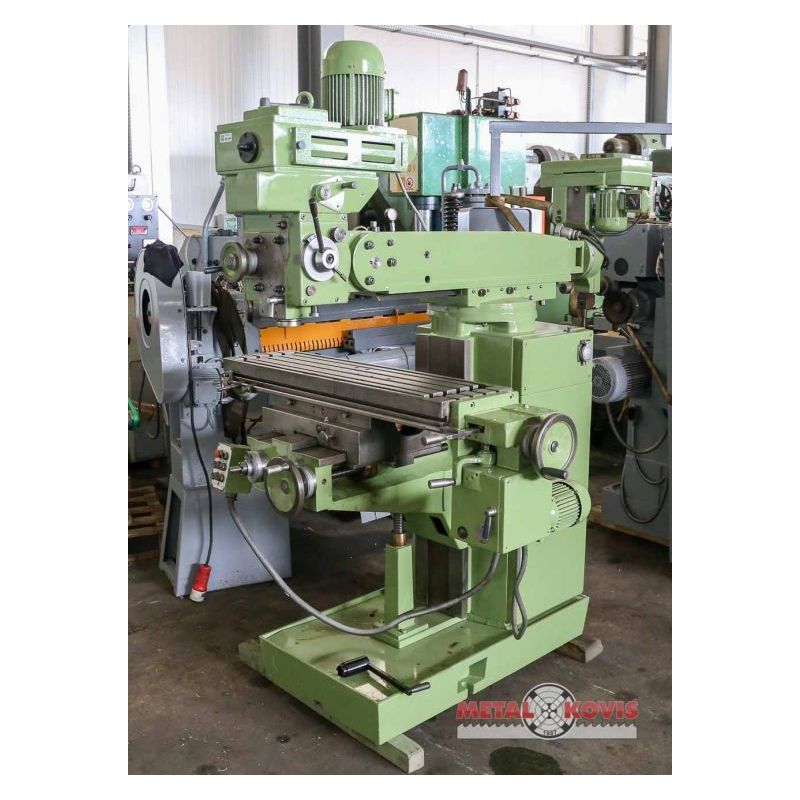
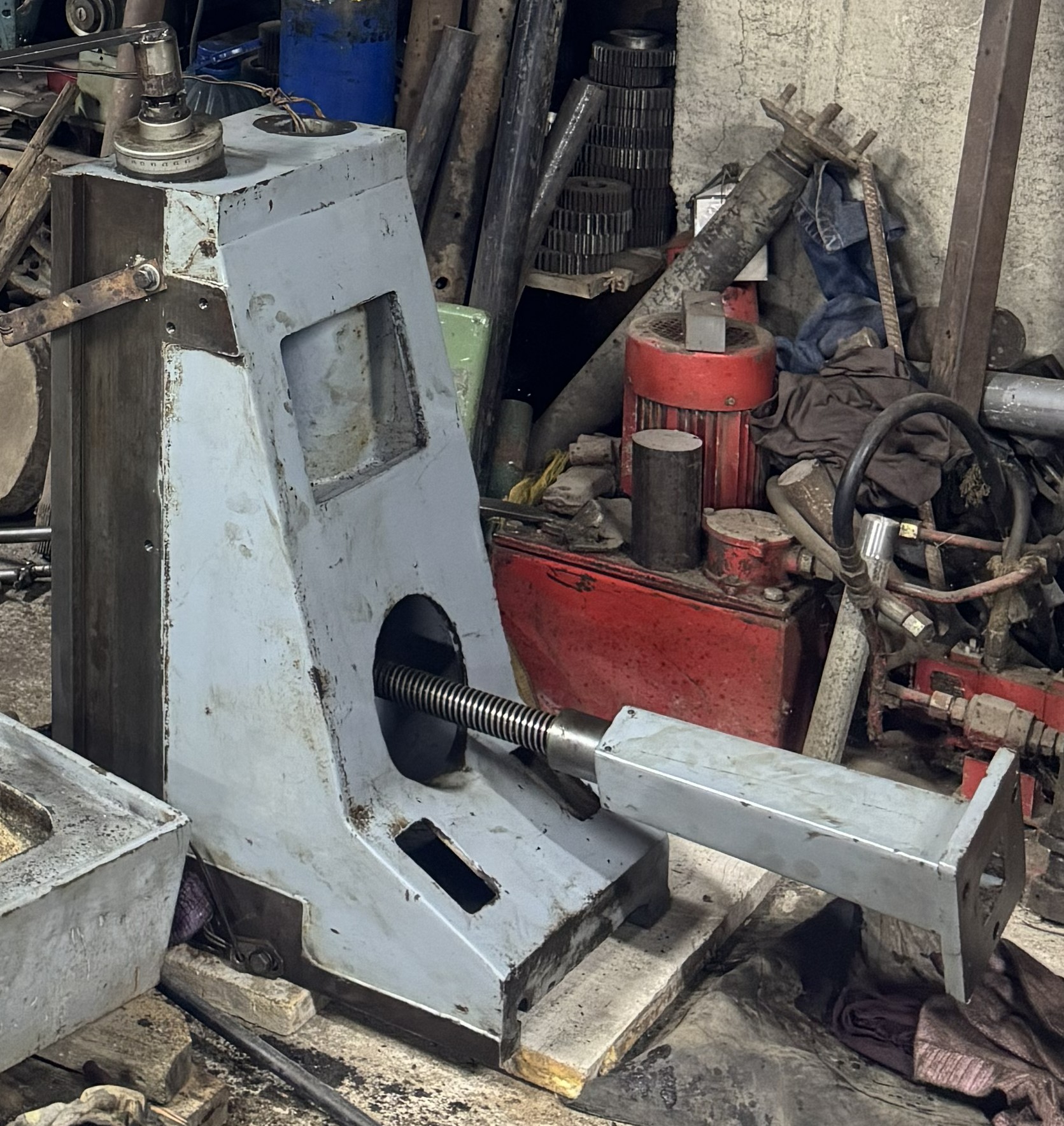
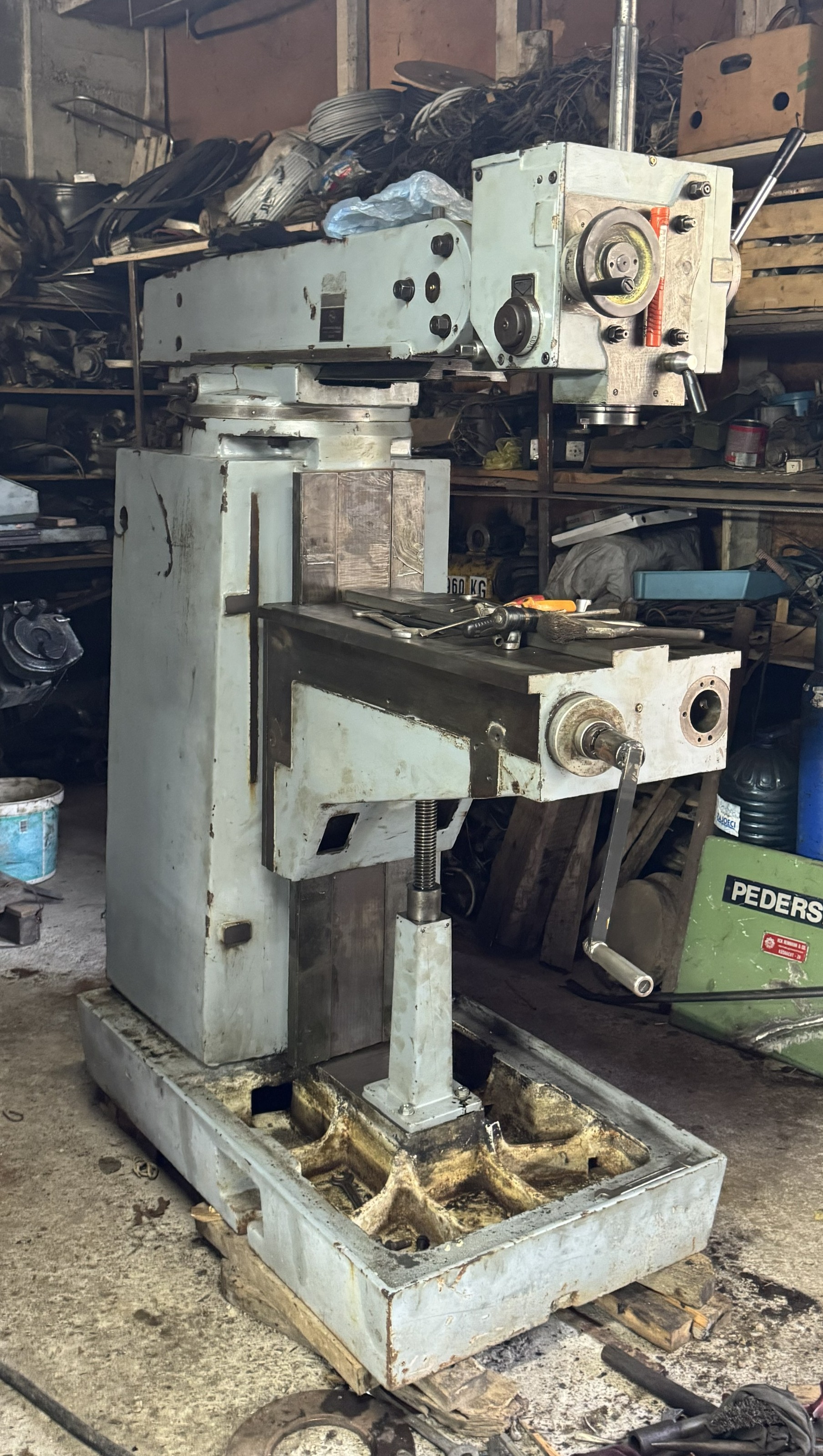
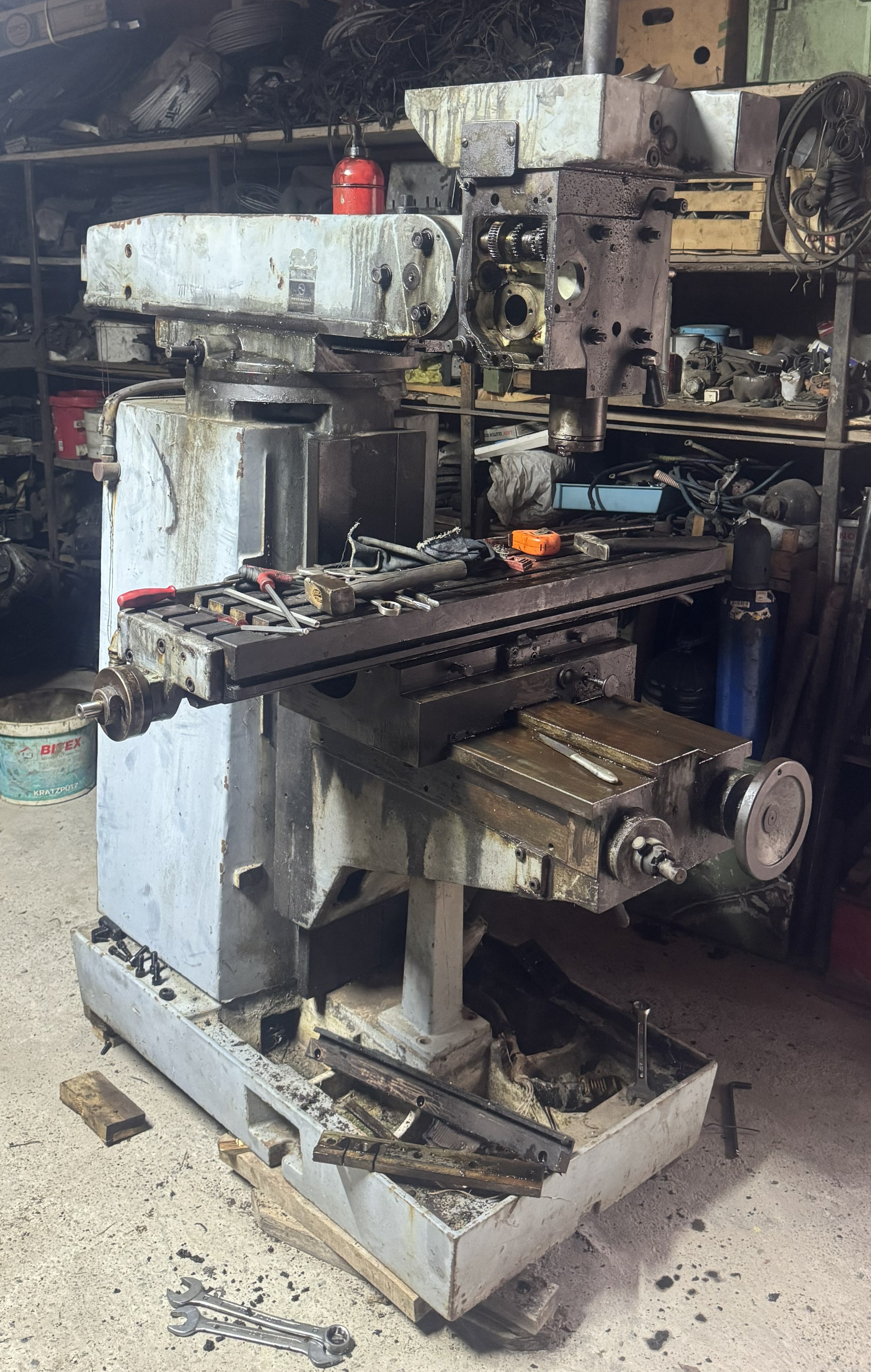
Attached are images of before and after cleanup and a picture of a machine we found online.
Couple of decisions weve come up with so far regarding the mechanical parts are as following:
Z-Axis: The Z-Axis has 36mm trapezoidal screw moved through bevel gears from the handle and the nut is bolted on the base of the machine offset by an iron piece, maybe can be seen from a picture when the saddle traverse was removed. Since we couldnt find a neat way to put a ball screw, also, were assuming the ball screw having less friction forces the z axis will just fall down, weve decided to leave the original screw and return back to it if we find any issue later on, following This Old Tony's conversion of his Maho and leaving its Z axis with trapezoidal screw, we're expecting the same...
X/Y-Axis: Both have 28mm trapeziodal screws with anti-backlash nut with pitch of 5mm. The nuts hole on the casting for both sides is 40mm which to our research matches the 25mm ballscrew so it is more or less the driving factor to chose 25mm ballscrews.
Issue #0: Throughout this project we always find it challenging to transport anything to place where we live due to some political issues and locally there is no store that sells parts. One of the solution we've found is a middleman in Germany that transports things to here so more or less we always have to check for delivery to Germany and goods that arent subject to VAT...
Question #1: We plan to travel to a nearby country that has ballscrews however im a little bit confused by Dynamic load rating and Static load rating related to price. A low price offers C(dyn) ~ 1100kgf and C(0) ~ 2700kgf, while a 5 times the low price C(dyn) ~ 1700kgf and C(0) ~ 5000kgf, but a 6 times the low price we can get a C(dyn) ~ 14900kgf and C(0) ~ 41500kgf... I'd appreciate a suggestion if going with the low price option is sufficient, as the 5 times the price seems to not gain much for the added cost and the last option seems like a straight up overkill..
Question #2: For the Motors to drive the axis of the machine, were planning to place stepperonline servo motors rated at 1kW ( link ) but interestingly they seem to have EtherCAT servos as well so im kinda on a edge here.. I was originally planning to go with mesa cards prior to seeing the EtherCAT options, but now i kinda dont mind the added cost for EtherCAT, however, my father hopes to use the machine as a manual mill but he isnt very technophile so we will have to add quite some buttons and dials rather than use the keyboard/mouse to control the machine manually and for this we will need some IO, so, is there any EtherCAT IO that i can daisy chain to the system? I have no experience with EtherCAT so i dont know what im getting into... does LinuxCNC need to support the mentioned drive? Do we have to expect support from the manufacturer for the application? Is it doable?
Question #3: If i was to go with normal drives, i cant really decide on the loop's of the system and therefore the cards. I dont have any experience with Mesa cards, but i do have some experiences with parallel port LinuxCNC and Raspberry GPIO LinuxCNC. Should i go straight to position loop on mesa cards and velocity loop on the drive (hence analog mesa cards) or shall i take it slow and get a step/dir card and later on get an analog card if im happy with it?
Question #3.1:This leads to does Mesa official store shipment to Germany include VAT and complicated transportation or is it simple drop off?
Question #3.2: Can you suggest a good card match up for 4 Axis movement + Spindle + Lots of IO for control panel?
Question #4: Since Servos offer modbus and you can read the position of its absolute encoder im assuming that you can skip the homing procedures on LinunxCNC and fetch position from drives directly, am i correct?
Question #5: How important is spindle encoder for a milling machine? I cant seem to find a proper place to seat it...
Any suggestion, question or comment welcomed!
Thanks in advance!
More than10 years ago (at that time i just started my studies) my father found a great milling machine in a scrapyard, Prvomajska G301 D1 manufactured in 1973 , the machine seems to be almost not used at all, unfortunately it was subject to weather changes and most of the axis were locked up by rust, its spindle motor and holding bracket broken off and x axis gearbox with motor broken off. Back when he brought it home we started to disassemble, we removed some parts from its quill and then life happened we left it on the field covered with plastic sheets as there was no more space on the workshop.
Recently we removed some things from the shop and got some place for the mill and we placed it inside, past week we were working very hard to clean up the rest of the machine and mount it back, so far the worst part is that its spindle bearing are quite rusty and once we get the rest sorted out will have to be replaced (altho, i still dont know where we could find it).
Attached are images of before and after cleanup and a picture of a machine we found online.
Couple of decisions weve come up with so far regarding the mechanical parts are as following:
Z-Axis: The Z-Axis has 36mm trapezoidal screw moved through bevel gears from the handle and the nut is bolted on the base of the machine offset by an iron piece, maybe can be seen from a picture when the saddle traverse was removed. Since we couldnt find a neat way to put a ball screw, also, were assuming the ball screw having less friction forces the z axis will just fall down, weve decided to leave the original screw and return back to it if we find any issue later on, following This Old Tony's conversion of his Maho and leaving its Z axis with trapezoidal screw, we're expecting the same...
X/Y-Axis: Both have 28mm trapeziodal screws with anti-backlash nut with pitch of 5mm. The nuts hole on the casting for both sides is 40mm which to our research matches the 25mm ballscrew so it is more or less the driving factor to chose 25mm ballscrews.
Issue #0: Throughout this project we always find it challenging to transport anything to place where we live due to some political issues and locally there is no store that sells parts. One of the solution we've found is a middleman in Germany that transports things to here so more or less we always have to check for delivery to Germany and goods that arent subject to VAT...
Question #1: We plan to travel to a nearby country that has ballscrews however im a little bit confused by Dynamic load rating and Static load rating related to price. A low price offers C(dyn) ~ 1100kgf and C(0) ~ 2700kgf, while a 5 times the low price C(dyn) ~ 1700kgf and C(0) ~ 5000kgf, but a 6 times the low price we can get a C(dyn) ~ 14900kgf and C(0) ~ 41500kgf... I'd appreciate a suggestion if going with the low price option is sufficient, as the 5 times the price seems to not gain much for the added cost and the last option seems like a straight up overkill..
Question #2: For the Motors to drive the axis of the machine, were planning to place stepperonline servo motors rated at 1kW ( link ) but interestingly they seem to have EtherCAT servos as well so im kinda on a edge here.. I was originally planning to go with mesa cards prior to seeing the EtherCAT options, but now i kinda dont mind the added cost for EtherCAT, however, my father hopes to use the machine as a manual mill but he isnt very technophile so we will have to add quite some buttons and dials rather than use the keyboard/mouse to control the machine manually and for this we will need some IO, so, is there any EtherCAT IO that i can daisy chain to the system? I have no experience with EtherCAT so i dont know what im getting into... does LinuxCNC need to support the mentioned drive? Do we have to expect support from the manufacturer for the application? Is it doable?
Question #3: If i was to go with normal drives, i cant really decide on the loop's of the system and therefore the cards. I dont have any experience with Mesa cards, but i do have some experiences with parallel port LinuxCNC and Raspberry GPIO LinuxCNC. Should i go straight to position loop on mesa cards and velocity loop on the drive (hence analog mesa cards) or shall i take it slow and get a step/dir card and later on get an analog card if im happy with it?
Question #3.1:This leads to does Mesa official store shipment to Germany include VAT and complicated transportation or is it simple drop off?
Question #3.2: Can you suggest a good card match up for 4 Axis movement + Spindle + Lots of IO for control panel?
Question #4: Since Servos offer modbus and you can read the position of its absolute encoder im assuming that you can skip the homing procedures on LinunxCNC and fetch position from drives directly, am i correct?
Question #5: How important is spindle encoder for a milling machine? I cant seem to find a proper place to seat it...
Any suggestion, question or comment welcomed!
Thanks in advance!
Please Log in or Create an account to join the conversation.
- tommylight
-

- Offline
- Moderator
-

Less
More
- Posts: 21990
- Thank you received: 7487
30 Jul 2026 01:16 #348187
by tommylight
Replied by tommylight on topic Prvomajska G301 Milling machine converting to CNC
Issue 0 = Siqa transport or something like that on Instagram
-
Reply 1 = i have some old industrial ballscrews that you can have for very little money, and you can come see them in person in Peja.
-
Reply 2 = yes and no, drives should be CIA 402 compatible to work, but not all implementations work as advertised, and some non CIA 402 work just fine
-
Reply 3 = I have plenty of experience with Mesa and i can help you with that, free of charge whenever i have time
-3.1 = Mesa has a dealer in Germany, www.welectron.com
-3.2 = Mesa 7i96S with 7i73 OR 7i84. 7i73 is for panels and low level signals, 7i84 is an IO card with 32 inputs and 16 outputs, all from 8-32 or 36V (i forgot). I used 7i84 on my lathe for panel despite having 2 of 7i73 back then.
-
Reply 4 = probably, but modbus is not used for anything real time, as far as i know. The new drives have encoder outputs. usually, that can be used to close the loop in LinuxCNC, but this is something you have to decide later, after figuring out ther balscrew/leadscrew situation, or just get linear scales, in your case a much better solution no matter what drives you use. This will also require a Mesa 7i85 for the encoder inputs.
-
Reply 5 = depends if you want to also tap, but i would for sure.
-
Reply 1 = i have some old industrial ballscrews that you can have for very little money, and you can come see them in person in Peja.
-
Reply 2 = yes and no, drives should be CIA 402 compatible to work, but not all implementations work as advertised, and some non CIA 402 work just fine
-
Reply 3 = I have plenty of experience with Mesa and i can help you with that, free of charge whenever i have time
-3.1 = Mesa has a dealer in Germany, www.welectron.com
-3.2 = Mesa 7i96S with 7i73 OR 7i84. 7i73 is for panels and low level signals, 7i84 is an IO card with 32 inputs and 16 outputs, all from 8-32 or 36V (i forgot). I used 7i84 on my lathe for panel despite having 2 of 7i73 back then.
-
Reply 4 = probably, but modbus is not used for anything real time, as far as i know. The new drives have encoder outputs. usually, that can be used to close the loop in LinuxCNC, but this is something you have to decide later, after figuring out ther balscrew/leadscrew situation, or just get linear scales, in your case a much better solution no matter what drives you use. This will also require a Mesa 7i85 for the encoder inputs.
-
Reply 5 = depends if you want to also tap, but i would for sure.
Please Log in or Create an account to join the conversation.
- rodw
-

- Offline
- Platinum Member
-

Less
More
- Posts: 12156
- Thank you received: 4149
30 Jul 2026 02:22 - 30 Jul 2026 02:25 #348191
by rodw
Replied by rodw on topic Prvomajska G301 Milling machine converting to CNC
I think your cheaper ball screws would be OK Look at your motor torque allow for any gearboxes. Convert 1700 kgf to Newtons = 17000 N = approx 17 kN so I doubt your motors will get anywhere near that!
In Europe A Beckhoff EK1100 with EL1008 and EL2008 is supported natively by Linuxcnc for you inputs and outputs. You can also add a encoder input (EL5151 from memory) if you wish.Check eBay too but get a price first.
If you can't add the encoder don't worry about it, just use thread milling to cut any threads you need. Its a lot easier on the machine. Because there are metric coarse and fine threads, you don't need that many thread mills initially. eg 12x1.25, 10x1.25, 8 x 1.25 can all be cut with the one thread mill.
Initially home your machine using Linuxcnc and convert to internal homing down the track as it might not be that easy.
and yes, get CIA402 compatible drives as life will be easier.
In Europe A Beckhoff EK1100 with EL1008 and EL2008 is supported natively by Linuxcnc for you inputs and outputs. You can also add a encoder input (EL5151 from memory) if you wish.Check eBay too but get a price first.
If you can't add the encoder don't worry about it, just use thread milling to cut any threads you need. Its a lot easier on the machine. Because there are metric coarse and fine threads, you don't need that many thread mills initially. eg 12x1.25, 10x1.25, 8 x 1.25 can all be cut with the one thread mill.
Initially home your machine using Linuxcnc and convert to internal homing down the track as it might not be that easy.
and yes, get CIA402 compatible drives as life will be easier.
Last edit: 30 Jul 2026 02:25 by rodw.
Please Log in or Create an account to join the conversation.
- dst
- Offline
- New Member
-
Less
More
- Posts: 3
- Thank you received: 0
30 Jul 2026 21:45 #348240
by dst
Replied by dst on topic Prvomajska G301 Milling machine converting to CNC
Hello Tommy, haven't seen you for quite some time so definitely ill visit you!
Answer 0: Yes, thats what i had in mind.
Answer 1: Thank you very much for the offer!
Answer 2: Seems like the drives are CIA402 compatible and they provide the XML file for it so ill maybe get one drive for experimentation and getting familiar with it.
Answer 3: Most of boards seems to be out of stock, and i am gravitating towards 7i95T, having 6 encoder i can use it for feedback and use it for pendant as well, so ill reduce the need IO pins by some.
Answer 4: I wasnt considerint it for real time application, just a method to avoid homing by searching limit switches and reading the position from the drives.
Replly 5: I'll see what i can do...
Answer 0: Yes, thats what i had in mind.
Answer 1: Thank you very much for the offer!
Answer 2: Seems like the drives are CIA402 compatible and they provide the XML file for it so ill maybe get one drive for experimentation and getting familiar with it.
Answer 3: Most of boards seems to be out of stock, and i am gravitating towards 7i95T, having 6 encoder i can use it for feedback and use it for pendant as well, so ill reduce the need IO pins by some.
Answer 4: I wasnt considerint it for real time application, just a method to avoid homing by searching limit switches and reading the position from the drives.
Replly 5: I'll see what i can do...
Please Log in or Create an account to join the conversation.
- dst
- Offline
- New Member
-
Less
More
- Posts: 3
- Thank you received: 0
30 Jul 2026 21:53 #348241
by dst
Replied by dst on topic Prvomajska G301 Milling machine converting to CNC
Hello rodw,
Thank you very much for your input, i feel more relieved knowing that about ball screws.
Regarding EtherCAT, i feel like it'd be better if i just get a servo drive (it seems to support CIA402) and cheap IO module to get familiar and maybe use it in the future projects.
For the home switches, yes, i initially plan to install limit switches and later on deal with homing through absolute position from drive and displacing the home switches as E-Stops.
Thank you very much for your input, i feel more relieved knowing that about ball screws.
Regarding EtherCAT, i feel like it'd be better if i just get a servo drive (it seems to support CIA402) and cheap IO module to get familiar and maybe use it in the future projects.
For the home switches, yes, i initially plan to install limit switches and later on deal with homing through absolute position from drive and displacing the home switches as E-Stops.
Please Log in or Create an account to join the conversation.
- tommylight
-
- Offline
- Moderator
-
Less
More
- Posts: 21990
- Thank you received: 7487
30 Jul 2026 23:46 #348249
by tommylight
Coffee's on me.
Replied by tommylight on topic Prvomajska G301 Milling machine converting to CNC
You are welcomed, always.Hello Tommy, haven't seen you for quite some time so definitely ill visit you!
Coffee's on me.
Please Log in or Create an account to join the conversation.
- dbtayl
- Offline
- Senior Member
-

Less
More
- Posts: 48
- Thank you received: 46
31 Jul 2026 00:18 #348252
by dbtayl
Replied by dbtayl on topic Prvomajska G301 Milling machine converting to CNC
I've found having a spindle encoder really nice. Specifically, the spindle-stall detection. It's definitely saved breaking some tools. Depending on how the spindle is set up, you may be able to get that without an encoder (and it may be a non-issue anyway if you use your machine within its limits and don't have a dubiously-tuned servo as the spindle motor).
Please Log in or Create an account to join the conversation.
Moderators: piasdom
Time to create page: 0.120 seconds