
- User Interfaces
- Other User Interfaces
- PathPilot
- Faceting/Linearization leading to poor surface finish
Faceting/Linearization leading to poor surface finish
- BSAT
- Offline
- New Member
-

Less
More
- Posts: 4
- Thank you received: 0
13 Sep 2026 16:58 #349614
by BSAT
Replied by BSAT on topic Faceting/Linearization leading to poor surface finish
I know this is an old thread, but I have a 2020 1100MX, with the same issue.
Has there been a solution to this issue?
Thanks
BSAT
Has there been a solution to this issue?
Thanks
BSAT
Please Log in or Create an account to join the conversation.
- spumco
- Offline
- Platinum Member
-

Less
More
- Posts: 2180
- Thank you received: 905
13 Sep 2026 18:23 #349615
by spumco
The OP never reported back attempting this, and it's step #1 in identifying the faceting.
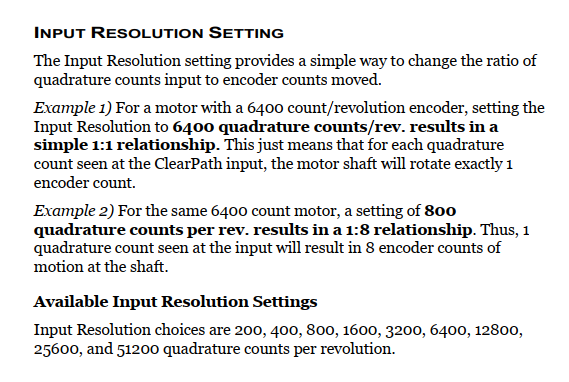
Step #2 would be checking the steps-per-unit - can be calculated from the OEM motor config (also available in Teknic's software).
Step #3 would be to see if PathPilot, the Tormach hardware, and the Clearpath are capable of finer resolution.
Step #4 - if #3 is possible, change to finer resolution and make some test cuts.
PathPilot could be set to Clearpath's default steps-per-rev input, and there may be some room left given the Tormach stock max rapids:
Replied by spumco on topic Faceting/Linearization leading to poor surface finish
Have you checked or adjusted the servo tuning using Teknic's software yet?I know this is an old thread, but I have a 2020 1100MX, with the same issue.
Has there been a solution to this issue?
Thanks
BSAT
The OP never reported back attempting this, and it's step #1 in identifying the faceting.
Step #2 would be checking the steps-per-unit - can be calculated from the OEM motor config (also available in Teknic's software).
Step #3 would be to see if PathPilot, the Tormach hardware, and the Clearpath are capable of finer resolution.
Step #4 - if #3 is possible, change to finer resolution and make some test cuts.
PathPilot could be set to Clearpath's default steps-per-rev input, and there may be some room left given the Tormach stock max rapids:
Attachments:
Please Log in or Create an account to join the conversation.
- BSAT
- Offline
- New Member
-
Less
More
- Posts: 4
- Thank you received: 0
19 Sep 2026 16:08 #349736
by BSAT
Replied by BSAT on topic Faceting/Linearization leading to poor surface finish
I have used the Teknic software and run an auto tune and it helped but the problem still exits.
I havent changed the step input resolution settings(which is 3200 steps/rev) because other folks have no problem nor should I. I can see a tuning change being needed per machine but not a reconfig of input vs resolution.
I havent changed the step input resolution settings(which is 3200 steps/rev) because other folks have no problem nor should I. I can see a tuning change being needed per machine but not a reconfig of input vs resolution.
Please Log in or Create an account to join the conversation.
- spumco
- Offline
- Platinum Member
-
Less
More
- Posts: 2180
- Thank you received: 905
22 Sep 2026 02:16 #349774
by spumco
Assuming you and they have the same pitch ballscrews, the next thing to check is the actual gcode.
Is this a CAM-generated toolpath with lots of linear segments, or are the facets present on G2/G3 moves?
Are you using G64 in the problem code? If so, what is it set to?
Replied by spumco on topic Faceting/Linearization leading to poor surface finish
Do the other folks you're talking about also have 1100MX's? Just making sure it's an apples-to-apples comparison.I have used the Teknic software and run an auto tune and it helped but the problem still exits.
I havent changed the step input resolution settings(which is 3200 steps/rev) because other folks have no problem nor should I. I can see a tuning change being needed per machine but not a reconfig of input vs resolution.
Assuming you and they have the same pitch ballscrews, the next thing to check is the actual gcode.
Is this a CAM-generated toolpath with lots of linear segments, or are the facets present on G2/G3 moves?
Are you using G64 in the problem code? If so, what is it set to?
Please Log in or Create an account to join the conversation.
- Todd Zuercher
-
- Offline
- Platinum Member
-
Less
More
- Posts: 4785
- Thank you received: 1475
22 Sep 2026 11:41 #349781
by Todd Zuercher
Replied by Todd Zuercher on topic Faceting/Linearization leading to poor surface finish
I agree completely with what spumco said and would like to expand on it. I have seen some faceting caused by a combination of extreemly short linear segmented CAM generated code and poorly chosen G64 settings. If multiple very short linear segments are used to approximate a curve, and a large G64 Pn setting are combined, sometimes the result will give a faceted tool path because G64Pn will assume "n" also for the Q setting. If Qn is less than the length of multiple lines of linear code in a row the interpreter will turn them into a single line. The result will be a bunch facets of approximately n length. The answer is to specify a value for Q less than the sum of two of your CAM program's shortest line segments instead of letting the Q be assumed to be equal to P.
The following user(s) said Thank You: spumco
Please Log in or Create an account to join the conversation.
- snowgoer540
-

- Offline
- Moderator
-

Less
More
- Posts: 2578
- Thank you received: 903
22 Sep 2026 22:11 #349789
by snowgoer540
Replied by snowgoer540 on topic Faceting/Linearization leading to poor surface finish
Have you reached out to Tormach for this? I know they had released updated servo configuration files for this issue at some point, I am unsure if it's after when this tread was created or not.
They haven't posted them but I have seen them on the FaceBook group(s) in the files section, also I made a pull request on their right to repair github to add all of them so people like yourself have access to them but they have not merged it as of yet.
They haven't posted them but I have seen them on the FaceBook group(s) in the files section, also I made a pull request on their right to repair github to add all of them so people like yourself have access to them but they have not merged it as of yet.
The following user(s) said Thank You: spumco
Please Log in or Create an account to join the conversation.
- BSAT
- Offline
- New Member
-
Less
More
- Posts: 4
- Thank you received: 0
25 Sep 2026 17:57 #349872
by BSAT
Replied by BSAT on topic Faceting/Linearization leading to poor surface finish
Its not gcode related. Im using the conversational and moving in straight lines. But, it doesnt matter if its a straight line because I also see it in interpolated moves. It doesnt change with feeds or speed changes or end mill changes. Its always there.
Please Log in or Create an account to join the conversation.
- BSAT
- Offline
- New Member
-
Less
More
- Posts: 4
- Thank you received: 0
25 Sep 2026 18:02 #349874
by BSAT
Replied by BSAT on topic Faceting/Linearization leading to poor surface finish
I have reached out & got the updated servo files. But they said it will only help with i templates moves. If im seeing thisnproblem in a straight line then there is a mechanical issues.
I have reached out to clear path & the point me to tormach.
I have set it up per their instruction, its there. I set it up tighter or looser, its there, ive replace contact bearings on the axis, its there.
I autotuned the servos, helped maybe a little. But still there.
At this point I gotta think its a limitation/configuration of the servos that I dont readily have access too. By accident as much as I have messed with, it should have made a difference one way or the other. But it seems to be the same no matter what.
Please Log in or Create an account to join the conversation.
- tommylight
-
- Away
- Moderator
-
Less
More
- Posts: 21951
- Thank you received: 7472
25 Sep 2026 19:30 #349879
by tommylight
Might want to try with a single or dual flute on some aluminium with the same high spindle speed and different feed rates to see if the distance changes, in general, if it does change would point to servo/tuning issues, if it does not would mean mechanical issue.
Would be nice to also do same feed rate, but vary the spindle speed.
Thinking of it, at what spindle speed are you cutting and what mill? I might have missed that.
Replied by tommylight on topic Faceting/Linearization leading to poor surface finish
Does the rastering change with those changes?It doesnt change with feeds or speed changes or end mill changes. Its always there.
Might want to try with a single or dual flute on some aluminium with the same high spindle speed and different feed rates to see if the distance changes, in general, if it does change would point to servo/tuning issues, if it does not would mean mechanical issue.
Would be nice to also do same feed rate, but vary the spindle speed.
Thinking of it, at what spindle speed are you cutting and what mill? I might have missed that.
Please Log in or Create an account to join the conversation.
- spumco
- Offline
- Platinum Member
-
Less
More
- Posts: 2180
- Thank you received: 905
26 Sep 2026 15:45 #349894
by spumco
If:
You have the 'enhanced' version of the servo - that is, it's capable of higher input resolution than the 'normal' version (p/n ends in -RLN). The ELN is capable of up to 6400 steps per rev, while the RLN is only capable of 800ppr.
The Tormach 1100MX configuration appears to use SCALE = 10000.0 in the INI file. (tormach_mill_base.ini)
Tormach_mill_clearpath_ecm1.hal:
Assuming a 5TPI ballscrew, it looks like the Clearpaths are set to ~2000 pulses per rev. You can verify this in Clearpath MSP software.
If that's the case, you can set the Clearpaths to 6400ppr input resolution, and edit the INI file to account for this increased resolution.
You may need to edit the INI file further to account for the decreased time between pulses:
I don't know what the hardware is that's driving the 1100MX, but if it's a Mesa board it will have zero problems outputtting a signal at that resolution & max speed.
If you get issues you can turn down the Clearpath resolution a bit, re-adjust INI file, and try again.
All of the above is free, easily reversible,and safe to test. A simple, short jog after startup will indicate if 1" jog looks like about 1". If everything appears to be OK, you can fine-tune the INI scale value if you find that the distance commanded isn't exactly the distance traveled.
Test short-ish moves at full rapid speed once you have the scale calibrated. Do it with the spindle running as well to see if any electrical noise is affecting the increase pulse frequency.
Then test the cutting performance again. WIth a 3x increase in servo resolution (a 3x decrease in distance per input pulse) the servo should both move and sound smoother.
If there is still no change in surface finish, and there are no mechanical deficiencies, then the problem may simply be the 1100MX isn't rigid enough or Tormach has changed/edited something inside the trajectory planner that causes this faceting.
Replied by spumco on topic Faceting/Linearization leading to poor surface finish
At this point I gotta think its a limitation/configuration of the servos that I dont readily have access too. By accident as much as I have messed with, it should have made a difference one way or the other. But it seems to be the same no matter what.
If:
- the machine is ok mechanically
- the autotune is sorted
- you have the appropriate servo settings from Tormach
- The G-code is 'clean' (no faceting in the code)
- Your M64 Pnnn is set appropriately, and
- Other Tormach owners report the same issue
You have the 'enhanced' version of the servo - that is, it's capable of higher input resolution than the 'normal' version (p/n ends in -RLN). The ELN is capable of up to 6400 steps per rev, while the RLN is only capable of 800ppr.
The Tormach 1100MX configuration appears to use SCALE = 10000.0 in the INI file. (tormach_mill_base.ini)
Tormach_mill_clearpath_ecm1.hal:
setp hm2_[HOSTMOT2](BOARD).0.stepgen.00.position-scale [AXIS_0]SCALEAssuming a 5TPI ballscrew, it looks like the Clearpaths are set to ~2000 pulses per rev. You can verify this in Clearpath MSP software.
If that's the case, you can set the Clearpaths to 6400ppr input resolution, and edit the INI file to account for this increased resolution.
You may need to edit the INI file further to account for the decreased time between pulses:
# nanoseconds
DIRSETUP = 10000
DIRHOLD = 10000
STEPLEN = 8000
STEPSPACE  = 5000
I don't know what the hardware is that's driving the 1100MX, but if it's a Mesa board it will have zero problems outputtting a signal at that resolution & max speed.
If you get issues you can turn down the Clearpath resolution a bit, re-adjust INI file, and try again.
All of the above is free, easily reversible,and safe to test. A simple, short jog after startup will indicate if 1" jog looks like about 1". If everything appears to be OK, you can fine-tune the INI scale value if you find that the distance commanded isn't exactly the distance traveled.
Test short-ish moves at full rapid speed once you have the scale calibrated. Do it with the spindle running as well to see if any electrical noise is affecting the increase pulse frequency.
Then test the cutting performance again. WIth a 3x increase in servo resolution (a 3x decrease in distance per input pulse) the servo should both move and sound smoother.
If there is still no change in surface finish, and there are no mechanical deficiencies, then the problem may simply be the 1100MX isn't rigid enough or Tormach has changed/edited something inside the trajectory planner that causes this faceting.
Please Log in or Create an account to join the conversation.
- User Interfaces
- Other User Interfaces
- PathPilot
- Faceting/Linearization leading to poor surface finish
Time to create page: 1.597 seconds