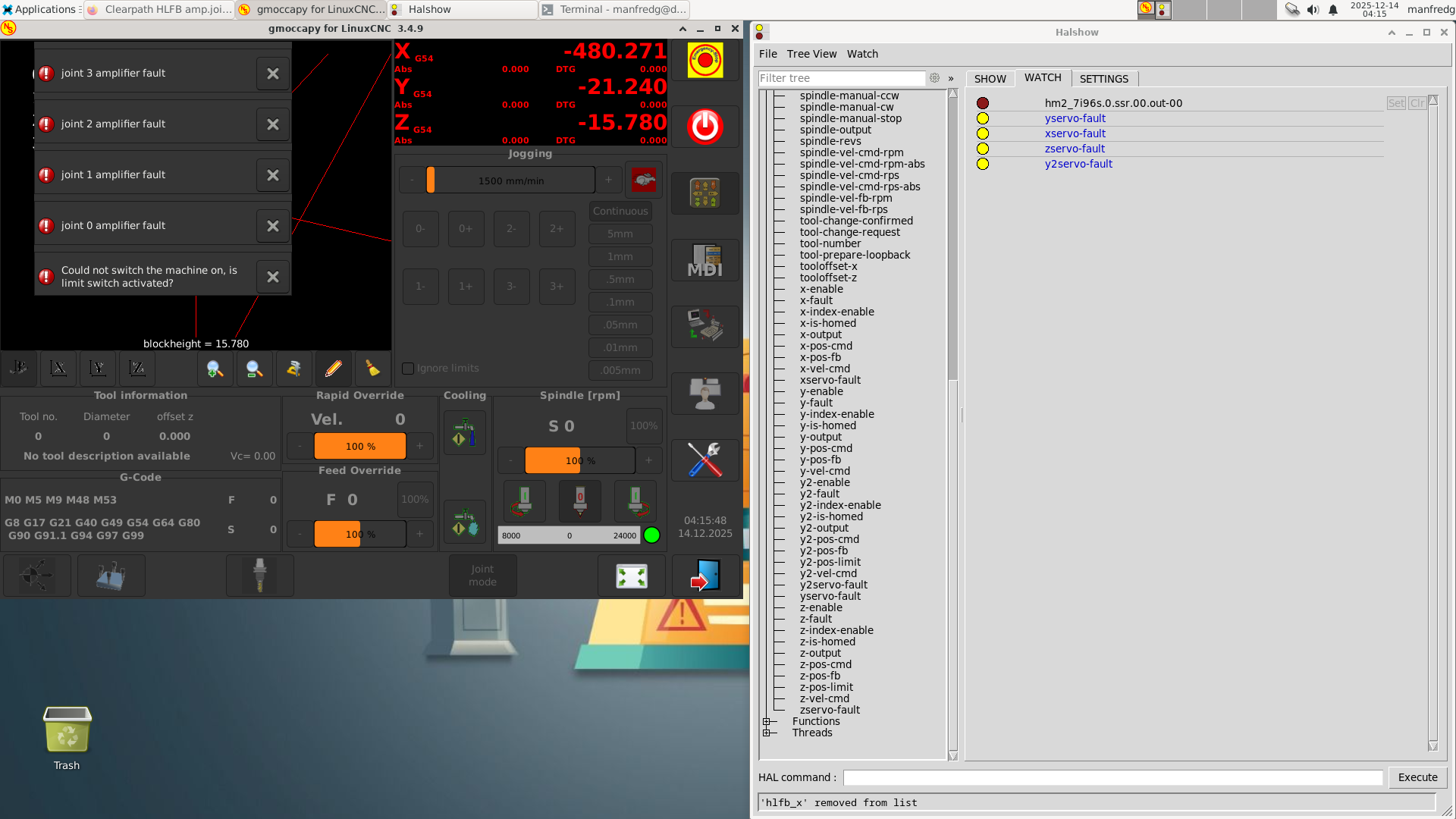
Good, thanks for verifying the servos are programmed appropriately.
Right now, your HLFB pins are HIGH (conducting) when the servos are enabled and OK. Since you have the inputs connected to your amp-fault-in pins like:
Code:
# HLFB is true when enabled *and* following
net joint.z.amp-fault-in hm2_7i96s.0.inm.00.input-07
net joint.y2.amp-fault-in hm2_7i96s.0.inm.00.input-08
net joint.y.amp-fault-in hm2_7i96s.0.inm.00.input-09
net joint.x.amp-fault-in hm2_7i96s.0.inm.00.input-10
LCNC thinks there is a fault when the servos are saying everything is OK. Here's the LCNC manual section (motion):
joint.N.amp-fault-in IN BIT should be driven TRUE if an external fault is detected with the amplifier for this joint.
Try changing the HLFB input pins to 'not' like so:
Code:
net joint.z.amp-fault-in hm2_7i96s.0.inm.00.input-07-not
net joint.y2.amp-fault-in hm2_7i96s.0.inm.00.input-08-not
net joint.y.amp-fault-in hm2_7i96s.0.inm.00.input-09-not
net joint.x.amp-fault-in hm2_7i96s.0.inm.00.input-10-not
At that point, the
joint.N.amp-fault-in pins should be HIGH when the servos are not enabled, and go LOW when they are enabled and OK.
Once you're at that point, you can test by pulling the encoder cable off the motors and see if it causes the amp-fault-in to go high (hopefully).
If you still need a delay we can work on that next.