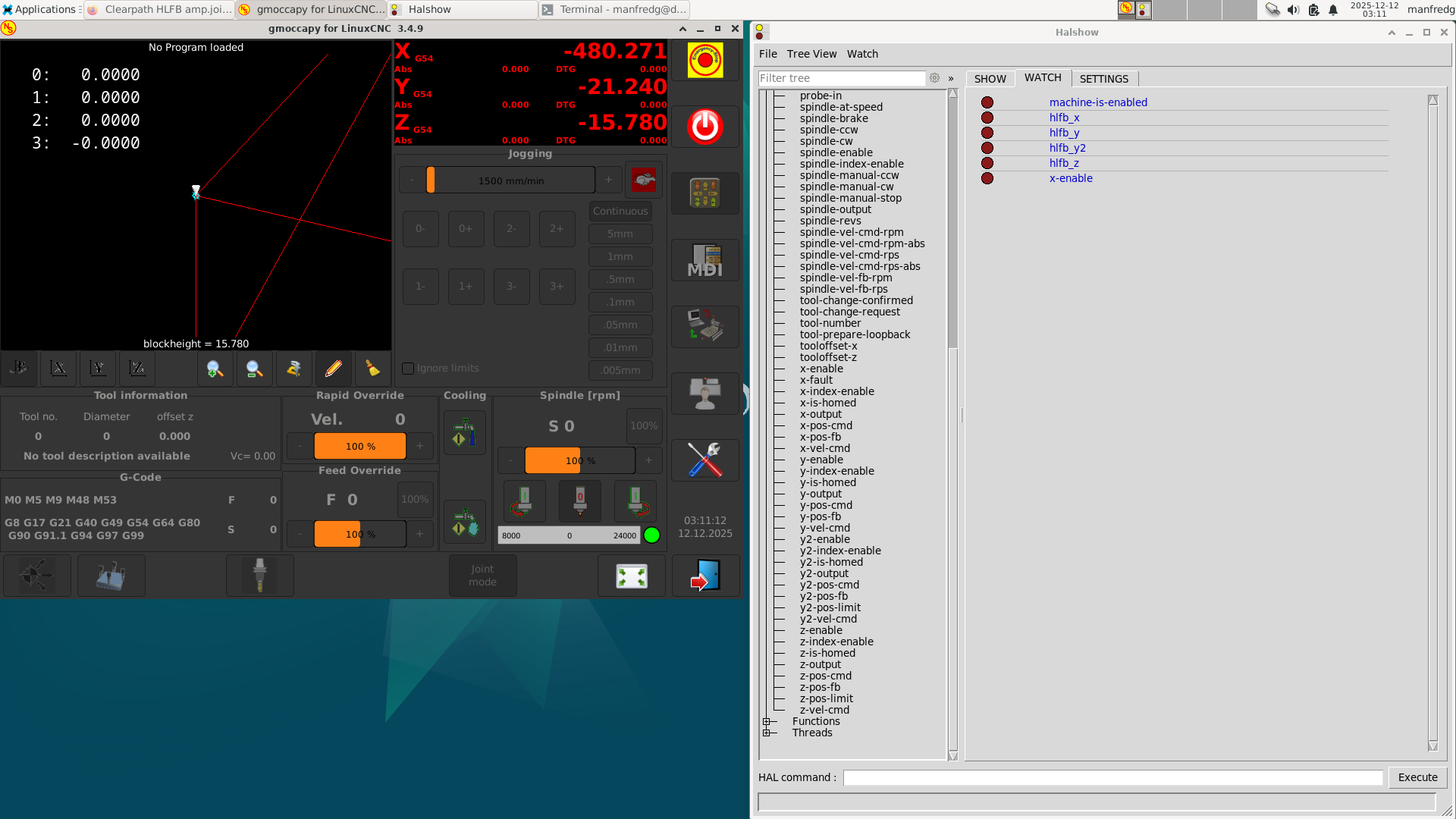
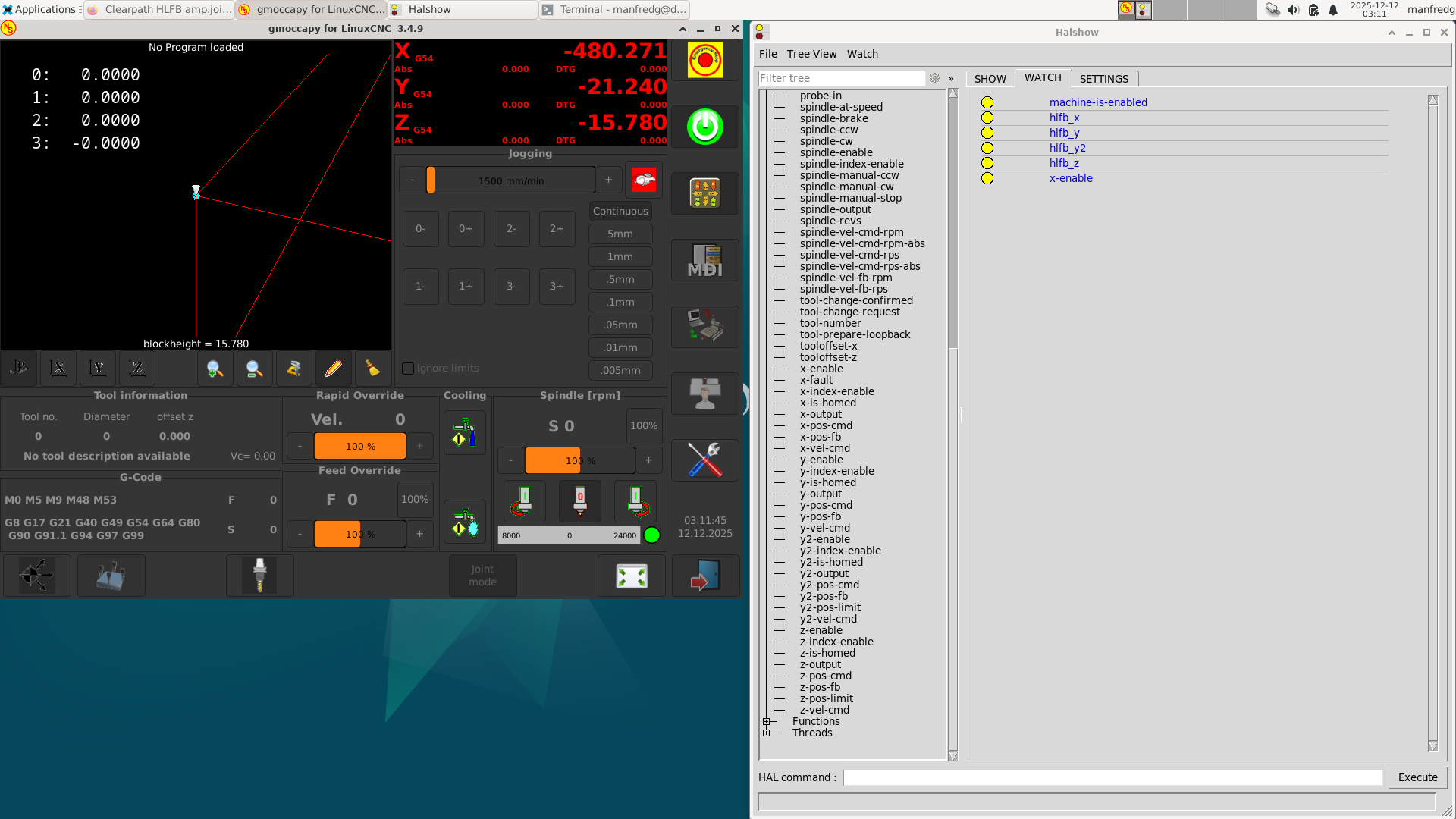
I did try reversing the input, Does my custom.hal file look correct? I get a joint 0 amplifier fault instantly its the only joint i am trying to figure out at the moment i haven't tried to add the other joints yet. Is there other ways of doing this that might be easier to add in my case ?
Thanks
First thing to do is make sure the Clearpath's HLFB function is programmed the way you want/need. Teknics permits a multitude of conditions which result in <some> sort of signal from HLFB, but I suggest you copy @djdelorie's setup and program the HLFB pin to be HIGH when 'enabled and following.'
Next, test the HLFB programming and your wiring to make sure LCNC is getting the HLFB signal properly. With any amp-fault stuff commented out of HAL, start the machine. The Clearpath should be enabled, and you should see (in halshow) the input pin which is connected to the HLFB output go HIGH (conducting).
You can also take this opportunity to estimate how long it takes the Clearpath to switch the HLFB signal from LOW to HIGH when it is enabled. You will want this delay estimate later when configuring the amp-fault time-delay in HAL.
Once you've satisfied yourself that you have everything
outside LCNC sorted, you've got a decision to make regarding the other servos' HLFB signal.
- If you want LCNC to 'know' which specific axis/motor trips, you will be using up an input pin for each motor's HLFB output signal. You will also need a HAL configuration the same as (or similar to) @djdelorie.
- If you don't care
which motors trips and just want the machine to stop when
any motor trips, then you can wire the HLFB signal from all motors in a series and have a single 'amp-fault' input to LCNC. This will reduce the number of inputs used to one, and will make the HAL configuration somewhat simpler at the expense of slightly more fussy physical wiring.
Do the tests (and HLFB programming), and think about the 'decision' I mentioned and come back here... we'll help you sort out HAL so everything works like you'd prefer.