
Injection molding
- Ritterchen
- Offline
- Junior Member
-

Less
More
- Posts: 34
- Thank you received: 18
06 Nov 2025 06:06 #337939
by Ritterchen
Replied by Ritterchen on topic Injection molding
Hi there,
I implemented an DIY Arduino a few weeks back into my automatic injection molding machine. So cool to see that topic popping up again!
For the background, I have two CNC machines running on LinuxCNC as well and I am familiar with some Arduino-Coding too.
In the beginning I evaluated the exact same question as you here and went with the Arduino based PLC-Route as it is easier to implement hardware and manage timers easily, which there are a lot of in injection molding as many events in a cycle are time-based.
A few lessons learned so far were:
So my position is that I have a working machine, but no real interface.
I consider now to mange all the IO's by Arduino as nothing is really time critical and the linear encoders in my app don't need to be updated to the GUI in real time. You can also mix both options and use a motion card like Mesa or a simple Breakout card for motor control and safety IOs and do the rest with an external "PLC".
Some strong points for LinuxCNC in this application:
I implemented an DIY Arduino a few weeks back into my automatic injection molding machine. So cool to see that topic popping up again!
For the background, I have two CNC machines running on LinuxCNC as well and I am familiar with some Arduino-Coding too.
In the beginning I evaluated the exact same question as you here and went with the Arduino based PLC-Route as it is easier to implement hardware and manage timers easily, which there are a lot of in injection molding as many events in a cycle are time-based.
A few lessons learned so far were:
- The evaluation of "Readymade" ESP32/Arduino resulted that there is no real all in one provider like Beckhoff Ethercat modules. That drove me away from it as you still need additional "raw PCB boards" for e.g. temperature input. Then "real" PLCs like Ethercat are freaking expensive if you need anything but standard IOs. Could be an option if you base everything on second hand components!
- These modules are really nice: sequentmicrosystems.com/products/eight-t...bj3cF5BPXDmnSfa68zMp
They are a bit more expensive then a MAX31855 etc. but a very clean solution, easy to install and you can just stack it on top of a Raspberry PI. And are very well documented too + some Libraries exist. Not affiliated with them, just made a really good impression! - Having temps all in one controller is nice for process debugging
- Used Breakout boards as Optocouplers, SSR Output boards (240V AC 1-2A), external SSRs (40A) and DC Relay boards (24V) and the Temp input board of Sequent Microsystems.
To be honest I would next time spend a bit more with Sequent Microsystems - they seem to be fairly well priced and offer a lot more IOs and flexibility then the "All in one" Arduino based PLCs. But if money is a big constraint you can go with the single modules too. - I prefer SSRs just because they are silent, and basically free today and never had a cheap Asian branded fail
- For the IO side Arduino is pretty nice and fast as it is easy to connect components and debug them. E.g. for installing a linear scale I did not need a Mesa card or other boards just connected it to an interrupt and fed it to an existing Library.
- I used BlockNot to create parallel tasks, such as asking for sensor states at fixed intervals, have interrupts for linear encoders, run all the cycle timers... that is a very cool lib to work with!
- Okay now the butttt...
As soon as you want to build an GUI for it it becomes annoying. Maybe its my lack of experience for it or I am not aware of better solutions. Let me know if anyone is aware of a similar GUI solution to LinuxCNC (in flexibility) but for simple controllers?!
I tried to use Nextion Displays - which are displays with their own IC. That is cool as they mostly run smooth without Display lags in comparison to other solutions and have a GUI editor.
The pain is that you need to manage the whole communication between the display IC and the IO-IC (e.g. Arduino) manually. Eg. read button pushes from the display and feed data back. That is not impossible but a ton of (unnecessary?) work. Additionally the GUI modules come with good limitations in all directions- e.g. you can only have 4 data inputs into a diagram display which is already limiting on e.g. temp tracking. The graph you get is also not really useful in manner of navigation as zoom/ set scale etc. There are many things that need to be build to get something usable.
So my position is that I have a working machine, but no real interface.
I consider now to mange all the IO's by Arduino as nothing is really time critical and the linear encoders in my app don't need to be updated to the GUI in real time. You can also mix both options and use a motion card like Mesa or a simple Breakout card for motor control and safety IOs and do the rest with an external "PLC".
Some strong points for LinuxCNC in this application:
- Easy to build GUIs
- Real time IO's for motors+safety
- ShowHAL+HalScope is priceless for real-time debugging of states, that would need to be programmed as special IO's otherwise
- Settings can easily saved in files - I would miss-use a .nc file to save projects, temps and timings?
- Calculations and conditions are just painful as you need to do everything with components, which would be a simple calc sign otherwise :/
- Not sure how to implement a nice cycles with timings? Could be several timers connected to each other! Would be cool to be able to activate/deactivate these in real time on GUI input to control auxiliary devices.
- Is there an option to use e.g. the HalScope inside a GUI? Or have another graph implemented?
Please Log in or Create an account to join the conversation.
- vre
- Offline
- Platinum Member
-

Less
More
- Posts: 610
- Thank you received: 17
20 Nov 2025 10:11 #338784
by vre
Replied by vre on topic Injection molding
Do you have some Arduino code to share ?
Please Log in or Create an account to join the conversation.
- Ritterchen
- Offline
- Junior Member
-
Less
More
- Posts: 34
- Thank you received: 18
21 Nov 2025 08:25 #338864
by Ritterchen
Replied by Ritterchen on topic Injection molding
Yes sure, here is the code attached. Most of it runs on the timers (Block-no) and Sensors.
The temperature is not implemented in this version jet.
Mainly to control the piston (plunger) and the closing mechanics.
Here are the electronics to get an idea. Yes its messy/ unnecessary complex.
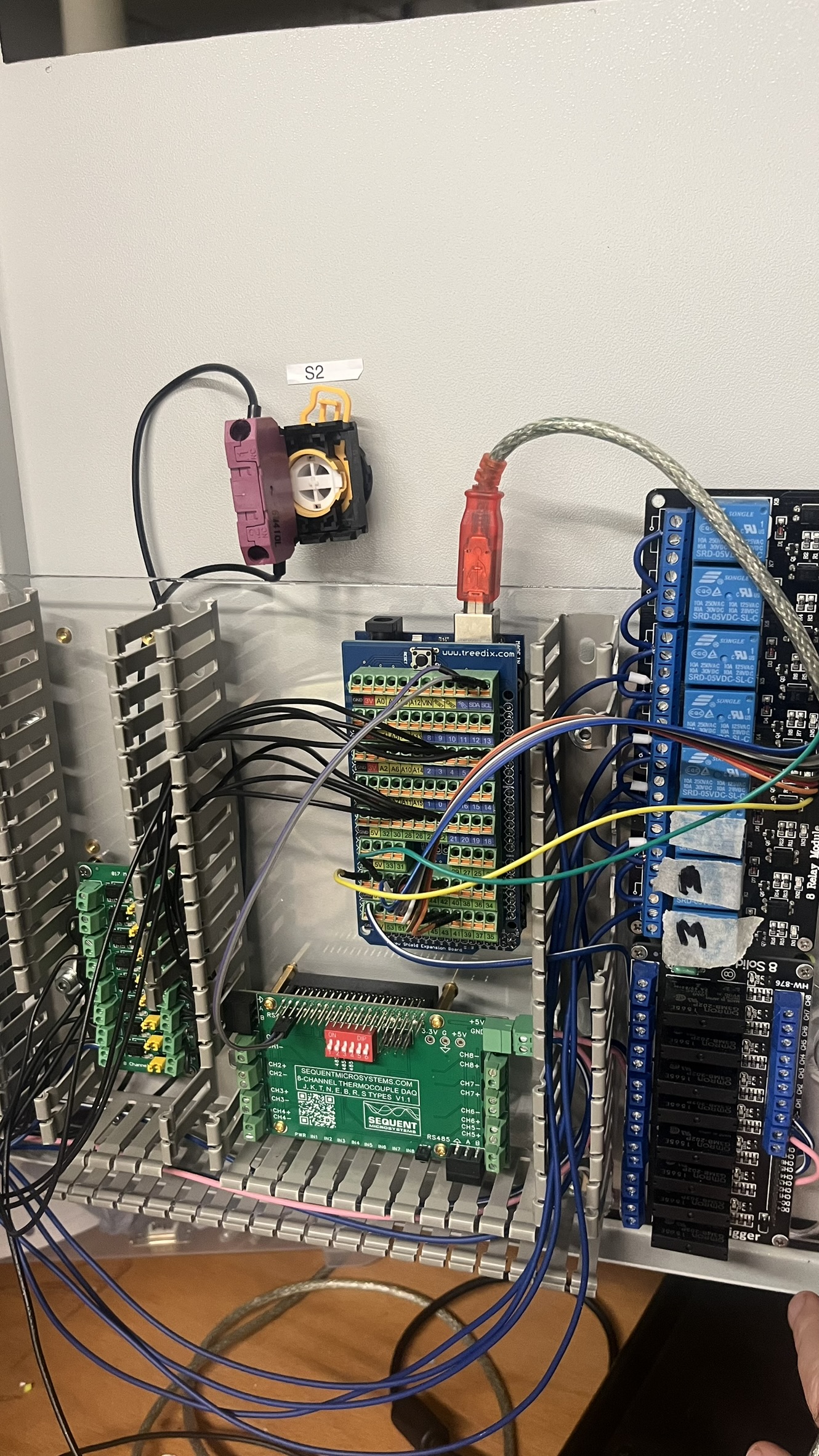
The temperature is not implemented in this version jet.
Mainly to control the piston (plunger) and the closing mechanics.
Here are the electronics to get an idea. Yes its messy/ unnecessary complex.
The following user(s) said Thank You: vre
Please Log in or Create an account to join the conversation.
- vre
- Offline
- Platinum Member
-
Less
More
- Posts: 610
- Thank you received: 17
23 Nov 2025 19:52 - 23 Nov 2025 19:54 #339085
by vre
Replied by vre on topic Injection molding
I think i will use something like you but with better mcu like esp32-s3 or an sbc like rpi5(only for the better user interface)
Last edit: 23 Nov 2025 19:54 by vre.
Please Log in or Create an account to join the conversation.
- Haras_abdrt
- Offline
- New Member
-

Less
More
- Posts: 1
- Thank you received: 0
06 Aug 2026 09:24 #348487
by Haras_abdrt
Replied by Haras_abdrt on topic Injection molding
Hello, good afternoon. I came across your post and wanted to ask you for some advice because I’m dealing with a very similar situation.
At the company I work for, we have an old Arburg 220-75.250 injection molding machine from the late 1980s. The floppy disk drive is no longer working, and I have been asked to find a way to get the machine back into operation.
I’ve been researching the machine, its control system and possible solutions, and from what I’ve seen so far, I’m starting to think that instead of trying to repair the original control, the better option might be to replace the control system and modernize the machine, potentially using something like LinuxCNC or another modern industrial control platform.
However, I have quite a few questions about how to approach a project like this.
First of all, how would you approach the retrofit from a technical point of view? What information would you consider essential to identify before starting?
I’m particularly unsure about the electrical side. How do you determine what the existing connections and signals are supposed to do? Is there normally an electrical schematic or I/O documentation that can be used to map the original controller’s inputs and outputs? If the original documentation is missing, how would you go about identifying and tracing the signals?
Could the existing sensors and switches on the machine be reused with a modern controller, or would they normally need to be replaced? For example, can the original position sensors, pressure sensors, limit switches, temperature sensors, etc. be connected directly to a modern I/O system, or does it depend on their signal type and voltage?
I’m also wondering about the hydraulic system. Would the original hydraulic valves and proportional valves normally be controllable by a modern system, or would these components also have to be replaced? How would you determine what type of signals the original valves require?
The same question applies to the injection and screw-position control. How would you interface a modern controller with the existing servo motors, drives, encoders or position feedback systems, if the machine has them?
Another important point is safety. How would you normally integrate the existing safety circuits, emergency stops, door switches, safety relays, etc. into a modern control system? Would you keep the original safety architecture wherever possible, or would you recommend replacing the safety system as part of the retrofit?
I’d also like to understand how you determine the required I/O. Is there a standard procedure for creating an I/O list for an old injection molding machine before designing the new control system?
Finally, if you have done a similar retrofit, I’d really appreciate any advice about the practical side of the project: what components you would keep, what you would replace, what information you would try to obtain from Arburg, and what mistakes or problems you would specifically look out for before starting.
If you don’t mind, I’d also be very interested in seeing any wiring diagrams, I/O lists, documentation, examples or photos from a similar retrofit that you could share.
Thanks a lot for your time. Any advice would be greatly appreciated.
At the company I work for, we have an old Arburg 220-75.250 injection molding machine from the late 1980s. The floppy disk drive is no longer working, and I have been asked to find a way to get the machine back into operation.
I’ve been researching the machine, its control system and possible solutions, and from what I’ve seen so far, I’m starting to think that instead of trying to repair the original control, the better option might be to replace the control system and modernize the machine, potentially using something like LinuxCNC or another modern industrial control platform.
However, I have quite a few questions about how to approach a project like this.
First of all, how would you approach the retrofit from a technical point of view? What information would you consider essential to identify before starting?
I’m particularly unsure about the electrical side. How do you determine what the existing connections and signals are supposed to do? Is there normally an electrical schematic or I/O documentation that can be used to map the original controller’s inputs and outputs? If the original documentation is missing, how would you go about identifying and tracing the signals?
Could the existing sensors and switches on the machine be reused with a modern controller, or would they normally need to be replaced? For example, can the original position sensors, pressure sensors, limit switches, temperature sensors, etc. be connected directly to a modern I/O system, or does it depend on their signal type and voltage?
I’m also wondering about the hydraulic system. Would the original hydraulic valves and proportional valves normally be controllable by a modern system, or would these components also have to be replaced? How would you determine what type of signals the original valves require?
The same question applies to the injection and screw-position control. How would you interface a modern controller with the existing servo motors, drives, encoders or position feedback systems, if the machine has them?
Another important point is safety. How would you normally integrate the existing safety circuits, emergency stops, door switches, safety relays, etc. into a modern control system? Would you keep the original safety architecture wherever possible, or would you recommend replacing the safety system as part of the retrofit?
I’d also like to understand how you determine the required I/O. Is there a standard procedure for creating an I/O list for an old injection molding machine before designing the new control system?
Finally, if you have done a similar retrofit, I’d really appreciate any advice about the practical side of the project: what components you would keep, what you would replace, what information you would try to obtain from Arburg, and what mistakes or problems you would specifically look out for before starting.
If you don’t mind, I’d also be very interested in seeing any wiring diagrams, I/O lists, documentation, examples or photos from a similar retrofit that you could share.
Thanks a lot for your time. Any advice would be greatly appreciated.
Please Log in or Create an account to join the conversation.
- robh
- Offline
- Premium Member
-

Less
More
- Posts: 110
- Thank you received: 24
28 Aug 2026 18:25 #349090
by robh
Replied by robh on topic Injection molding
this topic is grate so watching this closly to see how you solve this
i also have a nigribosi machine around 1998 eara , before they went full PLC type etc currently the conotrol keeps needing TLC on its many PCB boards due to age and drift , always down to the way it monitors position and control of its rams
in this machine there are a number of proportional valves , i looked at other controls out there but they are mostly aimed at VFD driven pumps and not many proportional valve outputs
mine has two proportional on the pump block
one for Flow and one for pressure , these work together during differant operations during the cycles to keep energy use down etc
also when the machine is first turned on, they use the platen valve block and pump in full flow to heat up the oil faster so no preheaters are needing only the pump is used.
valve on the screw carriage to control distance and speeds seems to be a standard vale and they must use the pump to control the speed in pump flow. and they seem to do this for afew other things, where only 1 thing works at one time,
one on the molding machine platen is proportional doing distance and speeds for the multi point open and shut speeds and distance for open and close strokes, this would be due to the fact you can do ejection while platten is still opening by seting the 1st ejectoin distance start
also one on the ejection plate to set the distance and speed for ejecting the part from the mold must be a proportional as works during the high flow high presure on the plattern if enabled to eject during open stroke.
looking at it, the same seems to be on the screw for the screw speed control, not sure how they are controlling the back pressure on the screw and screw injection profile settings.
i had through about using linuxcnc also as alot can be done in hal easy, not that much to address in a molding machine, more how you control its cycle in its little fucntion blocks as such.
mine has a safty relay for the estop buttons , not sure what else they routed through it
for safty guards, they seem to read these in on the control, the ones on the guard door and must work in the corrrect sequence when opening or closing the door or it does alarm out with guard out of sequence, i assume as on this machine you can move the safty switch and open the door extra day light which is good for loading in bigger tools over head
the control also has options for things like core pullers normaly 3/4 can be used
also air ejection is on this machine
also ability to read thermo couples from a mold tool
also the control also controls the hydrulic tank temp but turning on and off a valve that pushes the oil through the heat exchanger for cooling from the cooling water coming into the machine.
as already pointed out, alot of the machine works on timers and waits for one section to finish before it starts the next, is alot the user can input and change during the machine working cycles. also a good handfull in the machine setup pages that are fixed like time out for screw back and screw injection etc, along with max presure for platten open and close
they seem to be Bosh or Atos alot for the valves i find in nigri bosi
lube cycle tends to be done on the number of completed ejection cycles
i do have some wiring diagrams and hydrulic i can share if it would help in understanding , can also share some control screen shots for reff
i also have a nigribosi machine around 1998 eara , before they went full PLC type etc currently the conotrol keeps needing TLC on its many PCB boards due to age and drift , always down to the way it monitors position and control of its rams
in this machine there are a number of proportional valves , i looked at other controls out there but they are mostly aimed at VFD driven pumps and not many proportional valve outputs
mine has two proportional on the pump block
one for Flow and one for pressure , these work together during differant operations during the cycles to keep energy use down etc
also when the machine is first turned on, they use the platen valve block and pump in full flow to heat up the oil faster so no preheaters are needing only the pump is used.
valve on the screw carriage to control distance and speeds seems to be a standard vale and they must use the pump to control the speed in pump flow. and they seem to do this for afew other things, where only 1 thing works at one time,
one on the molding machine platen is proportional doing distance and speeds for the multi point open and shut speeds and distance for open and close strokes, this would be due to the fact you can do ejection while platten is still opening by seting the 1st ejectoin distance start
also one on the ejection plate to set the distance and speed for ejecting the part from the mold must be a proportional as works during the high flow high presure on the plattern if enabled to eject during open stroke.
looking at it, the same seems to be on the screw for the screw speed control, not sure how they are controlling the back pressure on the screw and screw injection profile settings.
i had through about using linuxcnc also as alot can be done in hal easy, not that much to address in a molding machine, more how you control its cycle in its little fucntion blocks as such.
mine has a safty relay for the estop buttons , not sure what else they routed through it
for safty guards, they seem to read these in on the control, the ones on the guard door and must work in the corrrect sequence when opening or closing the door or it does alarm out with guard out of sequence, i assume as on this machine you can move the safty switch and open the door extra day light which is good for loading in bigger tools over head
the control also has options for things like core pullers normaly 3/4 can be used
also air ejection is on this machine
also ability to read thermo couples from a mold tool
also the control also controls the hydrulic tank temp but turning on and off a valve that pushes the oil through the heat exchanger for cooling from the cooling water coming into the machine.
as already pointed out, alot of the machine works on timers and waits for one section to finish before it starts the next, is alot the user can input and change during the machine working cycles. also a good handfull in the machine setup pages that are fixed like time out for screw back and screw injection etc, along with max presure for platten open and close
they seem to be Bosh or Atos alot for the valves i find in nigri bosi
lube cycle tends to be done on the number of completed ejection cycles
i do have some wiring diagrams and hydrulic i can share if it would help in understanding , can also share some control screen shots for reff
Please Log in or Create an account to join the conversation.
- robh
- Offline
- Premium Member
-
Less
More
- Posts: 110
- Thank you received: 24
28 Aug 2026 18:27 #349091
by robh
Replied by robh on topic Injection molding
oh and on mine it has linear resistive measuring devices to track potion and they use this to control the proportional valve also.
Please Log in or Create an account to join the conversation.
Time to create page: 0.147 seconds