
Motor timing help
- nicklego
-
 Topic Author
- Offline
- New Member
-

Less
More
- Posts: 4
- Thank you received: 0
18 Mar 2026 17:14 #344470
by nicklego
Motor timing help was created by nicklego
Hi, I'm trying to get my motors running with LinuxCNC, and I have an old controller for the machine that can move the motors, but the card reader on it is broken. I have tried many times to get it working with LinuxCNC, but now I've tried to diagnose it with an oscilloscope on the old controller. For the x-axis output, the step pin outputs a constant 20MHz signal when not being told to move, but when being told to move, it outputs a 12MHz signal. Image 1 is the motor not moving (Consistent wave), and image 2 is the motor moving (weird-looking wave). I took a video of them side by side and is linked to a google drive. If anyone knows how I can replicate this signal/frequency in LinuxCNC, that would be greatly appreciated. Thanks. Link to video --> drive.google.com/file/d/1qQ6TFAT_yjkfDdm...Lns/view?usp=sharing
Image 1 -->
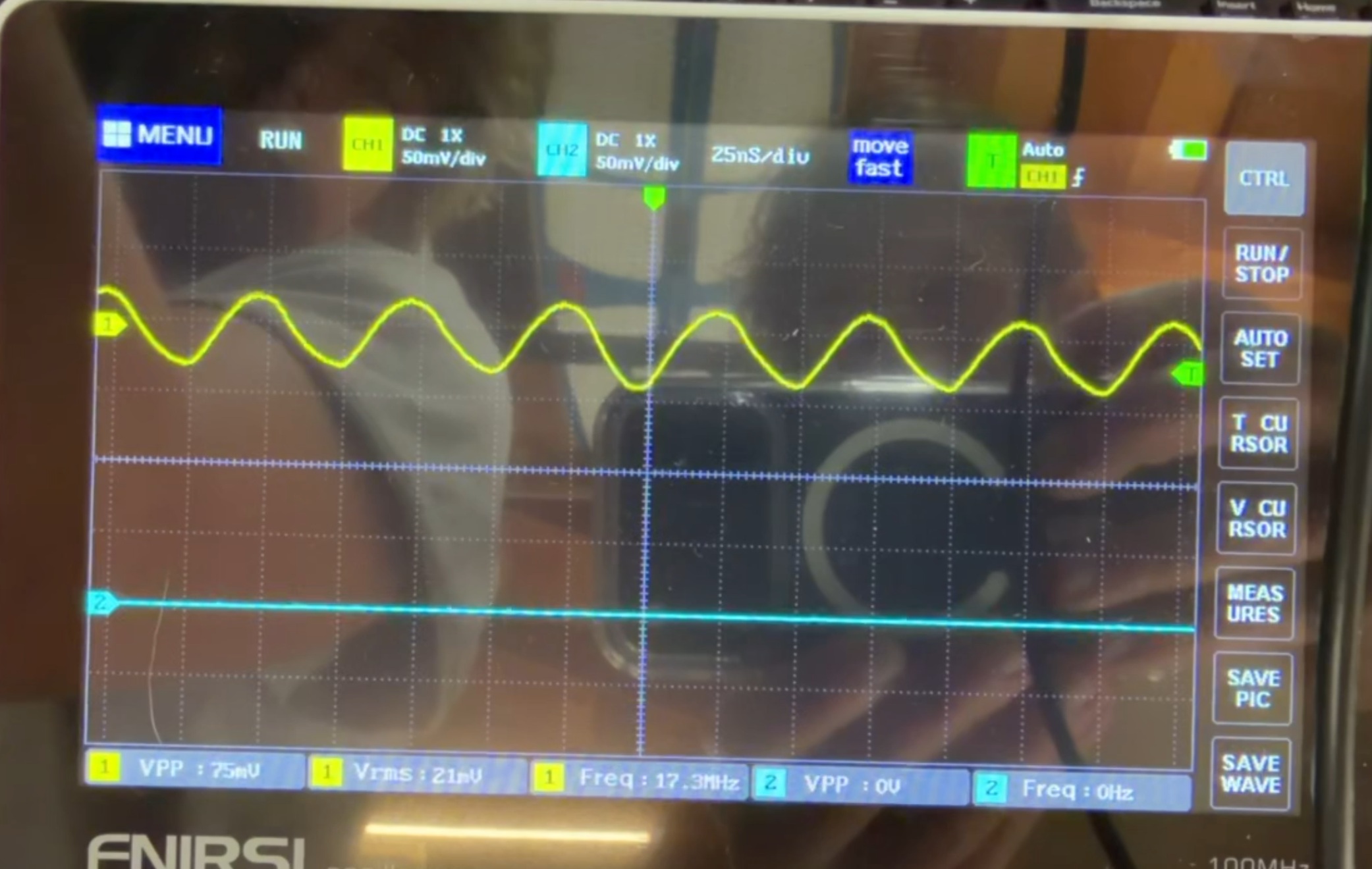 Image 2 -->
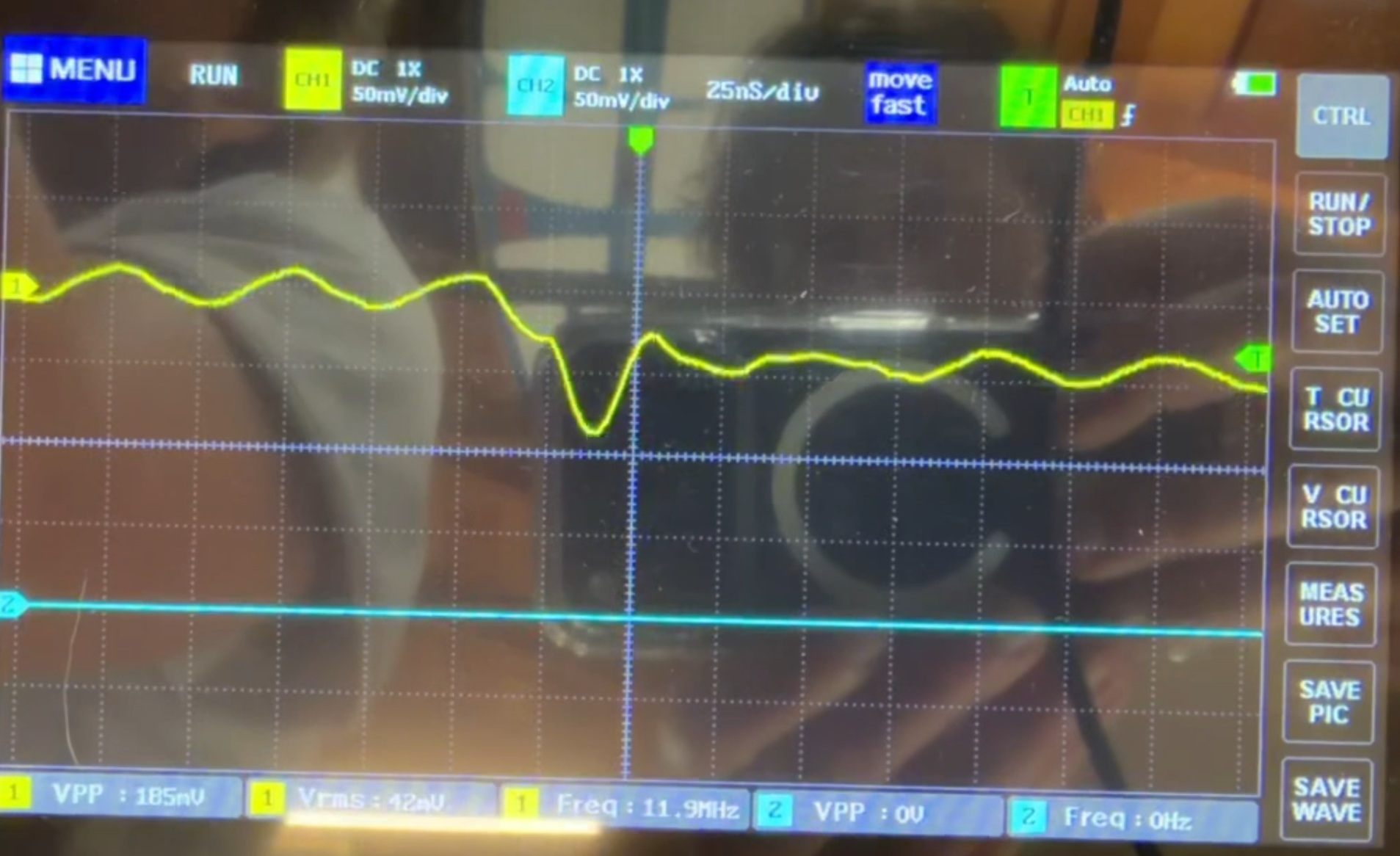
Image 1 -->
Attachments:
Please Log in or Create an account to join the conversation.
- tommylight
-

- Offline
- Moderator
-

Less
More
- Posts: 21995
- Thank you received: 7488
18 Mar 2026 20:40 #344487
by tommylight
Replied by tommylight on topic Motor timing help
At 75 and 185mVPP, those look like noise, not a signal of any kind, although the first one is weirdly clean sinusoidal.
Please Log in or Create an account to join the conversation.
- dbtayl
- Offline
- Senior Member
-

Less
More
- Posts: 49
- Thank you received: 47
18 Mar 2026 23:31 #344494
by dbtayl
Replied by dbtayl on topic Motor timing help
Yup, that's noise. Your scope settings are so "zoomed in" in time and voltage you probably can't see the real signals.

- Set your scope's Y axis (voltage) range to more like 1V/division. More if the signals are (eg) 24V.
- Set a trigger on a rising or falling edge, with a threshold of something in the middle of your signal voltage range. Eg, if it's a 5V system, set the trigger at 3V or some such.
- Change your X axis (time) to much longer. This depends on how fast you're moving the motor, but 25 ns is way too fast to see the signals you probably care about. Something more in the 100 us or 1 ms range probably makes much more sense.
The following user(s) said Thank You: tommylight, nicklego
Please Log in or Create an account to join the conversation.
- tommylight
-
- Offline
- Moderator
-
Less
More
- Posts: 21995
- Thank you received: 7488
18 Mar 2026 23:46 #344498
by tommylight
Replied by tommylight on topic Motor timing help
After another glance, 17.3MHz !!!
That is the realm of radio frequencies, not something you find on a machine.... usually.
That is the realm of radio frequencies, not something you find on a machine.... usually.
Please Log in or Create an account to join the conversation.
- nicklego
-
Topic Author
- Offline
- New Member
-
Less
More
- Posts: 4
- Thank you received: 0
19 Mar 2026 00:51 #344504
by nicklego
Replied by nicklego on topic Motor timing help
What range of frequencies are usually used by cnc machines?
Please Log in or Create an account to join the conversation.
- tommylight
-
- Offline
- Moderator
-
Less
More
- Posts: 21995
- Thank you received: 7488
19 Mar 2026 01:01 #344506
by tommylight
Replied by tommylight on topic Motor timing help
Signaling usually from 100Hz to 1000Hz, some up to 100KHz, and very rarely up to 1MHz.
There is no recipe for it, depends on a lot of stuff, so not easily framed into an answer, but:
-switching power supplies from 15KHz (older) to 400KHz (new ones)
-CPU inside a PC nowadays 2-6GHz, but almost all use a 100MHz clock
-power lines in USA 60Hz, in Europe 50Hz
-Mesa boards can do up to 10MHz, but most i ever needed was 0.96Mhz or 960KHz
-etc etc
There is no recipe for it, depends on a lot of stuff, so not easily framed into an answer, but:
-switching power supplies from 15KHz (older) to 400KHz (new ones)
-CPU inside a PC nowadays 2-6GHz, but almost all use a 100MHz clock
-power lines in USA 60Hz, in Europe 50Hz
-Mesa boards can do up to 10MHz, but most i ever needed was 0.96Mhz or 960KHz
-etc etc
The following user(s) said Thank You: nicklego
Please Log in or Create an account to join the conversation.
Time to create page: 0.118 seconds