
Search Results (Searched for: raspberry)
- kate
- kate
30 Oct 2025 20:22 - 31 Oct 2025 12:54
I have an issue, after running LinuxCNC Raspberry Pi Ethercat with Rtelligent ECT60 closed loop stepper controller i will gat about roughly half of hour or sometimes less EtherCAT ERROR 0-0: AL status message 0x001A: "Synchronization error". I have narrowed down problem that it occurs when raspberry pi ethernet goes down for a moment and then back up.Then the narrowing down part, I have tried with Raspberry Pi5 and couple of Raspberry Pi 4, I have used own build Rt-preempt kernel and all Linuxcnc/Ethercat from sources and now I have downloaded ready made LinuxCNC 2.9.4 Raspberry Pi image for rpi4 and rpi5. I have followed installation instructions from "Ethercat installation from repositories - how to step by step". I have tried with two separate controller boxes that are having Rtelligent ECT60 boards with two CNC machines and test configuration with just raspberry pi, controller and stepper motors. I have used multiple brand new ethernet cables, tried multiple Raspberry Pi power supplies including original one. I have tried to disable all other possible services like ntpd NetworknaMager touching interface. I can say that I have changed every component in system. Ethercat is direct cable connection from Raspberry Pi to ETC60.
Good ideas what to try next or even workaround ideas. When searching "macb 1f00100000.ethernet eth0: Link is Down" for rpi5 or similar for rpi4 i got lot of matching posts from raspberry pi forums. Just not help, there is similar theories about reason, bad ethernet cable, bad power supply, bad ethernet switch. I have tried with multiple cables , mutiple power supplies and I don't have switch but direct ethercat.
I least assume that issue is not in Ethercat configuration or Rpi RT-Preempt kernel because all of these are now standard from repo.
RaspberryPi 4/5 Ethercat Rtelligent ECT60 Synchronization error was created by kate
RaspberryPi 4/5 Ethercat Rtelligent ECT60 Synchronization error
Category: EtherCAT
I have an issue, after running LinuxCNC Raspberry Pi Ethercat with Rtelligent ECT60 closed loop stepper controller i will gat about roughly half of hour or sometimes less EtherCAT ERROR 0-0: AL status message 0x001A: "Synchronization error". I have narrowed down problem that it occurs when raspberry pi ethernet goes down for a moment and then back up.
[ 4189.236501] EtherCAT ERROR 0-1: Failed to receive AL state datagram: Datagram timed out.
[ 4189.300500] EtherCAT 0: 0 slave(s) responding on main device. Re-scanning on next possibility.
[ 4189.300504] EtherCAT 0: Re-scanning now.
[ 4189.848960] macb 1f00100000.ethernet eth0: Link is Down
[ 4189.849054] EtherCAT 0: Link state of ecm0 changed to DOWN.
[ 4190.184505] EtherCAT WARNING 0: 50 datagrams TIMED OUT!
[ 4191.898355] macb 1f00100000.ethernet eth0: Link is Up - 100Mbps/Full - flow control off
[ 4191.899068] EtherCAT 0: Link state of ecm0 changed to UP.Good ideas what to try next or even workaround ideas. When searching "macb 1f00100000.ethernet eth0: Link is Down" for rpi5 or similar for rpi4 i got lot of matching posts from raspberry pi forums. Just not help, there is similar theories about reason, bad ethernet cable, bad power supply, bad ethernet switch. I have tried with multiple cables , mutiple power supplies and I don't have switch but direct ethercat.
I least assume that issue is not in Ethercat configuration or Rpi RT-Preempt kernel because all of these are now standard from repo.
- Will_cnc
- Will_cnc
30 Oct 2025 19:38
Replied by Will_cnc on topic Stepper online A6 Servo motor as Spindle motor
Stepper online A6 Servo motor as Spindle motor
Category: General LinuxCNC Questions
cnc@raspberrypi:~$ % halrun
halcmd: loadrt cia402pv names=cia402pv.Spindle
Note: Using POSIX realtime
halcmd: show all
bash: fg: %: no such job
bash: halcmd:: command not found
bash: Note:: command not found
bash: halcmd:: command not found
cnc@raspberrypi:~$ halrun
halcmd: loadrt cia402pv names=cia402pv.Spindle
Note: Using POSIX realtime
halcmd: show all
Loaded HAL Components:
ID Type Name PID State
4 RT cia402pv ready
2 User halcmd2602 2602 ready
Component Pins:
Owner Type Dir Value Name
4 float IN 0 cia402pv.Spindle.acceleration
4 u32 OUT 0x00000000 cia402pv.Spindle.controlword
4 float IN 0 cia402pv.Spindle.deceleration
4 s32 OUT 0 cia402pv.Spindle.drv-acceleration
4 s32 IN 0 cia402pv.Spindle.drv-actual-position
4 s32 IN 0 cia402pv.Spindle.drv-actual-velocity
4 s32 OUT 0 cia402pv.Spindle.drv-deceleration
4 bit OUT FALSE cia402pv.Spindle.drv-fault
4 s32 OUT 0 cia402pv.Spindle.drv-quickstop-deceleration
4 s32 OUT 0 cia402pv.Spindle.drv-target-position
4 s32 OUT 0 cia402pv.Spindle.drv-target-velocity
4 bit IN FALSE cia402pv.Spindle.enable
4 bit IN FALSE cia402pv.Spindle.fault-reset
4 bit I/O FALSE cia402pv.Spindle.home
4 s32 OUT 0 cia402pv.Spindle.opmode
4 bit OUT FALSE cia402pv.Spindle.opmode-cyclic-position
4 bit OUT FALSE cia402pv.Spindle.opmode-cyclic-velocity
4 s32 IN 0 cia402pv.Spindle.opmode-display
4 bit OUT FALSE cia402pv.Spindle.opmode-homing
4 bit OUT FALSE cia402pv.Spindle.opmode-no-mode
4 bit OUT FALSE cia402pv.Spindle.opmode-profile-velocity
4 float IN 0 cia402pv.Spindle.pos-cmd
4 float OUT 0 cia402pv.Spindle.pos-fb
4 float IN 0 cia402pv.Spindle.quickstop-acceleration
4 s32 OUT 0 cia402pv.Spindle.read-all.time
4 bit IN FALSE cia402pv.Spindle.run
4 bit OUT FALSE cia402pv.Spindle.stat-at-speed
4 bit OUT FALSE cia402pv.Spindle.stat-fault
4 bit OUT FALSE cia402pv.Spindle.stat-homed
4 bit OUT FALSE cia402pv.Spindle.stat-homing
4 bit OUT FALSE cia402pv.Spindle.stat-op-enabled
4 bit OUT FALSE cia402pv.Spindle.stat-quick-stop
4 bit OUT FALSE cia402pv.Spindle.stat-quick-stop-valid
4 bit OUT FALSE cia402pv.Spindle.stat-remote
4 bit OUT FALSE cia402pv.Spindle.stat-switched-on
4 bit OUT FALSE cia402pv.Spindle.stat-switchon-disabled
4 bit OUT FALSE cia402pv.Spindle.stat-switchon-ready
4 bit OUT FALSE cia402pv.Spindle.stat-target-reached
4 bit OUT FALSE cia402pv.Spindle.stat-voltage-enabled
4 bit OUT FALSE cia402pv.Spindle.stat-warning
4 bit OUT FALSE cia402pv.Spindle.stat-zero-speed
4 u32 IN 0x00000000 cia402pv.Spindle.statusword
4 float IN 0 cia402pv.Spindle.velocity-cmd
4 float OUT 0 cia402pv.Spindle.velocity-fb
4 s32 OUT 0 cia402pv.Spindle.write-all.time
Pin Aliases:
Alias Original Name
Signals:
Type Value Name (linked to)
Parameters:
Owner Type Dir Value Name
4 bit RW TRUE cia402pv.Spindle.auto-fault-reset
4 bit RW TRUE cia402pv.Spindle.csp-mode
4 float RW 1 cia402pv.Spindle.pos-scale
4 bit RW FALSE cia402pv.Spindle.pv-mode
4 s32 RW 0 cia402pv.Spindle.read-all.tmax
4 bit RO FALSE cia402pv.Spindle.read-all.tmax-increased
4 float RW 1 cia402pv.Spindle.velo-scale
4 s32 RW 0 cia402pv.Spindle.write-all.tmax
4 bit RO FALSE cia402pv.Spindle.write-all.tmax-increased
Parameter Aliases:
Alias Original Name
Exported Functions:
Owner CodeAddr Arg FP Users Name
00004 7fff005c2a20 7fff005f0120 YES 0 cia402pv.Spindle.read-all
00004 7fff005c1e04 7fff005f0120 YES 0 cia402pv.Spindle.write-all
Realtime Threads:
Period FP Name ( Time, Max-Time )
halcmd: Note: Using POSIX realtime
cnc@raspberrypi:~$
halcmd: loadrt cia402pv names=cia402pv.Spindle
Note: Using POSIX realtime
halcmd: show all
bash: fg: %: no such job
bash: halcmd:: command not found
bash: Note:: command not found
bash: halcmd:: command not found
cnc@raspberrypi:~$ halrun
halcmd: loadrt cia402pv names=cia402pv.Spindle
Note: Using POSIX realtime
halcmd: show all
Loaded HAL Components:
ID Type Name PID State
4 RT cia402pv ready
2 User halcmd2602 2602 ready
Component Pins:
Owner Type Dir Value Name
4 float IN 0 cia402pv.Spindle.acceleration
4 u32 OUT 0x00000000 cia402pv.Spindle.controlword
4 float IN 0 cia402pv.Spindle.deceleration
4 s32 OUT 0 cia402pv.Spindle.drv-acceleration
4 s32 IN 0 cia402pv.Spindle.drv-actual-position
4 s32 IN 0 cia402pv.Spindle.drv-actual-velocity
4 s32 OUT 0 cia402pv.Spindle.drv-deceleration
4 bit OUT FALSE cia402pv.Spindle.drv-fault
4 s32 OUT 0 cia402pv.Spindle.drv-quickstop-deceleration
4 s32 OUT 0 cia402pv.Spindle.drv-target-position
4 s32 OUT 0 cia402pv.Spindle.drv-target-velocity
4 bit IN FALSE cia402pv.Spindle.enable
4 bit IN FALSE cia402pv.Spindle.fault-reset
4 bit I/O FALSE cia402pv.Spindle.home
4 s32 OUT 0 cia402pv.Spindle.opmode
4 bit OUT FALSE cia402pv.Spindle.opmode-cyclic-position
4 bit OUT FALSE cia402pv.Spindle.opmode-cyclic-velocity
4 s32 IN 0 cia402pv.Spindle.opmode-display
4 bit OUT FALSE cia402pv.Spindle.opmode-homing
4 bit OUT FALSE cia402pv.Spindle.opmode-no-mode
4 bit OUT FALSE cia402pv.Spindle.opmode-profile-velocity
4 float IN 0 cia402pv.Spindle.pos-cmd
4 float OUT 0 cia402pv.Spindle.pos-fb
4 float IN 0 cia402pv.Spindle.quickstop-acceleration
4 s32 OUT 0 cia402pv.Spindle.read-all.time
4 bit IN FALSE cia402pv.Spindle.run
4 bit OUT FALSE cia402pv.Spindle.stat-at-speed
4 bit OUT FALSE cia402pv.Spindle.stat-fault
4 bit OUT FALSE cia402pv.Spindle.stat-homed
4 bit OUT FALSE cia402pv.Spindle.stat-homing
4 bit OUT FALSE cia402pv.Spindle.stat-op-enabled
4 bit OUT FALSE cia402pv.Spindle.stat-quick-stop
4 bit OUT FALSE cia402pv.Spindle.stat-quick-stop-valid
4 bit OUT FALSE cia402pv.Spindle.stat-remote
4 bit OUT FALSE cia402pv.Spindle.stat-switched-on
4 bit OUT FALSE cia402pv.Spindle.stat-switchon-disabled
4 bit OUT FALSE cia402pv.Spindle.stat-switchon-ready
4 bit OUT FALSE cia402pv.Spindle.stat-target-reached
4 bit OUT FALSE cia402pv.Spindle.stat-voltage-enabled
4 bit OUT FALSE cia402pv.Spindle.stat-warning
4 bit OUT FALSE cia402pv.Spindle.stat-zero-speed
4 u32 IN 0x00000000 cia402pv.Spindle.statusword
4 float IN 0 cia402pv.Spindle.velocity-cmd
4 float OUT 0 cia402pv.Spindle.velocity-fb
4 s32 OUT 0 cia402pv.Spindle.write-all.time
Pin Aliases:
Alias Original Name
Signals:
Type Value Name (linked to)
Parameters:
Owner Type Dir Value Name
4 bit RW TRUE cia402pv.Spindle.auto-fault-reset
4 bit RW TRUE cia402pv.Spindle.csp-mode
4 float RW 1 cia402pv.Spindle.pos-scale
4 bit RW FALSE cia402pv.Spindle.pv-mode
4 s32 RW 0 cia402pv.Spindle.read-all.tmax
4 bit RO FALSE cia402pv.Spindle.read-all.tmax-increased
4 float RW 1 cia402pv.Spindle.velo-scale
4 s32 RW 0 cia402pv.Spindle.write-all.tmax
4 bit RO FALSE cia402pv.Spindle.write-all.tmax-increased
Parameter Aliases:
Alias Original Name
Exported Functions:
Owner CodeAddr Arg FP Users Name
00004 7fff005c2a20 7fff005f0120 YES 0 cia402pv.Spindle.read-all
00004 7fff005c1e04 7fff005f0120 YES 0 cia402pv.Spindle.write-all
Realtime Threads:
Period FP Name ( Time, Max-Time )
halcmd: Note: Using POSIX realtime
cnc@raspberrypi:~$
- PCW
30 Oct 2025 19:11
Replied by PCW on topic 7i96s Pinout/Wiring Help
7i96s Pinout/Wiring Help
Category: General LinuxCNC Questions
1. No 7I96S step/dir pin should ever be wired to 5V or ground.
This directly shorts out the drivers and if done for more
than a short time will damage the driver chips.
2. Not sure what you mean by this:
I wired them to Raspberry Pi GPIO using external 10k pull-ups.
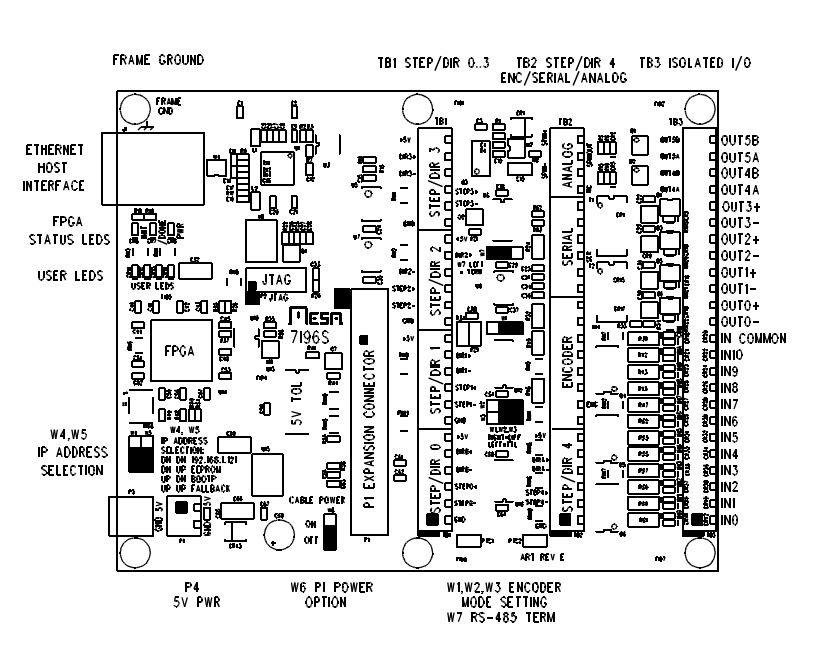
3. Are the pins you have trouble with encoder pins (TB2 pins)
or isolated input pins?
P1 pinout is standard header pinout
pin one is marked with the Square
1 2
3 4
5 6
7 8
etc
Note that mesaflash show equivalent DB25 pins
(if you use the latest mesaflash you can show HDR26 pins
with the --dbname hdr26 option)
This directly shorts out the drivers and if done for more
than a short time will damage the driver chips.
2. Not sure what you mean by this:
I wired them to Raspberry Pi GPIO using external 10k pull-ups.
3. Are the pins you have trouble with encoder pins (TB2 pins)
or isolated input pins?
P1 pinout is standard header pinout
pin one is marked with the Square
1 2
3 4
5 6
7 8
etc
Note that mesaflash show equivalent DB25 pins
(if you use the latest mesaflash you can show HDR26 pins
with the --dbname hdr26 option)
- maruf1777
- maruf1777
30 Oct 2025 18:39
7i96s Pinout/Wiring Help was created by maruf1777
7i96s Pinout/Wiring Help
Category: General LinuxCNC Questions
Hello everyone
I am encountering an issue that appears to be EMI-related despite applying the usual mitigation steps.
EMI / System Setup:
VFD in steel enclosure
Input EMI filter
Ferrite rings on VFD output and all related cables
Shielded spindle/motor cables (grounded both ends)
AC/VFD cabling physically separated from DC lines
High-current DC cables are shielded and routed separately
Control Setup:
I am using the 7i96S encoder pins for MPG inputs (I have no motor or spindle encoders).
I do not have any unused OUT pins and only 4 available IN pins.
To get X, Y, Z, X1, X10, and X100 signals, I wired them to Raspberry Pi GPIO using external 10k pull-ups.
Issue
After wiring the MPG inputs, some of the pins intermittently remain latched HIGH or LOW, making jog selection unreliable. This problem has occurred twice, and both times it started after spindle-speed testing.
Earlier in setup, I believe I damaged one of the 7i96S step/dir channels. After that, instead of wiring STEP- and DIR- to GND and STEP+ / DIR+ to the respective inputs, I reversed them — STEP+ and DIR+ to +5V and STEP- / DIR- to the Mesa pins.I have since added additional ferrites and shielding, Ferrites on servo lines, data cables, and MPG cable
Steel mesh added to enclosure ventilation fans but the issue persists.
I am now planning to use the P1 pins on the 7i96S for X/Y/Z and X1/X10/X100 inputs instead.
W6 jumper is OFF.
Questions
I am encountering an issue that appears to be EMI-related despite applying the usual mitigation steps.
EMI / System Setup:
VFD in steel enclosure
Input EMI filter
Ferrite rings on VFD output and all related cables
Shielded spindle/motor cables (grounded both ends)
AC/VFD cabling physically separated from DC lines
High-current DC cables are shielded and routed separately
Control Setup:
I am using the 7i96S encoder pins for MPG inputs (I have no motor or spindle encoders).
I do not have any unused OUT pins and only 4 available IN pins.
To get X, Y, Z, X1, X10, and X100 signals, I wired them to Raspberry Pi GPIO using external 10k pull-ups.
Issue
After wiring the MPG inputs, some of the pins intermittently remain latched HIGH or LOW, making jog selection unreliable. This problem has occurred twice, and both times it started after spindle-speed testing.
Earlier in setup, I believe I damaged one of the 7i96S step/dir channels. After that, instead of wiring STEP- and DIR- to GND and STEP+ / DIR+ to the respective inputs, I reversed them — STEP+ and DIR+ to +5V and STEP- / DIR- to the Mesa pins.I have since added additional ferrites and shielding, Ferrites on servo lines, data cables, and MPG cable
Steel mesh added to enclosure ventilation fans but the issue persists.
I am now planning to use the P1 pins on the 7i96S for X/Y/Z and X1/X10/X100 inputs instead.
W6 jumper is OFF.
Questions
- The MPG has extra wires that appear intended to power LEDs or similar features. Can these be safely powered from the 5V rail, or is that risky for the inputs?
- Where exactly are pin 1 and pin 2 physically located on the P1 expansion header?
- Which P1 pins are appropriate to use for these MPG signals?
- May I safely use 5V for the MPG input power in this configuration?
- Any recommendations to avoid EMI issues when using these inputs on the 7i96S?
Thank you for your help.
- Will_cnc
- Will_cnc
30 Oct 2025 11:00
Replied by Will_cnc on topic Stepper online A6 Servo motor as Spindle motor
Stepper online A6 Servo motor as Spindle motor
Category: General LinuxCNC Questions
sudo halcompile --install cia402pv.comp
cnc@raspberrypi:~$ sudo halcompile --install cia402pv.comp
Traceback (most recent call last):
File "/usr/bin/halcompile", line 1553, in <module>
main()
File "/usr/bin/halcompile", line 1523, in main
process(f, mode, outfile)
File "/usr/bin/halcompile", line 1363, in process
a, b = parse(filename)
^^^^^^^^^^^^^^^
File "/usr/bin/halcompile", line 434, in parse
f = open(filename).read()
^^^^^^^^^^^^^^
FileNotFoundError: [Errno 2] No such file or directory: 'cia402pv.comp'
cnc@raspberrypi:~$ sudo halcompile --install cia402pv.comp
Traceback (most recent call last):
File "/usr/bin/halcompile", line 1553, in <module>
main()
File "/usr/bin/halcompile", line 1523, in main
process(f, mode, outfile)
File "/usr/bin/halcompile", line 1363, in process
a, b = parse(filename)
^^^^^^^^^^^^^^^
File "/usr/bin/halcompile", line 434, in parse
f = open(filename).read()
^^^^^^^^^^^^^^
FileNotFoundError: [Errno 2] No such file or directory: 'cia402pv.comp'
- tommylight

30 Oct 2025 00:18
Replied by tommylight on topic Raspberry PI4/5 I2C support for non realtime IO/ADC/LCD
Raspberry PI4/5 I2C support for non realtime IO/ADC/LCD
Category: General LinuxCNC Questions
@LangdonS,
He does that always, just have a browse through his posts.
@Oli,
Danke schon.
He does that always, just have a browse through his posts.
@Oli,
Danke schon.
- nanowhat
- nanowhat
29 Oct 2025 04:28
Replied by nanowhat on topic Loading 32 bit shared library with GladeVCP/python on a Raspberry Pi
Loading 32 bit shared library with GladeVCP/python on a Raspberry Pi
Category: General LinuxCNC Questions
I'm going to write a separate 32 bit executable that loads the shared library, and presents a named pipe that I can access via Python.
- nanowhat
- nanowhat
29 Oct 2025 02:27
Loading 32 bit shared library with GladeVCP/python on a Raspberry Pi was created by nanowhat
Loading 32 bit shared library with GladeVCP/python on a Raspberry Pi
Category: General LinuxCNC Questions
I need to load a 32 bit shared library from GladeVCP/python to communicate with an existing machine. This shared library is only available as a 32 bit library for ARM systems, and I want to see if this will run on a Raspberry Pi. I don't have access to the source, so I can't recompile arm64.
Is there any way to do this, or do I have to run on a x86_64 machine?
Is there any way to do this, or do I have to run on a x86_64 machine?
- Chad
- Chad
26 Oct 2025 10:12
Remora SPI: Bad SPI payload, estop won’t reset, SKR 1.4 + RPi4 – config below was created by Chad
Remora SPI: Bad SPI payload, estop won’t reset, SKR 1.4 + RPi4 – config below
Category: Computers and Hardware
Hi,
I’m trying to get Remora to work with a Raspberry Pi 4 Compute Module (on the official IO board) and a BTT SKR 1.4 (LPC1768) board via SPI (using EXP2 directly).No matter what I do, I keep getting “bad spi payload” errors and I can’t reset estop in LinuxCNC. The estop status toggles randomly, sometimes reporting errors like “fffff”, “3a”, “71”, then “0”, but it never clears or lets me enable the machine.Here’s what I’ve already tried:, and files plus a photo of my wiring. Any advice, example configs, or troubleshooting steps would be greatly appreciated!
.hal file:
.ini file:
config.txt:
I’m trying to get Remora to work with a Raspberry Pi 4 Compute Module (on the official IO board) and a BTT SKR 1.4 (LPC1768) board via SPI (using EXP2 directly).No matter what I do, I keep getting “bad spi payload” errors and I can’t reset estop in LinuxCNC. The estop status toggles randomly, sometimes reporting errors like “fffff”, “3a”, “71”, then “0”, but it never clears or lets me enable the machine.Here’s what I’ve already tried:
- Double/triple-checked config files (.hal/.ini/config.txt) for base/servo thread values and SPI freq
- Tried SPI_FREQ values from 40000 down to 2500
- Used multiple different SD cards, freshly copied firmware/config.txt every time
- Swapped and powered from two different power supplies, always with common ground
- Used short (10–20 cm) jumper wires and a dedicated IDC ribbon cable between RPi CM4 IO board and SKR (connected to SPI0 CS0)
- Confirmed CS line matches config and wiring
- Tried wiring both loosened and via the screw-terminal “HAT”
- Tested with two different RPi modules
- Flashed the correct Remora firmware for LPC1768, config.txt matches hardware
- LinuxCNC starts, RPi and SKR both power up
- E-stop never disengages, status bits change randomly
- Console/log shows many “bad spi payload” errors, with hex codes changing each time
- Stepper drivers do not respond, SPI module loads but does not work
- Raspberry Pi 4 Compute Module on official IO board
- BTT SKR 1.4 (LPC1768) with Remora firmware
- Connecting via SPI (EXP2 header), CS0
- Cables all short, tried IDC and normal dupont/jumper types
- Is there anything obvious I’m missing in configs or wiring?
- Has anyone had this persist even with good IDC cable and CM4?
- Any proven working “plug-and-play” cable or adapter for this combo?
- Are there common hardware quirks or firmware issues with this setup?
- Would using a logic analyzer or scope help, and what to look for?
.hal.iniconfig.txt.hal file:
# Load the realtime components loadrt [KINS]KINEMATICS loadrt [EMCMOT]EMCMOT base_period_nsec=[EMCMOT]BASE_PERIOD servo_period_nsec=[EMCMOT]SERVO_PERIOD num_joints=[KINS]JOINTS loadrt remora-spi SPI num=0 CS_num=0 SPI [remora]SPI_FREQ=20000 # estop loopback, SPI comms enable and feedback net user-enable-out <= iocontrol.0.user-enable-out => remora.SPI.enable net user-request-enable <= iocontrol.0.user-request-enable => remora.SPI-reset net remora-status <= remora.SPI-status => iocontrol.0.emc-enable-in # add the remora and motion functions to threads addf remora.read servo-thread addf motion-command-handler servo-thread addf motion-controller servo-thread addf remora.update-req servo-thread addf remora.write servo-thread # Joint 0 setup setp remora.joint.0.scale [JOINT_0]SCALE setp remora.joint.0.maxaccel [JOINT_0]STEPGEN_MAXACCEL net x:pos-cmd <= joint.0.motor-pos-cmd => remora.joint.0.pos-cmd net x:pos-fb <= remora.joint.0.pos-fb => joint.0.pos-fb net x:enable <= joint.0.amp-enable-out => remora.joint.0.enable # Joint 1 setup setp remora.joint.1.scale [JOINT_1]SCALE setp remora.joint.1.maxaccel [JOINT_1]STEPGEN_MAXACCEL net y:pos-cmd <= joint.1.motor-pos-cmd => remora.joint.1.pos-cmd net y:pos-fb <= remora.joint.1.pos-fb => joint.1.pos-fb net y:enable <= joint.1.amp-enable-out => remora.joint.1.enable # Joint 2 setup setp remora.joint.2.scale [JOINT_2]SCALE setp remora.joint.2.maxaccel [JOINT_2]STEPGEN_MAXACCEL net z:pos-cmd <= joint.2.motor-pos-cmd => remora.joint.2.pos-cmd net z:pos-fb <= remora.joint.2.pos-fb => joint.2.pos-fb net z:enable <= joint.2.amp-enable-out => remora.joint.2.enable.ini file:
# Basic LinuxCNC config for testing of Remora firmware [EMC] MACHINE = Remora-XYZ DEBUG = 0 VERSION = 1.1 [DISPLAY] DISPLAY = axis EDITOR = gedit POSITION_OFFSET = RELATIVE POSITION_FEEDBACK = ACTUAL ARCDIVISION = 64 GRIDS = 10mm 20mm 50mm 100mm MAX_FEED_OVERRIDE = 1.2 MIN_SPINDLE_OVERRIDE = 0.5 MAX_SPINDLE_OVERRIDE = 1.2 DEFAULT_LINEAR_VELOCITY = 50.00 MIN_LINEAR_VELOCITY = 0.00 MAX_LINEAR_VELOCITY = 200.00 DEFAULT_ANGULAR_VELOCITY = 36.00 MAX_ANGULAR_VELOCITY = 45.00 INTRO_GRAPHIC = linuxcnc.gif INTRO_TIME = 5 PROGRAM_PREFIX = ~/linuxcnc/nc_files INCREMENTS = 50mm 10mm 5mm 1mm .5mm .1mm .05mm .01mm [KINS] JOINTS = 3 #KINEMATICS =trivkins coordinates=XYZ kinstype=BOTH KINEMATICS = trivkins coordinates=XYZ [FILTER] PROGRAM_EXTENSION = .py Python Script py = python [TASK] TASK = milltask CYCLE_TIME = 0.010 [RS274NGC] PARAMETER_FILE = linuxcnc.var [EMCMOT] EMCMOT = motmod COMM_TIMEOUT = 1.0 COMM_WAIT = 0.010 BASE_PERIOD = 25000 SERVO_PERIOD = 1000000 [HAL] HALFILE = remora-xyz.hal POSTGUI_HALFILE = postgui_call_list.hal [TRAJ] COORDINATES = X Y Z LINEAR_UNITS = mm ANGULAR_UNITS = degree CYCLE_TIME = 0.010 DEFAULT_LINEAR_VELOCITY = 50.00 MAX_LINEAR_VELOCITY = 200.00 NO_FORCE_HOMING = 1 [EMCIO] EMCIO = io CYCLE_TIME = 1.00 TOOL_TABLE = tool.tbl [AXIS_X] MAX_VELOCITY = 250 MAX_ACCELERATION = 750.0 MIN_LIMIT = -5.0 MAX_LIMIT = 300.0 [JOINT_0] TYPE = LINEAR HOME = 0.0 MIN_LIMIT = -5.0 MAX_LIMIT = 300.0 MAX_VELOCITY = 250.0 MAX_ACCELERATION = 750.0 STEPGEN_MAXACCEL = 2000.0 SCALE = 80.0 FERROR = 2 MIN_FERROR = 2.0 HOME_OFFSET = 2.0 HOME_SEARCH_VEL = 0 HOME_LATCH_VEL = 0 HOME_SEQUENCE = 0 [AXIS_Y] MAX_VELOCITY = 250.0 MAX_ACCELERATION = 750.0 MIN_LIMIT = -0.01 MAX_LIMIT = 300.0 [JOINT_1] TYPE = LINEAR HOME = 0.0 MIN_LIMIT = -5.0 MAX_LIMIT = 300.0 MAX_VELOCITY = 250.0 MAX_ACCELERATION = 750.0 STEPGEN_MAXACCEL = 2000.0 SCALE = 80.0 FERROR = 5 MIN_FERROR = 5.0 HOME_OFFSET = 0.0 HOME_SEARCH_VEL = 0 HOME_LATCH_VEL = 0 HOME_SEQUENCE = 0 [AXIS_Z] OFFSET_AV_RATIO = 0.2 MAX_VELOCITY = 5.0 MAX_ACCELERATION = 200.0 MIN_LIMIT = -280 MAX_LIMIT = 280 [JOINT_2] TYPE = LINEAR HOME = 0.0 MIN_LIMIT = -280 MAX_LIMIT = 280 MAX_VELOCITY = 5.0 MAX_ACCELERATION = 200.0 STEPGEN_MAXACCEL = 3000.0 SCALE = 400.0 FERROR = 5 MIN_FERROR = 1.0 HOME_OFFSET = 0.0 HOME_SEARCH_VEL = 0 HOME_LATCH_VEL = 0 HOME_SEQUENCE = 0config.txt:
{
  "Board": "BIGTREETECH SKR v1.3 & v1.4",
  "Threads": [
    { "Thread": "Base", "Frequency": 40000 },
    { "Thread": "Servo", "Frequency": 1000 }
  ],
  "Modules": [
    {
      "Thread": "Servo",
      "Type": "Reset Pin",
      "Comment": "Reset pin",
      "Pin": "1.31"
    },
    {
      "Thread": "Base",
      "Type": "SPI",
      "Comment": "SPI interface to Raspberry Pi",
      "CS Pin": "0.16"
    },
    {
      "Thread": "Base",
      "Type": "Stepgen",
      "Comment": "X - Joint 0 step generator",
      "Joint Number": 0,
      "Step Pin": "2.2",
      "Direction Pin": "2.6",
      "Enable Pin": "2.1"
    },
    {
      "Thread": "Base",
      "Type": "Stepgen",
      "Comment": "Y - Joint 1 step generator",
      "Joint Number": 1,
      "Step Pin": "0.19",
      "Direction Pin": "0.20",
      "Enable Pin": "2.8"
    },
    {
      "Thread": "Base",
      "Type": "Stepgen",
      "Comment": "Z - Joint 2 step generator",
      "Joint Number": 2,
      "Step Pin": "0.22",
      "Direction Pin": "2.11",
      "Enable Pin": "0.21"
    }
  ]
}
Time to create page: 1.271 seconds