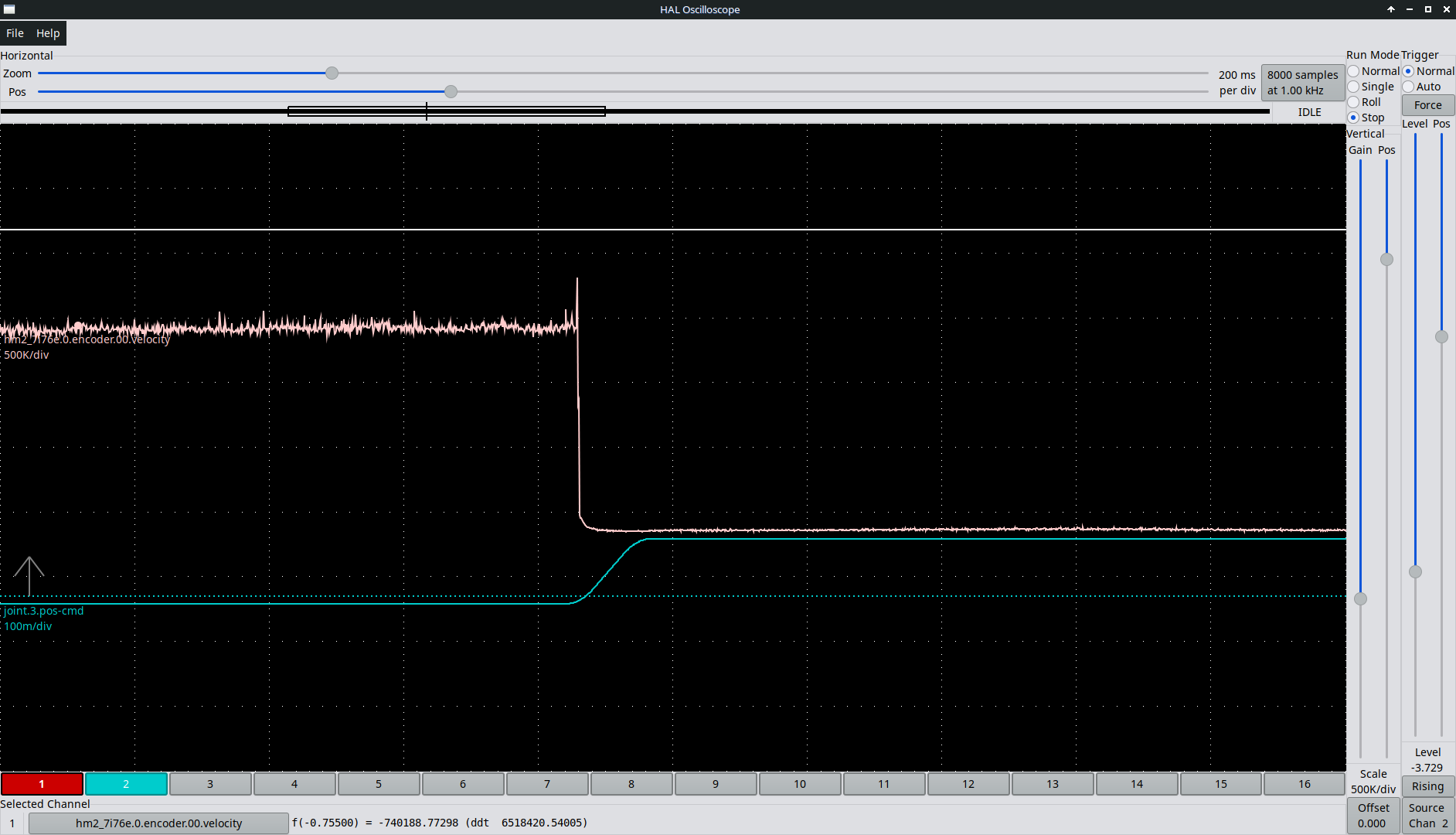
I've figured out that the issue was due to the muxed encoders limiting my sampling frequency since I am using firmware that adds a 7i85s to the 7i76e P1 expansion port. I knew that the 7i85s encoders were set this way, but it wasn't until I checked the firmware pin file that I saw the 7i76e encoders are also set as muxed encoders.
I first tried updating the sample frequency:
Code:
setp hm2_7i76e.0.encoder.muxed-sample-frequency 25000000
It was at 8333333 previously (8.333 MHz?), but this higher sample rate didn't solve the issue. I went back and flashed my 7i76e with the stock firmware, changing the 7i76e encoder back to a quad encoder instead of muxed. With all other things remaining the same as before, my signal is now being read, and looks very close to yours. Although the value is inverted, I can just scale it negatively.
Would you mind sharing your hal/ini files? I'm interested in how you scaled it to a reasonable value while maintaining resolution. It is a very small window based on the cut height required to keep it on target.
Here's some data, 0.100" Z move. capacitance.txt is csv scope output data
PCW: Can the 7i76e+7i85s firmware be changed to just "A" input encoders and bypass the need to have muxed encoders that are sample limited? Would this work? My setup requires 3 different single ended encoder "A" inputs, 7 stepgens, and 2 pwmgens.