
- Posts: 28
- Thank you received: 9
Retrofitting a 1986 Maho MH400E
- cgroth
- Offline
- Junior Member
-

Less
More
8 years 1 month ago #118281
by cgroth
Replied by cgroth on topic Retrofitting a 1986 Maho MH400E
Mark, to get it right, your machine was already equipped with Heidenhain scales instead of Philips ones? What series is mounted? How is the cable mounted? My Kunzmann has LS903 as far as I remember that have a remote socked with about 20cm cable. I already dismantled one to clean the sealing. Cable to the CNC is connected using the 9-pin Heidenhain round socket. The scales have 11uA sinusoidal signals, so any dirt between pins or bad insulation may have severe impact. What EXE converters do you use? I bought 3 brand new EXE 602 last week for 40€ each, so in case your not sure about yours it may be worth to buy one new and test.
Please Log in or Create an account to join the conversation.
- cgroth
- Offline
- Junior Member
-
Less
More
- Posts: 28
- Thank you received: 9
8 years 1 month ago #118283
by cgroth
Replied by cgroth on topic Retrofitting a 1986 Maho MH400E
Hi Jesper,
I am just a listener as I can't spend time on my project at the moment. With your skills I suggest to start with setting up the machine running the Philips CNC. If that was working before moving the machine, restoring the parameters by hand is easy. And you can play around with the machine for a while discovering all its features before starting a conversion. A lot of information may be useful to your machine thought there might be difference for instance if your machine has a variable speed DC spindle drive.
Christian
Christian
Please Log in or Create an account to join the conversation.
- akb1212
- Away
- Senior Member
-

Less
More
- Posts: 75
- Thank you received: 12
8 years 1 month ago #118285
by akb1212
Replied by akb1212 on topic Retrofitting a 1986 Maho MH400E
Loddestuen and all,
I hope you end up buying this mill! And you seem to be in good shape to do this, with the background to get all the difficult practical things fixed.
The software part is possible to learn, and as you must have seen by now the support here is absolutely comparable to other commercial vendors! Absolutely top notch!
I have a Maho MH600E from 1990 I'm restoring, so I do know that it's quite a bit of work to undertake. But at the same time it's highly rewarding when you succeed.
My mill isn't fully running yet, that is the conversion isn't fully completed. And there have been a long period of no time to spend on this project. But I hope to be able to get something done on this soon.
And if you haven't seen it yet I suggest you visit the thread I started about it on Practical Machinist: www.practicalmachinist.com/vb/dmg-mori-g...-maho-thread-270525/
It's long, but should be a good starting point if you haven't already seen it.
I expect this mill comes with a tool changer? I think that was standard on the -C class of Mahos? In that case I'd be really interested in participating it getting this sorted, as this is one of the missing prices on my retrofit.
An important point with the machine you are considering is the available documentation. That will be of huge help, and make everything go a lot smoother.
Hope to see you here soon with a new retrofit project!
Regards
Anders from Norway
Please Log in or Create an account to join the conversation.
- RotarySMP
- Offline
- Platinum Member
-

Less
More
- Posts: 1635
- Thank you received: 595
8 years 4 weeks ago #118334
by RotarySMP
Replied by RotarySMP on topic Retrofitting a 1986 Maho MH400E
Bob,
I took a look at that X axis braided conduit yesterday, but there is no obvious brand marking on it. The mounting hardware is marked PG 29 TYP US ... .
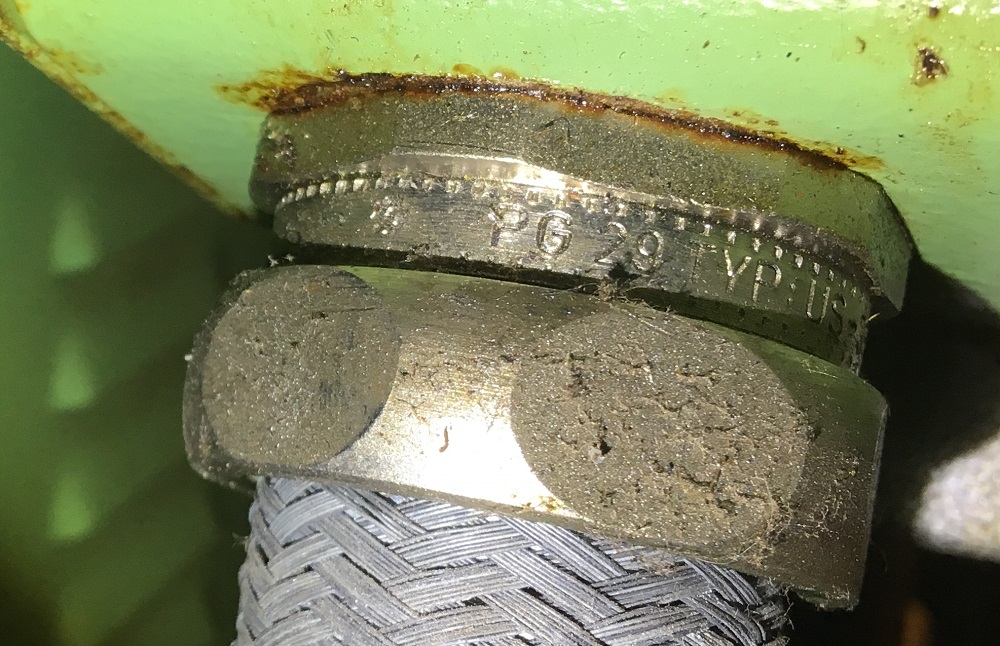
Sorry, I just realised I didn't get a full shot of that part number, but googling it reveals that PG29 is just a generic gland nut.
www.mencom.com/shop/cable-glands/pg29-me...ass-0-702-0-994.html
The Z axis conduit is larger. Sorry I forgot to photograph that as well.
Jesper,
I would agree with Christian that the best thing would be to get it up and running with the Phillips first. I'd contact DMG and ask them nicely for the constants. Starting a retrofit with a non-functional machine leaves you scratching your head whether things are not working because you made a mistake, or because there is an unidentified existing failure.
You will need to get more information, such as photos of the control cabinet. In google I found these photos of the 700C...
www.aptint.com/en/used-second-hand-machi...0-y-500-z-400mm_9317
Here are some ideas, based on what I see there...
- You have schematics, that is good (essential). Whether you retrofit of not, owning one of these machines without schematics would be a nightmare.
- There appears to be a control relay panel at the bottom of the control cabinet. This is not the same as the 28A1 used on the MHx00E series, but appears more simple.
- Since the spindle is driven by a huge DC motor, how is your power service? I am running my MH400E off a household 16A 400VAC 3PH supply, and occasionally the inrush trips the breaker when I first power up the machine. I haven't had any cutting loads yet, so this may be an issue. The 700C will need a much higher current supply.
- MuellerNick retrofitted a 700C years ago. They only have a single gearbox control stage, so you could probably adapt the gearbox.comp Andy Pugh wrote for his Holbrook, or adapt the comp Sergey wrote for me. To start with you could probably do manual gear changes, as the DC spindle speed control should cover many jobs.
www.youtube.com/user/MuellerNick/videos
- The 700C has three Indramats, a 1TRM3, a 3TRM2 and a third one which I can't read. I am going to assume that the 3TRM2 drives the three X/Y/Z axis. This is the same unit which the MHx00E series used. I would guess that the 1TRM3 controls the main spindle DC motor. I'd also guess that that the third indramat controls the four axis and the tool changer drive. Indramats are easy to control with the MESA 7i77, which can control up to six axis. If the drives and motors still work, this is the easiest part of the retrofit, as you only connect two wires per axis.
- MuellerNicks 700C had Phillips linear encoders, which he analysed the output of, but couldn't reverse engineer the signal for. He replaced them with modern TLL output encoders. If the encoder mounts are anything like on my Maho, it is a simple job to replace them. TLL encoders can be read directly by the MESA7i77. If I can't get my two flakey encoders working reliably, I will also be replacing them.
- The LinuxCNC side of things is not that complicated. Takes a while to get your head around the HAL and INI syntax, but I am also no programmer, but with the generous assistance of the forum, have been able to solve each challenge so far.
As Anders said, go for it. The cool thing about a MAHO is the modular control design. You can break it down into steps, and get things going piece by piece.
- get a PC running on the live image of LinuxCNC
- get the Mesa cards installed and running
- Install the PC in the control cabinet
- get the hardware E-Stop chain connected to LinuxCNC
- connect the I/O to the MESA's
- connect in the linear encoders and get postion feedback
- connect up the Indramats and get closed loop motion
- configure your HAL and INI
- modify a COMP to bring your spindle gearbox under LinuxCNC control.
- make a user control module
- make a pendant.
I can understand how someone with more experience, drive and motivation than me could retrofit one of these machines in about a month of evenings. Mine is taking much longer because:
- Laziness
- other projects
- steep learning curve for me
- making a new control cabinet from scratch, which is not really necessary.
- paralysis by analysis.
Mark
I took a look at that X axis braided conduit yesterday, but there is no obvious brand marking on it. The mounting hardware is marked PG 29 TYP US ... .
Sorry, I just realised I didn't get a full shot of that part number, but googling it reveals that PG29 is just a generic gland nut.
www.mencom.com/shop/cable-glands/pg29-me...ass-0-702-0-994.html
The Z axis conduit is larger. Sorry I forgot to photograph that as well.
Jesper,
I would agree with Christian that the best thing would be to get it up and running with the Phillips first. I'd contact DMG and ask them nicely for the constants. Starting a retrofit with a non-functional machine leaves you scratching your head whether things are not working because you made a mistake, or because there is an unidentified existing failure.
You will need to get more information, such as photos of the control cabinet. In google I found these photos of the 700C...
www.aptint.com/en/used-second-hand-machi...0-y-500-z-400mm_9317
Here are some ideas, based on what I see there...
- You have schematics, that is good (essential). Whether you retrofit of not, owning one of these machines without schematics would be a nightmare.
- There appears to be a control relay panel at the bottom of the control cabinet. This is not the same as the 28A1 used on the MHx00E series, but appears more simple.
- Since the spindle is driven by a huge DC motor, how is your power service? I am running my MH400E off a household 16A 400VAC 3PH supply, and occasionally the inrush trips the breaker when I first power up the machine. I haven't had any cutting loads yet, so this may be an issue. The 700C will need a much higher current supply.
- MuellerNick retrofitted a 700C years ago. They only have a single gearbox control stage, so you could probably adapt the gearbox.comp Andy Pugh wrote for his Holbrook, or adapt the comp Sergey wrote for me. To start with you could probably do manual gear changes, as the DC spindle speed control should cover many jobs.
www.youtube.com/user/MuellerNick/videos
- The 700C has three Indramats, a 1TRM3, a 3TRM2 and a third one which I can't read. I am going to assume that the 3TRM2 drives the three X/Y/Z axis. This is the same unit which the MHx00E series used. I would guess that the 1TRM3 controls the main spindle DC motor. I'd also guess that that the third indramat controls the four axis and the tool changer drive. Indramats are easy to control with the MESA 7i77, which can control up to six axis. If the drives and motors still work, this is the easiest part of the retrofit, as you only connect two wires per axis.
- MuellerNicks 700C had Phillips linear encoders, which he analysed the output of, but couldn't reverse engineer the signal for. He replaced them with modern TLL output encoders. If the encoder mounts are anything like on my Maho, it is a simple job to replace them. TLL encoders can be read directly by the MESA7i77. If I can't get my two flakey encoders working reliably, I will also be replacing them.
- The LinuxCNC side of things is not that complicated. Takes a while to get your head around the HAL and INI syntax, but I am also no programmer, but with the generous assistance of the forum, have been able to solve each challenge so far.
As Anders said, go for it. The cool thing about a MAHO is the modular control design. You can break it down into steps, and get things going piece by piece.
- get a PC running on the live image of LinuxCNC
- get the Mesa cards installed and running
- Install the PC in the control cabinet
- get the hardware E-Stop chain connected to LinuxCNC
- connect the I/O to the MESA's
- connect in the linear encoders and get postion feedback
- connect up the Indramats and get closed loop motion
- configure your HAL and INI
- modify a COMP to bring your spindle gearbox under LinuxCNC control.
- make a user control module
- make a pendant.
I can understand how someone with more experience, drive and motivation than me could retrofit one of these machines in about a month of evenings. Mine is taking much longer because:
- Laziness
- other projects
- steep learning curve for me
- making a new control cabinet from scratch, which is not really necessary.
- paralysis by analysis.
Mark
The following user(s) said Thank You: Bernd
Please Log in or Create an account to join the conversation.
- RotarySMP
- Offline
- Platinum Member
-
Less
More
- Posts: 1635
- Thank you received: 595
8 years 4 weeks ago - 8 years 4 weeks ago #118335
by RotarySMP
Replied by RotarySMP on topic Retrofitting a 1986 Maho MH400E
Christian,
Yes my MH400E has the Heidenhain LS-403's. The cable is hard wired to the sensor head with about five meter cable to an M23 connector. I recycled the three axis EXE board from the Phillips control cabinet.
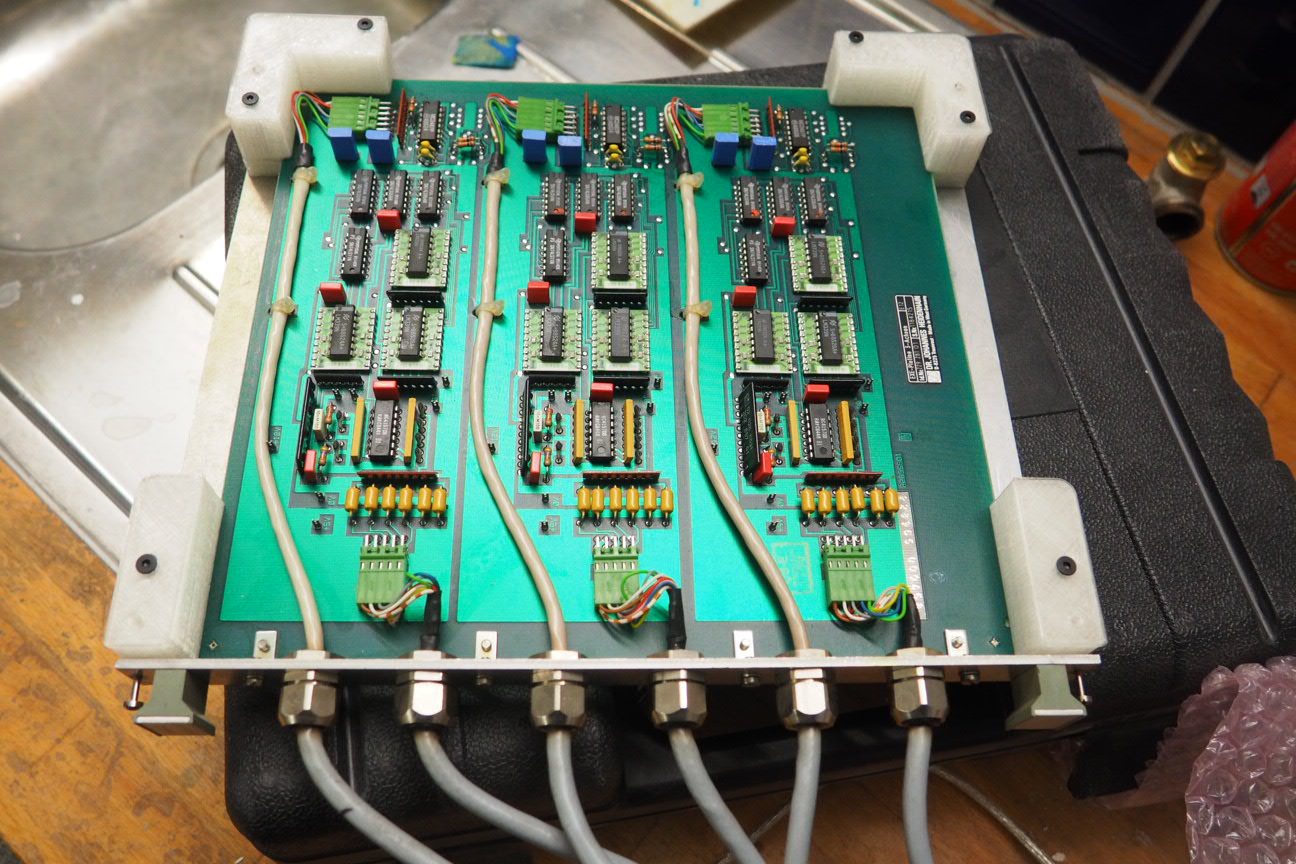
It is also hard wired with the matching connectors to the encoders, and with hard wired output cables to the Phillips. I made a metal shield (the grey square) for that EXE board and mounted it to the wall of the cabinet. You can see the encoder connectors on the floor of the control cabinet.
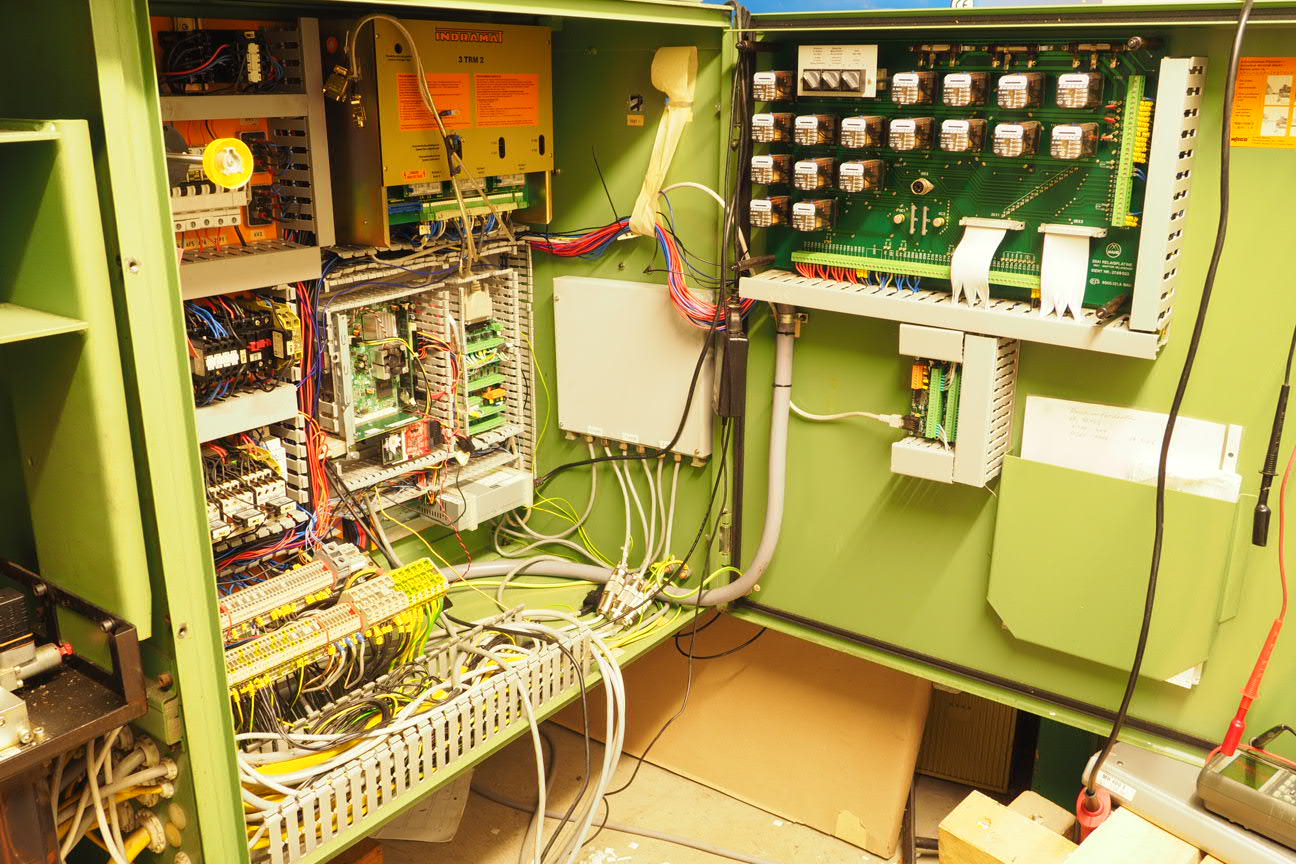
The only change I made was to cut off the Phillips dSub connectors, and terminate these wire into the MESA 7i77. Since the X axis encoder -> EXE -> Mesa signal path works perfectly, I have used that encoder to check the other two axis of the EXE, and they work.
Yesterday I pulled the sensing head from the Y axis.
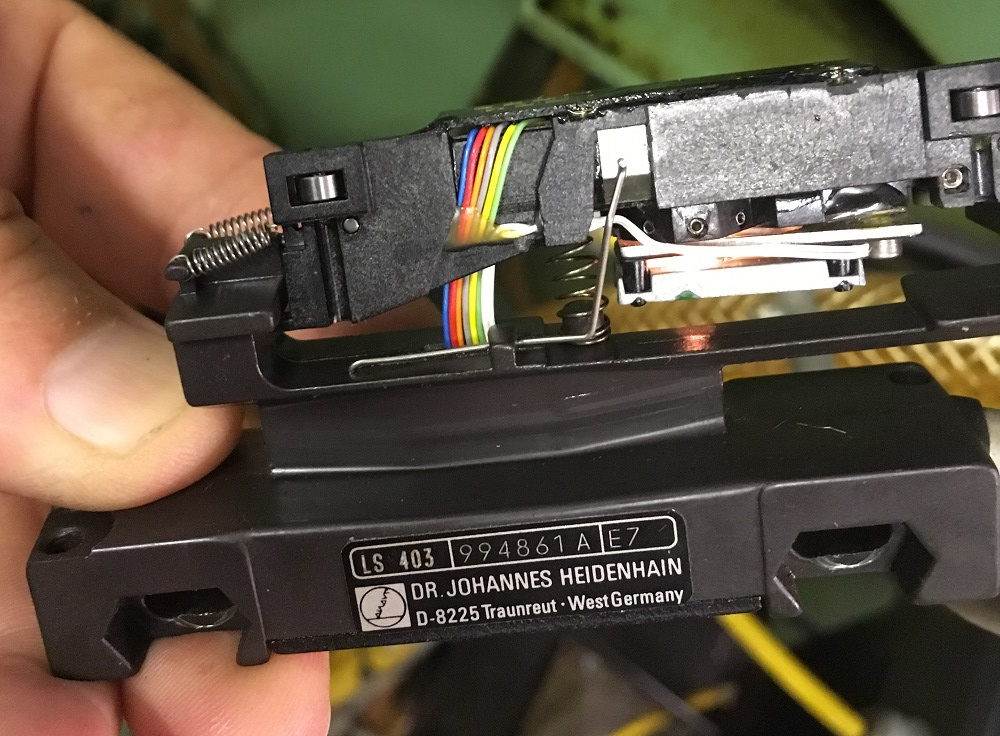
This is the axis which has a signal but is flakey. I cleaned the scale a few months ago and it started working normally, then got flakey again. As you can see it is not a bulb issue.
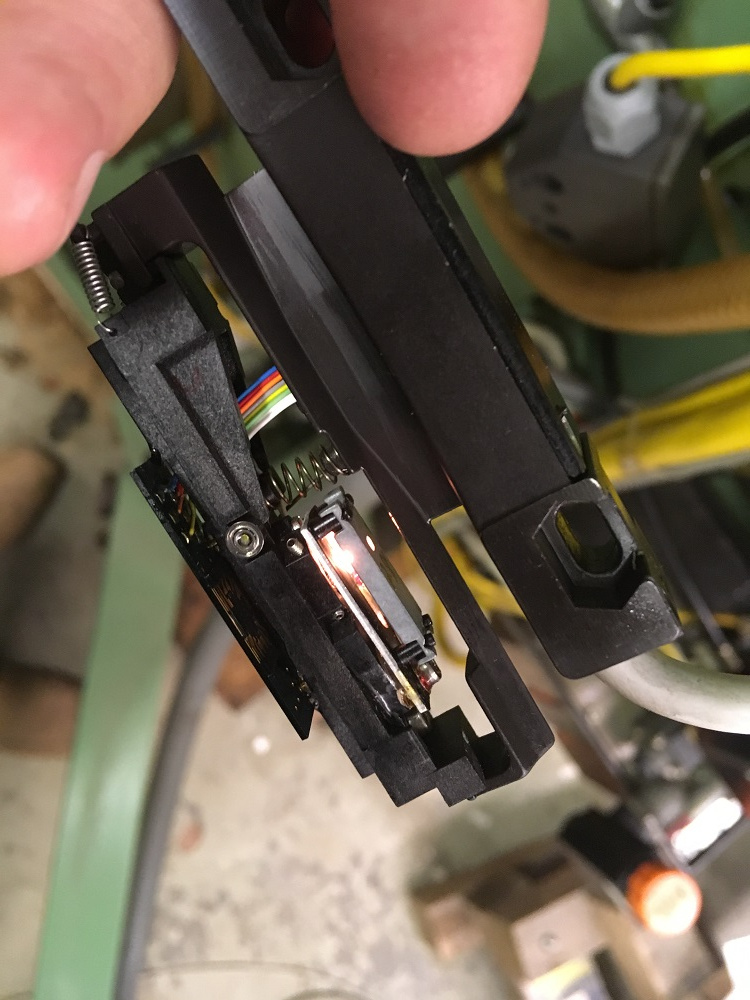
I'll reclean the scale, and this time also try to clean the condensor and sensor more thoroughly.
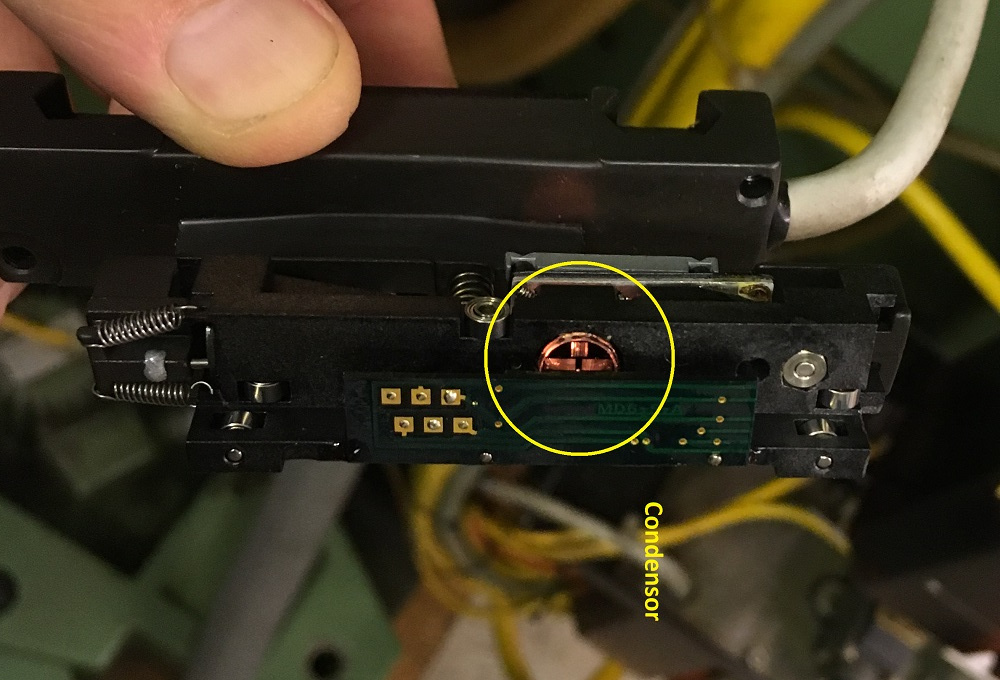
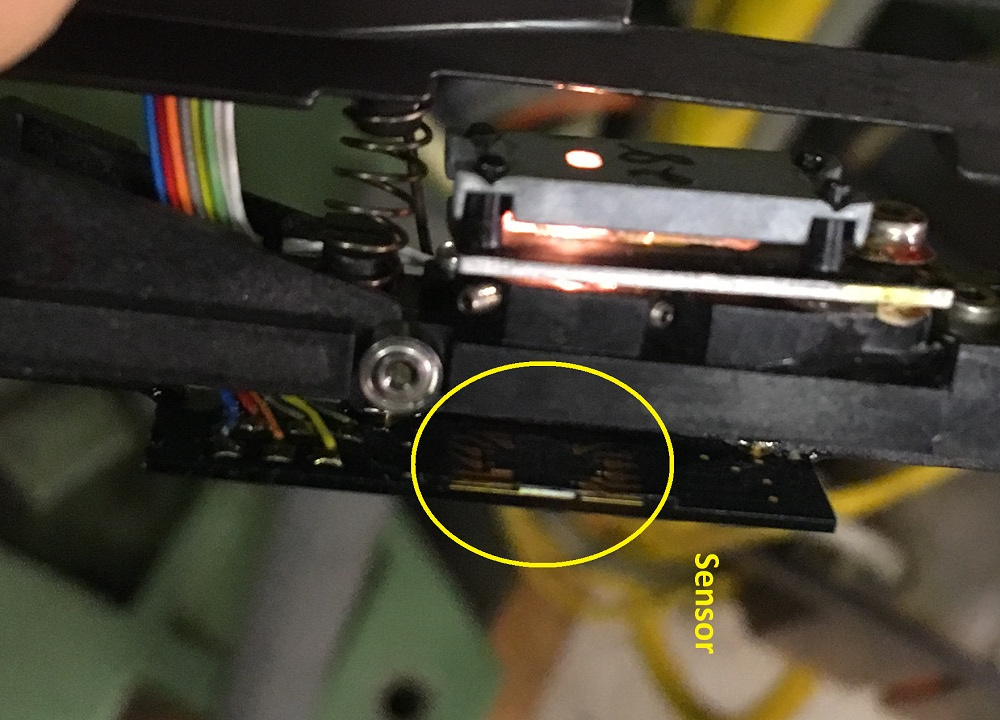
The solder joints of the wiring look fine.
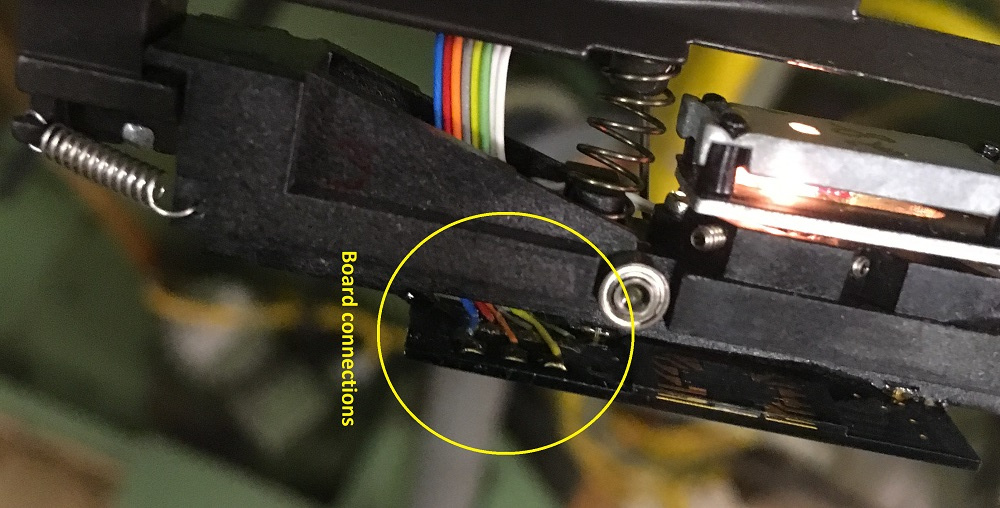
Good idea to look at cleaning the pins on the m23 connectors. They look spotless, but cleaning should remove a variable.
Mark
Yes my MH400E has the Heidenhain LS-403's. The cable is hard wired to the sensor head with about five meter cable to an M23 connector. I recycled the three axis EXE board from the Phillips control cabinet.
It is also hard wired with the matching connectors to the encoders, and with hard wired output cables to the Phillips. I made a metal shield (the grey square) for that EXE board and mounted it to the wall of the cabinet. You can see the encoder connectors on the floor of the control cabinet.
The only change I made was to cut off the Phillips dSub connectors, and terminate these wire into the MESA 7i77. Since the X axis encoder -> EXE -> Mesa signal path works perfectly, I have used that encoder to check the other two axis of the EXE, and they work.
Yesterday I pulled the sensing head from the Y axis.
This is the axis which has a signal but is flakey. I cleaned the scale a few months ago and it started working normally, then got flakey again. As you can see it is not a bulb issue.
I'll reclean the scale, and this time also try to clean the condensor and sensor more thoroughly.
The solder joints of the wiring look fine.
Good idea to look at cleaning the pins on the m23 connectors. They look spotless, but cleaning should remove a variable.
Mark
Last edit: 8 years 4 weeks ago by RotarySMP.
The following user(s) said Thank You: J Green
Please Log in or Create an account to join the conversation.
- andypugh
- Offline
- Moderator
-

Less
More
- Posts: 19899
- Thank you received: 4655
8 years 4 weeks ago #118337
by andypugh
PG = Panzergewinde = Stahlpanzerrohrgewinde = steel armoured conduit thread
en.wikipedia.org/wiki/Panzergewinde
It's an interesting thread in that it has an 80 degree thread angle, so has a relatively shallow depth for the pitch.
(I think the steepest full-thread is BA at 47.5 degrees. Proper threads are 55 degrees, of course
Replied by andypugh on topic Retrofitting a 1986 Maho MH400E
RotarySMP wrote: Sorry, I just realised I didn't get a full shot of that part number, but googling it reveals that PG29 is just a generic gland nut.
PG = Panzergewinde = Stahlpanzerrohrgewinde = steel armoured conduit thread
en.wikipedia.org/wiki/Panzergewinde
It's an interesting thread in that it has an 80 degree thread angle, so has a relatively shallow depth for the pitch.
(I think the steepest full-thread is BA at 47.5 degrees. Proper threads are 55 degrees, of course
The following user(s) said Thank You: J Green
Please Log in or Create an account to join the conversation.
Moderators: piasdom
Time to create page: 2.349 seconds