last video - I swear!

and on a more serious note..
So - as far as I can tell - the original control did 1/2 stepping up to about 19ipm - then full stepping from there to 30ipm. Now the lathe runs fine on full stepping from 0 to 40 (maybe 45)ipm. Half stepping only works well up to 20ipm-ish. (stalls above that)
But why stop there..
I started thinking about if linuxcnc could do that.... (without coding anything)
A couple advantages of halfstepping..
1 higher resolution 0.000273403/step vs 0.000546806 per step
2 reduced resonance.. (I have not run into this with full stepping on the lathe)
Then at normal cutting speeds - < 16ipm you get a higher resolution.
So why not have 2 stepgens running. One that half steps (type 9) with input scale of 3657.6073152 and the other full stepping (type 6) with a scale of 1828.8036576 (lathe calculation - metric screws)
Then switch between the two stepgens at a specific feed (I picked 16ipm with a hysteresis of 1ipm)
All I can say is - HAL IS AWESOME
I setup a Lut5 with Jeff E's help (thanks jeff!) that switches the printer port between the 2 stepgens.
A offset componant was used between the 2 stepgens to better align the phasing. (not tweeked 100% yet) but we jogged it around - could not tell that it was switching between the 2 stepgens and it always came back to 0.
there is a bit more than that.. (ddt for calculating the axis velocity, abs of that, comp w/hystorisis, and stuff I have forgotten already.)
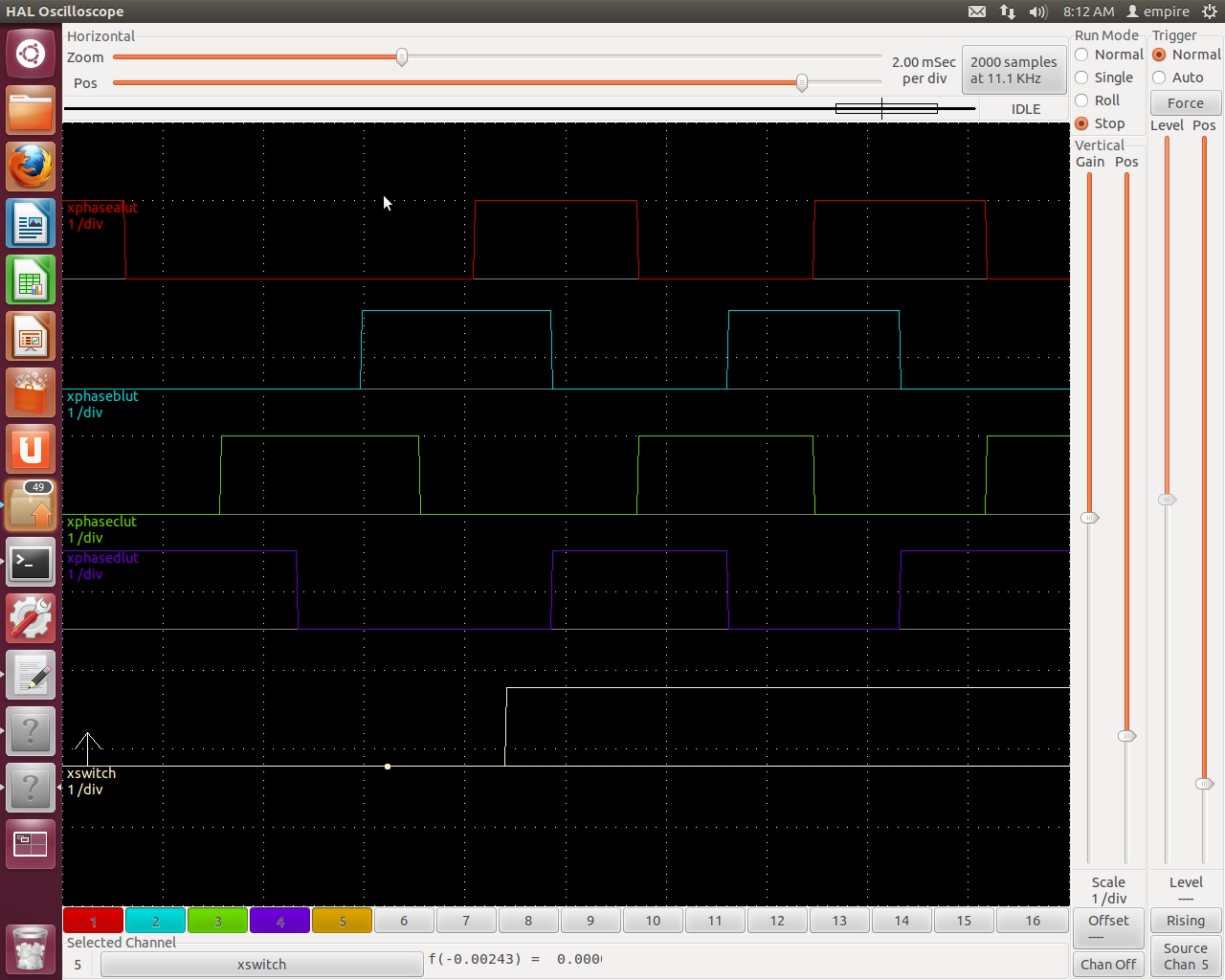
And here is a halscope capture. Left side is halfstepping - right side is full stepping. The trigger is the velocity threshold.
www.electronicsam.com/images/emco/Screenshot.png
I think the offset could be tweaked more scientifically to maybe get rid of the blip. But as it is running the 4 phases directly - it didn't seem to effect the motion.
here is the initial configs.
www.electronicsam.com/images/emco/linuxc...full-half_step_test/
again - jmk and everyone that has worked on hal - Very very awesome work!
sam