
- Posts: 459
- Thank you received: 158
LinuxCNC S-Curve Accelerations
- arvidb
- Offline
- Platinum Member
-

Less
More
5 years 4 months ago #211919
by arvidb
Did you download and compile/run the code that I've already published ? If not, that's a good place to start (for anyone who wants to help).
Replied by arvidb on topic LinuxCNC S-Curve Accelerations
Thanks!automata wrote: Hi arvidb,
Nice work with the jerk limited motion.
I am very much interested in helping out and have decent experience in the linuxcnc codebase.
Did you download and compile/run the code that I've already published ? If not, that's a good place to start (for anyone who wants to help).
Please Log in or Create an account to join the conversation.
- arvidb
- Offline
- Platinum Member
-
Less
More
- Posts: 459
- Thank you received: 158
5 years 4 months ago #211921
by arvidb
Replied by arvidb on topic LinuxCNC S-Curve Accelerations
Another step forward: I managed to implement that missing corner case yesterday. Here's an oscilloscope plot showing MPG jogging, where jerk limited planning might have its biggest impact:
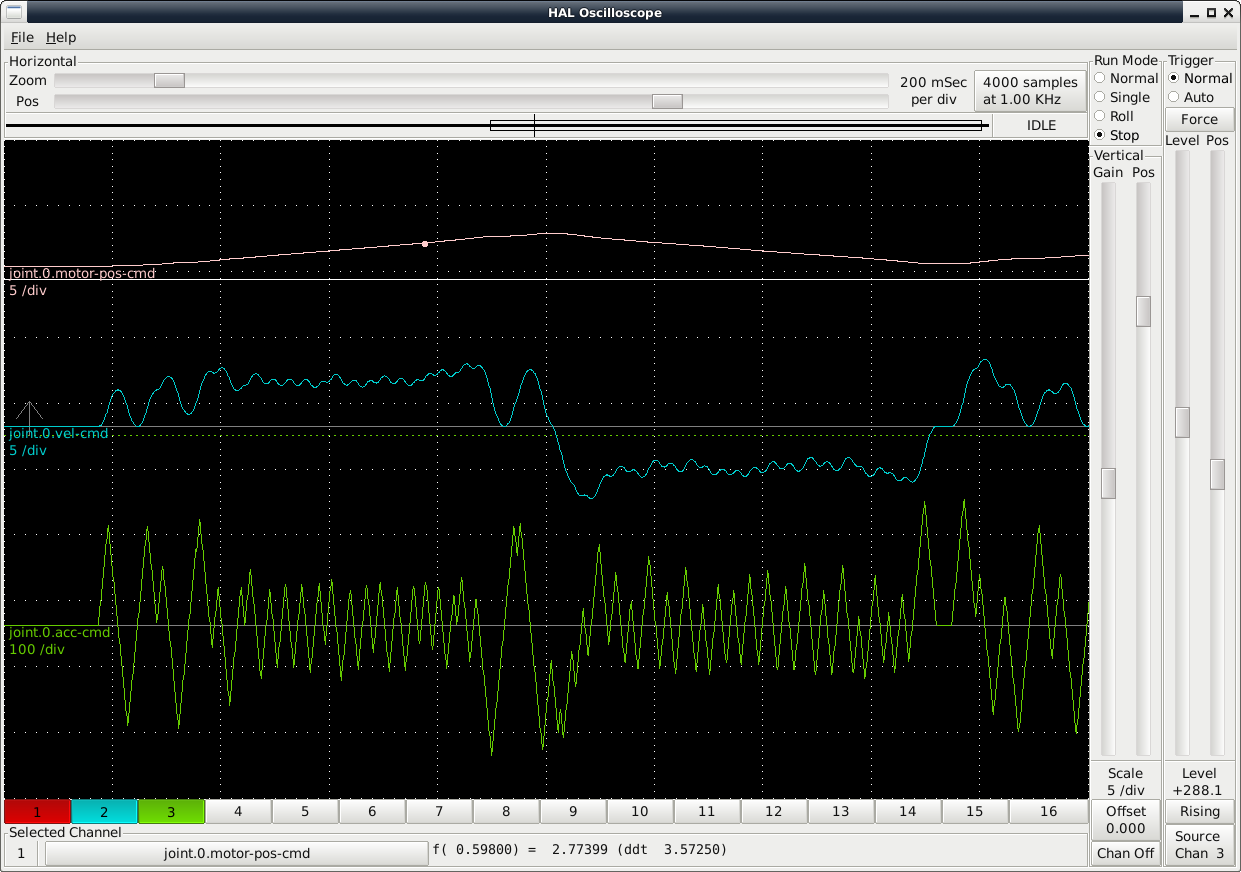
A bit more interesting than the last plot, don't you think?
There are still a few known bugs in the code, but it's nearing a state where testing might soon become meaningful!
A bit more interesting than the last plot, don't you think?
There are still a few known bugs in the code, but it's nearing a state where testing might soon become meaningful!
Please Log in or Create an account to join the conversation.
- arvidb
- Offline
- Platinum Member
-
Less
More
- Posts: 459
- Thank you received: 158
5 years 4 months ago - 5 years 4 months ago #211925
by arvidb
I think a great way to start would be to make your algorithm move a specified distance. Looking at your plot above, your algorithm moves from v = 0.0 to v = 1.0. Add a deceleration stage (from v = 1.0 to v = 0.0) and then scale peak velocity so that your algorithm ends up moving any distance that you specify as an input.
Then check that your peak velocity doesn't violate any "max velocity" (also specified as an input). If it does, insert a constant velocity segment.
Then make it work with initial velocity not zero.
And so on...
Replied by arvidb on topic LinuxCNC S-Curve Accelerations
Hi Christian!chris@cnc wrote: hello arvidb hello automata, i would also help as far as i can. My approach would be a 2nd acceleration time in the ini that defines the curve. So we can easily decide whether linear or in s-curve. And the curve defines, for example, the sigmoid function. Some servo manufacturers go this route and it works very well. I have no idea how to start this. what do you think of this idea?
Christian
I think a great way to start would be to make your algorithm move a specified distance. Looking at your plot above, your algorithm moves from v = 0.0 to v = 1.0. Add a deceleration stage (from v = 1.0 to v = 0.0) and then scale peak velocity so that your algorithm ends up moving any distance that you specify as an input.
Then check that your peak velocity doesn't violate any "max velocity" (also specified as an input). If it does, insert a constant velocity segment.
Then make it work with initial velocity not zero.
And so on...
Last edit: 5 years 4 months ago by arvidb.
The following user(s) said Thank You: chris@cnc
Please Log in or Create an account to join the conversation.
- chris@cnc
- Offline
- Platinum Member
-
Less
More
- Posts: 529
- Thank you received: 140
5 years 4 months ago #211954
by chris@cnc
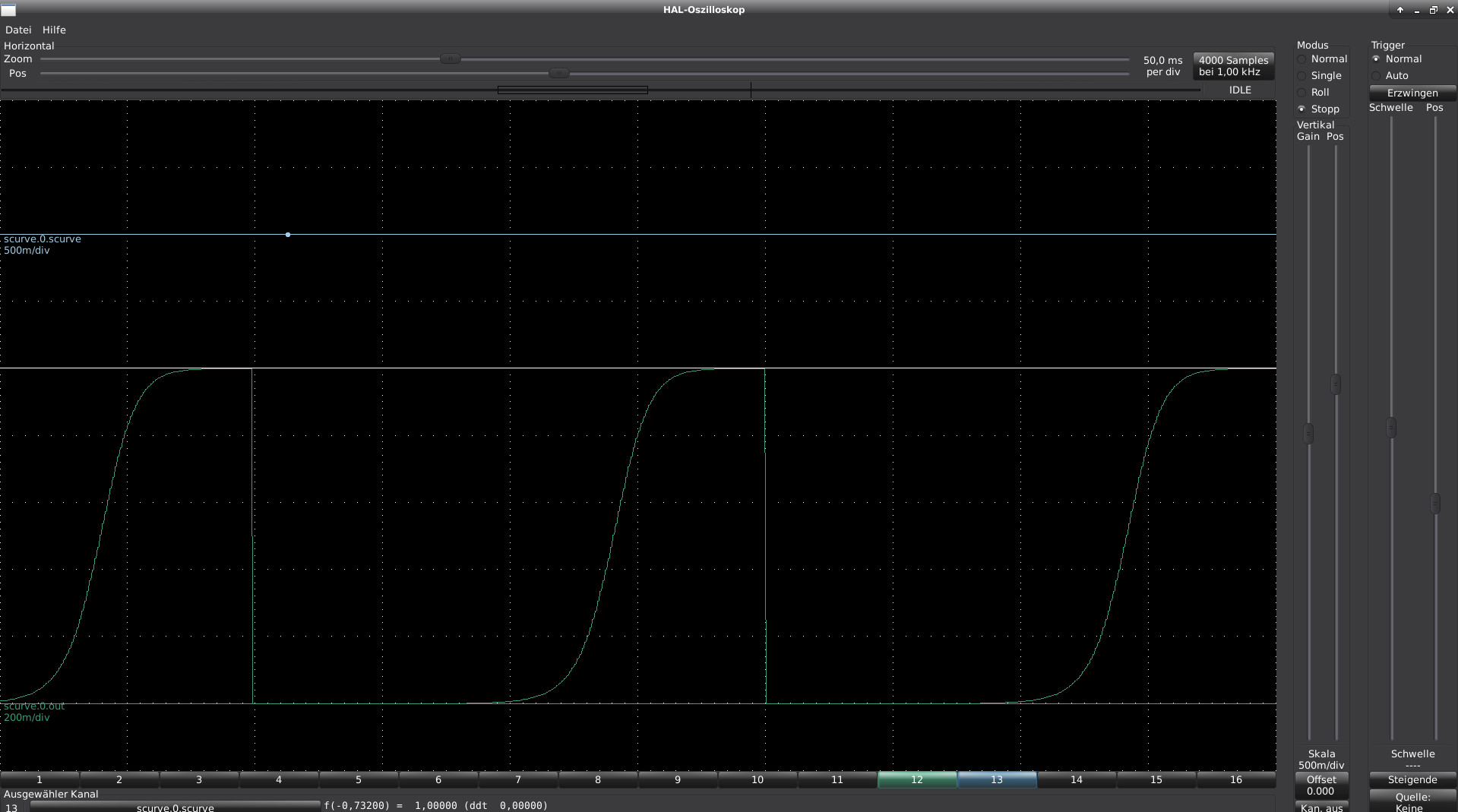
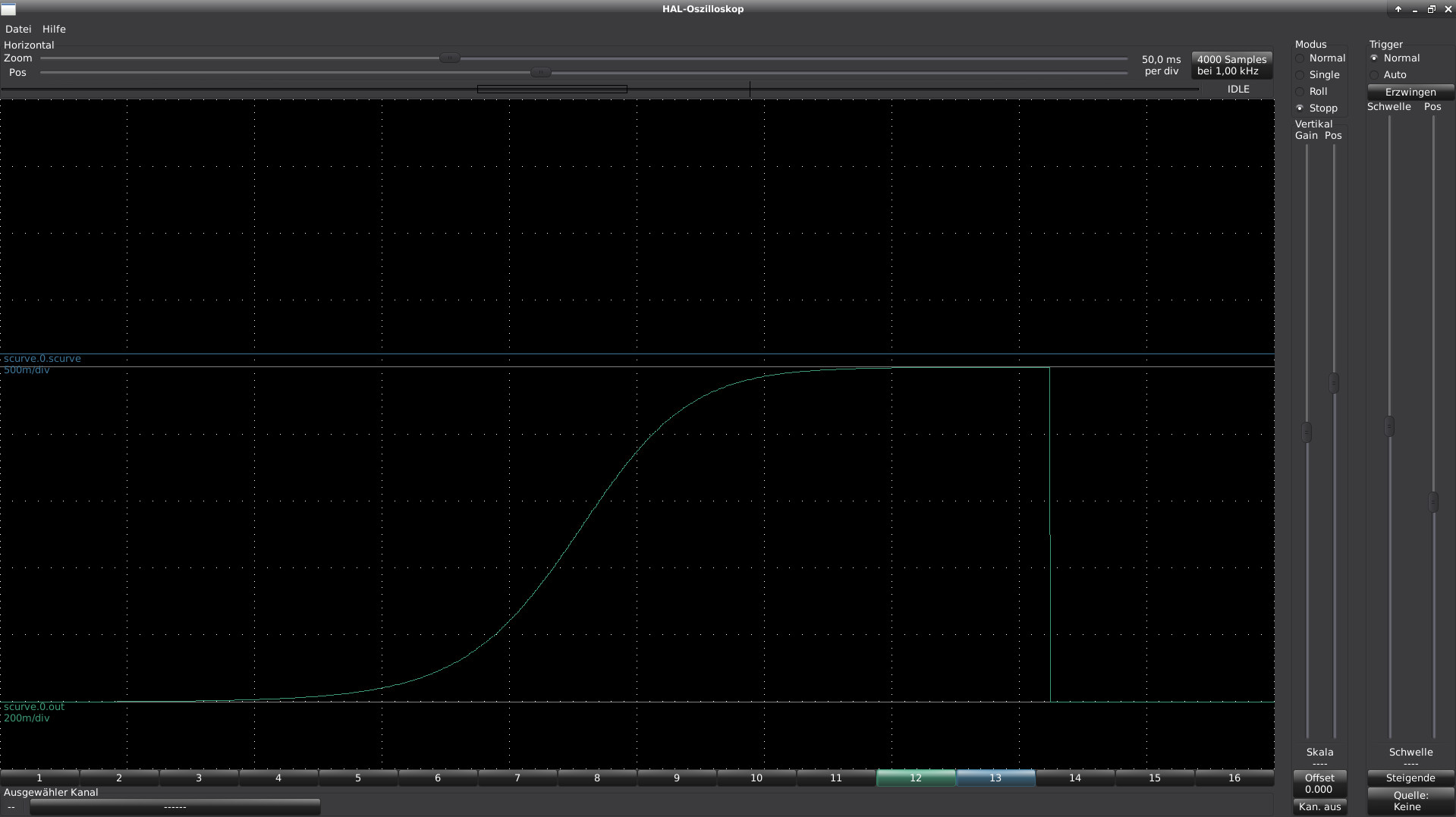
You're right. It's a good idea to climb down the hill. But i can't do it.I can't do two calculations in a row. I can now control the length of the curve using a pin. My programming skills are not enough. I should leave it to people who know what they're doing. Try and error no longer leads to the goal.
Maybe someone else can make something of it. I can not...
Replied by chris@cnc on topic LinuxCNC S-Curve Accelerations
Hi arvidb,arvidb wrote: . Add a deceleration stage (from v = 1.0 to v = 0.0) and then scale peak velocity so that your algorithm ends up moving any distance that you specify as an input.
You're right. It's a good idea to climb down the hill.
But i can't do it.I can't do two calculations in a row. I can now control the length of the curve using a pin. My programming skills are not enough. I should leave it to people who know what they're doing. Try and error no longer leads to the goal.Maybe someone else can make something of it. I can not...
Warning: Spoiler!
Code:
component scurve " ";
description
"""
/******* Description *****************
HAL componet to put out scurve gain
Input scurve timecycle
Output scurve
********* Compile **************
halcompile --compile scurve.comp
sudo halcompile --install scurve.comp
Halfile load :
loadrt scurve
addf scurve.0 servo-thread
setp scurve.0.scurve
setp scurve.0.in
*/
""";
license "GPL";
// Input pins
pin in float scurve=1; //Scurve length
pin in bit in=0;
// Output pins
pin out float out;
pin out float totalnsec;
//Global Variable
variable float counter=-10;
variable int stime=10;
function _;
;;
#include "rtapi_math.h"
FUNCTION(_) {
if(in && counter <= stime) {
totalnsec += fperiod;
counter += totalnsec * scurve;
out = 1 / ( 1+exp(-counter));
}
else {
out = 0;
counter = -10;
totalnsec = 0;
}
}
Please Log in or Create an account to join the conversation.
- rodw
- Offline
- Platinum Member
-
Less
More
- Posts: 12170
- Thank you received: 4153
5 years 4 months ago #211956
by rodw
Replied by rodw on topic LinuxCNC S-Curve Accelerations
Don't you just need to change the sign so values are negative to come back down? Could a direction pin to control that?
eg. Save the output first in an intermediate pin and then multiply by 1 or -1 before setting the out pin.
eg. Save the output first in an intermediate pin and then multiply by 1 or -1 before setting the out pin.
Please Log in or Create an account to join the conversation.
- chris@cnc
- Offline
- Platinum Member
-
Less
More
- Posts: 529
- Thank you received: 140
5 years 4 months ago #211957
by chris@cnc
Replied by chris@cnc on topic LinuxCNC S-Curve Accelerations
Hi Rod,
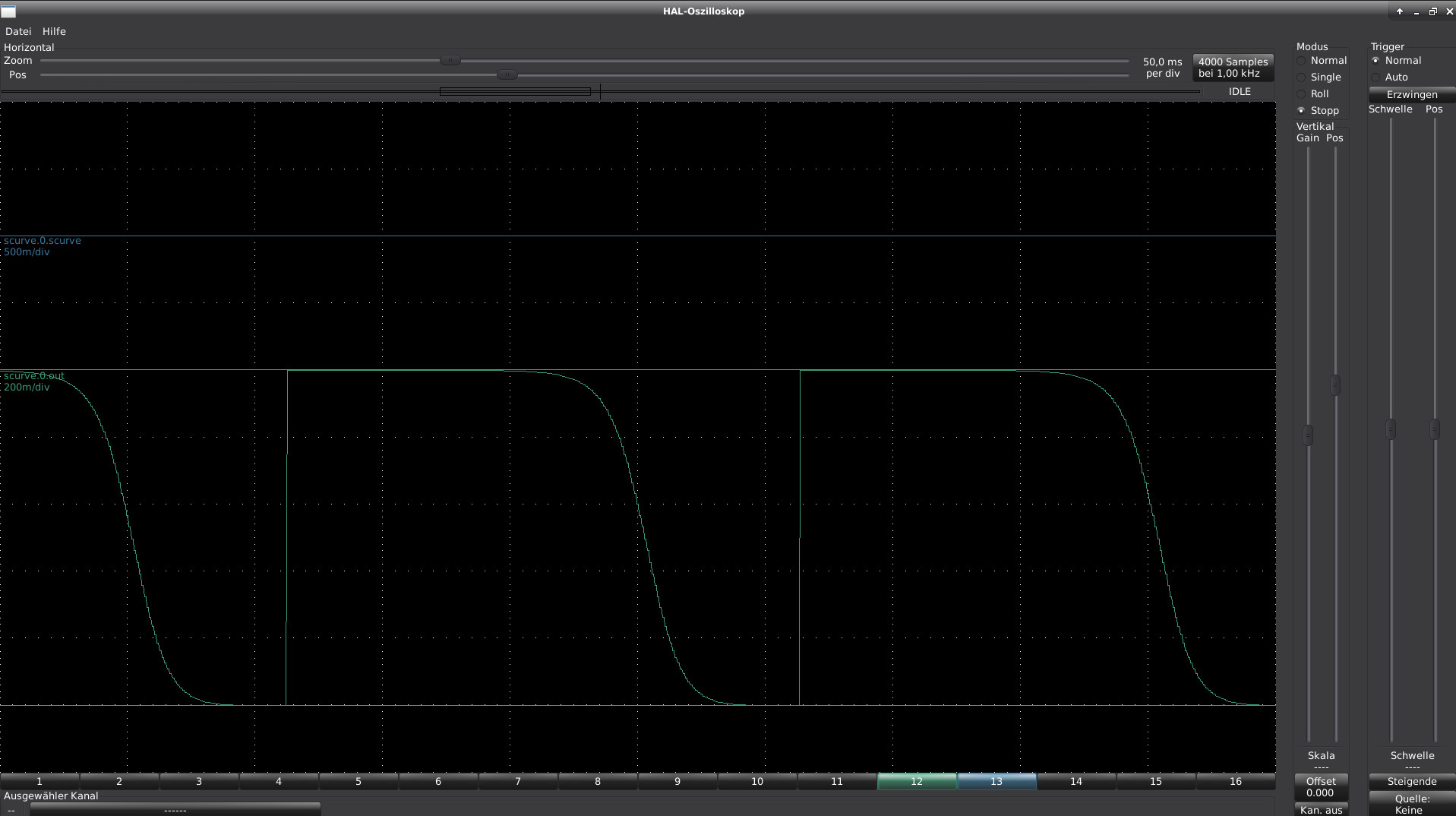
Yes the reverse calculation is "out = 1 / ( 1+exp(counter));" But i am not able to set it in loop. I try it now since 6h but it doesn't work...
Yes the reverse calculation is "out = 1 / ( 1+exp(counter));" But i am not able to set it in loop. I try it now since 6h but it doesn't work...
Please Log in or Create an account to join the conversation.
Time to create page: 5.990 seconds