
- Posts: 224
- Thank you received: 115
LinuxCNC S-Curve Accelerations
- Becksvill
- Offline
- Elite Member
-

Less
More
5 years 4 months ago #212013
by Becksvill
Replied by Becksvill on topic LinuxCNC S-Curve Accelerations
when your ready I have a 6 ton high speed cnc mill and can help out testing. really want to see jerk limited stuff come to linuxcnc!
The following user(s) said Thank You: arvidb
Please Log in or Create an account to join the conversation.
- chris@cnc
- Offline
- Platinum Member
-

Less
More
- Posts: 529
- Thank you received: 140
5 years 4 months ago #212022
by chris@cnc
Of course, modifying the LinuxCNC's motion planner is always the better solution. Practically an incredibly complex job outside of my mind. Well then I don't want to keep you from work any longer.
Replied by chris@cnc on topic LinuxCNC S-Curve Accelerations
Yes, the machine will no longer be precise. She will always be lagging behind. This type of acceleration is often used on toolchanger, tailstock or turretaxis. Everywhere there when the position does not have to be interpolated with a 2nd axis. Now if that is needed you can always install a servo that already has the function and do not have to make linuxcnc imprecise.arvidb wrote:
But if you modify the calculated acceleration, then you also modify the speed of the tool in each instant in time, and thereby also its position at that time. If you multiply the preset (constant) acceleration value of the linear planner with a value < 1.0, then you will need to accelerate for a longer time to reach the target velocity.
Of course, modifying the LinuxCNC's motion planner is always the better solution. Practically an incredibly complex job outside of my mind. Well then I don't want to keep you from work any longer.
Take a look in your servodriver manual. Maybe you find some acceleration parameter including s-curve, jerk limit, bell-shaped acceleration/deceleratio. Maybe it's enough for smooth operation.Becksvill wrote:when your ready I have a 6 ton high speed cnc mill and can help out testing. really want to see jerk limited stuff come to linuxcnc!
Please Log in or Create an account to join the conversation.
- arvidb
- Offline
- Platinum Member
-
Less
More
- Posts: 459
- Thank you received: 158
5 years 4 months ago #212023
by arvidb
Replied by arvidb on topic LinuxCNC S-Curve Accelerations
Hehe, maybe I'm a bit of a perfectionist?  (Yes I am...)
But even if you did modify only the acc-cmd, how would you use it to control your machine? If I'm not mistaken, pretty much all configs use the motor-pos-cmd as the setpoint for the PID controller (that then outputs a velocity command to +/-10 V outputs, or to stepgens). So you really do need to have the pos-cmd itself change in a way that doesn't lead to infinite jerk.
(Yes I am...)But even if you did modify only the acc-cmd, how would you use it to control your machine? If I'm not mistaken, pretty much all configs use the motor-pos-cmd as the setpoint for the PID controller (that then outputs a velocity command to +/-10 V outputs, or to stepgens). So you really do need to have the pos-cmd itself change in a way that doesn't lead to infinite jerk.
Please Log in or Create an account to join the conversation.
- Grotius
- Offline
- Platinum Member
-
Less
More
- Posts: 2419
- Thank you received: 2349
5 years 4 months ago - 5 years 4 months ago #212025
by Grotius
Replied by Grotius on topic LinuxCNC S-Curve Accelerations
Hi,
The problem of c coding or mathematical knowledge is solved.
Attached a component that uses a scurve header only library.
#include "scurve.h" to your component or c code or c++ code.
I think with this example users can retrieve all the info related to the scurve's acc, dcc, timestamp points, etc.
For interpolating on arc's just give the arclenght to the function. And then interpolate the result to the arc bow.
This can be done by % pathlenght interpolation.
The output is printed with rtapi into the terminal. This is done by setting the debug to 1.
The function call from the component, wich is a line (path) of 100mm :
Rtapi result :
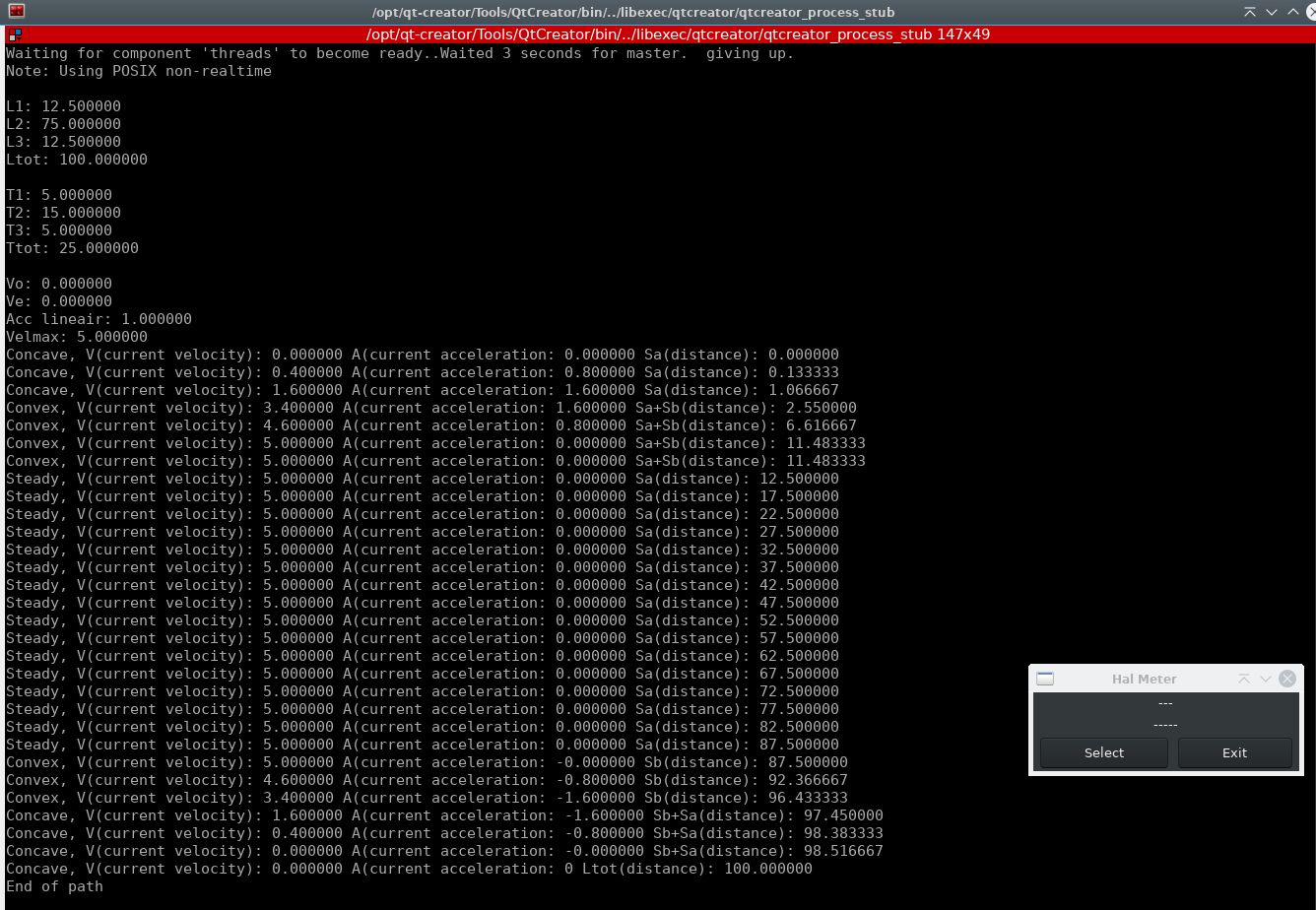
Now you can imagine what to do. Just play around with the code.
It has jerk, initial velocity and end velocity implemented. It has also a sampler if max velocity can not be reached.
Attached code is a "c kernel style" derivate from my original work at : github.com/grotius-cnc/S-curve-motion-pl...g/releases/tag/1.0.1
test.c
scurve.h
The problem of c coding or mathematical knowledge is solved.
Attached a component that uses a scurve header only library.
#include "scurve.h" to your component or c code or c++ code.
I think with this example users can retrieve all the info related to the scurve's acc, dcc, timestamp points, etc.
For interpolating on arc's just give the arclenght to the function. And then interpolate the result to the arc bow.
This can be done by % pathlenght interpolation.
The output is printed with rtapi into the terminal. This is done by setting the debug to 1.
The function call from the component, wich is a line (path) of 100mm :
Code:
scurve(5, // velmax
1, // accmax
0, // vo
0, // ve
0, // xs
0, // ys
0, // zs
100, // xe
0, // ye
0, // ze
1, // time output resolution in sec, for example 0.001 is a point every ms
1); // debug 0 or 1
Rtapi result :
Now you can imagine what to do. Just play around with the code.
It has jerk, initial velocity and end velocity implemented. It has also a sampler if max velocity can not be reached.
Attached code is a "c kernel style" derivate from my original work at : github.com/grotius-cnc/S-curve-motion-pl...g/releases/tag/1.0.1
test.c
Warning: Spoiler!
Code:
/* Autogenerated by /opt/linuxcnc/bin/halcompile on Sun Jun 13 16:30:04 2021 -- do not edit */
#include "rtapi.h"
#ifdef RTAPI
#include "rtapi_app.h"
#endif
#include "rtapi_string.h"
#include "rtapi_errno.h"
#include "hal.h"
#include "rtapi_math64.h"
#include "scurve.h"
static int comp_id;
#ifdef MODULE_INFO
MODULE_INFO(linuxcnc, "component:test:test component");
MODULE_INFO(linuxcnc, "descr:\nTest Component\n\nCompile slogan :\n/opt/linuxcnc/bin/halcompile --compile /opt/linuxcnc/src/hal/components/test.comp\n\nPreprocess slogan :\n/opt/linuxcnc/bin/halcompile --preprocess /opt/linuxcnc/src/hal/components/test.comp\n\nThen copy it to the rtlib.\n\nThen in halview : loadrt test\n\n");
MODULE_INFO(linuxcnc, "author:Skynet");
MODULE_INFO(linuxcnc, "license:GPLv2 or greater");
MODULE_INFO(linuxcnc, "pin:enable:bit:0:in::None:None");
MODULE_INFO(linuxcnc, "pin:value:float:0:out::None:None");
MODULE_INFO(linuxcnc, "funct:_:1:");
MODULE_LICENSE("GPLv2 or greater");
#endif // MODULE_INFO
struct __comp_state {
struct __comp_state *_next;
hal_bit_t *enable;
hal_float_t *value;
};
struct __comp_state *__comp_first_inst=0, *__comp_last_inst=0;
static void _(struct __comp_state *__comp_inst, long period);
static int __comp_get_data_size(void);
#undef TRUE
#define TRUE (1)
#undef FALSE
#define FALSE (0)
#undef true
#define true (1)
#undef false
#define false (0)
static int export(char *prefix, long extra_arg) {
char buf[HAL_NAME_LEN + 1];
int r = 0;
int sz = sizeof(struct __comp_state) + __comp_get_data_size();
struct __comp_state *inst = hal_malloc(sz);
memset(inst, 0, sz);
r = hal_pin_bit_newf(HAL_IN, &(inst->enable), comp_id,
"%s.enable", prefix);
if(r != 0) return r;
r = hal_pin_float_newf(HAL_OUT, &(inst->value), comp_id,
"%s.value", prefix);
if(r != 0) return r;
rtapi_snprintf(buf, sizeof(buf), "%s", prefix);
r = hal_export_funct(buf, (void(*)(void *inst, long))_, inst, 1, 0, comp_id);
if(r != 0) return r;
if(__comp_last_inst) __comp_last_inst->_next = inst;
__comp_last_inst = inst;
if(!__comp_first_inst) __comp_first_inst = inst;
return 0;
}
int rtapi_app_main(void) {
int r = 0;
comp_id = hal_init("test");
if(comp_id < 0) return comp_id;
r = export("test", 0);
if(r) {
hal_exit(comp_id);
} else {
hal_ready(comp_id);
}
return r;
}
void rtapi_app_exit(void) {
hal_exit(comp_id);
}
#undef FUNCTION
#define FUNCTION(name) static void name(struct __comp_state *__comp_inst, long period)
#undef EXTRA_SETUP
#define EXTRA_SETUP() static int extra_setup(struct __comp_state *__comp_inst, char *prefix, long extra_arg)
#undef EXTRA_CLEANUP
#define EXTRA_CLEANUP() static void extra_cleanup(void)
#undef fperiod
#define fperiod (period * 1e-9)
#undef enable
#define enable (0+*__comp_inst->enable)
#undef value
#define value (*__comp_inst->value)
#line 33 "/opt/linuxcnc/src/hal/components/test.comp"
#include "rtapi_math.h"
FUNCTION(_) {
if(enable){
}
if(value==0){
scurve(5, // velmax
1, // accmax
0, // vo
0, // ve
0, // xs
0, // ys
0, // zs
100, // xe
0, // ye
0, // ze
1, // time output resolution in sec, for example 0.001 is a point every ms
1); // debug 0 or 1
}
value=1;
}
static int __comp_get_data_size(void) { return 0; }
scurve.h
Warning: Spoiler!
Code:
#ifndef SCURVE_H
#define SCURVE_H
#include "rtapi.h" /* RTAPI realtime OS API */
#include "rtapi_app.h" /* RTAPI realtime module decls */
#include "math.h" /* Used for pow and sqrt */
// With qt always do a make clean before a compile.
// Example function:
void myfirstvoid(float a, float b, float *result);
void myfirstvoid(float a, float b, float *result){
*result=a+b;
}
// Data structures:
struct point {
double x,y,z;
};
struct line {
double xs,ys,zs; //startpos
double xe,ye,ze; //endpos
double lenght; //lenght of primitive.
};
struct traject {
double Vo; //start velocity
double Ve; //end velocity
double Vm; //max velocity if atspeed can not be reached
double Vel; //feedrate - velocity
double Acc_lineair; //lineair acceleration, mm/sec^2
double Acc_inflation; //max acceleration at inflection point, acc_lin*2, mm/sec^2
double T1; //total Acc time.
double T2; //total atspeed time.
double T3; //total Dcc time.
double Ttot; //total traject time, T1+T2+T3
double T1h; //total half Acc time, time to inflection point.
double T3h; //total half Dcc time, time to inflection point.
double L1; //acceleration lenght
double L2; //atspeed lenght.
double L3; //deacceleration lenght
double Ltot; //total traject lenght, L1+L2+L3
double Li; //line-line intersection x-value
double Jm; //max jerk for profile, x*acc_infl/T1 or T3
struct line line;
};
// Declarations:
// Driver:
void scurve(double velmax,
double accmax,
double vo,
double ve,
double xs, double ys, double zs, // Line startpoint
double xe, double ye, double ze, // Line endpoint
double timeresolution, // 0.001 for ms.
int debug ); // 0 or 1
struct traject TrajectCalculator(double Vel, double Acc, double Vo, double Ve, struct line line, int debug); // First calculate classical lineair way
struct traject ScurveUp(struct traject tr, double timeresolution, int debug);
struct traject ScurveSteady(struct traject tr, double timeresolution, int debug);
struct traject ScurveDown(struct traject tr, double timeresolution, int debug);
// Functions:
void scurve(double velmax, double accmax, double vo, double ve, double xs, double ys, double zs, double xe, double ye, double ze, double timeresolution, int debug){
struct line line;
line.xs=xs; line.ys=ys; line.zs=zs;
line.xe=xe; line.ye=ye; line.ze=ze;
struct traject traject;
// Add traject properties and calculate traject interval
traject = TrajectCalculator(velmax,
accmax,
vo,
ve,
line,
debug); // debug 0 or 1
// Calculate Scurve
ScurveUp(traject, timeresolution, debug);
ScurveSteady(traject, timeresolution, debug);
ScurveDown(traject, timeresolution, debug);
}
struct traject TrajectCalculator(double Vel, double Acc, double Vo, double Ve, struct line line, int debug){
struct traject tr;
// Data.
tr.Vel=Vel;
tr.Vo=Vo;
tr.Ve=Ve;
tr.Acc_lineair=Acc;
// Formula.
tr.Acc_inflation=tr.Acc_lineair*2; // Acceleration at s-curve inflation point = normal acceleration*2.
tr.Ltot=sqrt(pow(line.xe-line.xs,2)+pow(line.ye-line.ys,2)+pow(line.ze-line.zs,2));
tr.line.lenght=tr.Ltot; // Copy above lenght value.
// Acc path.
tr.T1=(tr.Vel-tr.Vo)/tr.Acc_lineair;
tr.L1=0.5*tr.Acc_lineair*pow(tr.T1,2);
// Dcc path.
tr.T3=(tr.Vel-tr.Ve)/tr.Acc_lineair; // We could use a seperate dcc value.
tr.L3=0.5*tr.Acc_lineair*pow(tr.T3,2);
// At speed path.
tr.L2=tr.Ltot-tr.L1-tr.L3;
tr.T2=tr.L2/tr.Vel;
// Motion can not reach full speed, find acc dcc intersection.
if(tr.L2<0){
// Decrease Velocity until L2 is positive, if Acceleration stays the same value.
double TempVel=tr.Vel;
for(double i=TempVel; i>0; i-=0.1){
tr.Vel=i;
//std::cout<<"Vel:"<<tr.Vel<<std::endl;
// Acc path.
tr.T1=(tr.Vel-tr.Vo)/tr.Acc_lineair;
tr.L1=0.5*tr.Acc_lineair*pow(tr.T1,2);
// Dcc path.
tr.T3=(tr.Vel-tr.Ve)/tr.Acc_lineair; // We could use a seperate dcc value.
tr.L3=0.5*tr.Acc_lineair*pow(tr.T3,2);
// At speed path.
tr.L2=tr.Ltot-tr.L1-tr.L3;
tr.T2=tr.L2/tr.Vel;
if(tr.L2>=0){
//ui->doubleSpinBox_velocity_max->setValue(i);
break;
}
}
}
tr.Ttot=tr.T1+tr.T2+tr.T3;
tr.T1h=tr.T1/2;
tr.T3h=tr.T3/2;
if(debug){
rtapi_print_msg(RTAPI_MSG_INFO,"TRAJECT CALCULATOR \n");
rtapi_print_msg(RTAPI_MSG_ERR,"L1: %f \n", tr.L1);
rtapi_print_msg(RTAPI_MSG_ERR,"L2: %f \n", tr.L2);
rtapi_print_msg(RTAPI_MSG_ERR,"L3: %f \n", tr.L3);
rtapi_print_msg(RTAPI_MSG_ERR,"Ltot: %f \n", tr.Ltot);
rtapi_print_msg(RTAPI_MSG_ERR,"\n");
rtapi_print_msg(RTAPI_MSG_ERR,"T1: %f \n", tr.T1);
rtapi_print_msg(RTAPI_MSG_ERR,"T2: %f \n", tr.T2);
rtapi_print_msg(RTAPI_MSG_ERR,"T3: %f \n", tr.T3);
rtapi_print_msg(RTAPI_MSG_ERR,"Ttot: %f \n", tr.Ttot);
rtapi_print_msg(RTAPI_MSG_ERR,"\n");
rtapi_print_msg(RTAPI_MSG_ERR,"Vo: %f \n", tr.Vo);
rtapi_print_msg(RTAPI_MSG_ERR,"Ve: %f \n", tr.Ve);
rtapi_print_msg(RTAPI_MSG_ERR,"Acc lineair: %f \n", tr.Acc_lineair);
rtapi_print_msg(RTAPI_MSG_ERR,"Velmax: %f \n", tr.Vel);
}
return tr;
}
struct traject ScurveUp(struct traject tr, double timeresolution, int debug){
double A=0; // Current acceleration.
double V=0; // Current velocity.
double t=0; // Time.
double Jm=0; // Max Jerk for profile, 2*Ainfl/T <= Jm.
double Sa=0; // Concave distance.
double Sb=0; // Convex distance.
for(double T=0; T<=tr.T1; T+=timeresolution){
Jm = 2*tr.Acc_inflation/tr.T1;
if(T<(tr.T1/2)){
t=T;
V = Jm*(t*t)/2;
V+=tr.Vo; // Add initial velocity.
A = Jm*t;
Sa = 0*t + Jm*(t*t*t)/6;
struct point p;
p.x=tr.line.xs+((tr.line.xe-tr.line.xs)*(Sa/tr.line.lenght));
p.y=tr.line.ys+((tr.line.ye-tr.line.ys)*(Sa/tr.line.lenght));
p.z=tr.line.zs+((tr.line.ze-tr.line.zs)*(Sa/tr.line.lenght));
//pointvec.push_back(p); // Store the path point every 1ms, t=0.001
if(debug){
rtapi_print_msg(RTAPI_MSG_ERR,"Concave, V(current velocity): %f A(current acceleration: %f Sa(distance): %f \n", V, A, Sa);
}
}
if(T>(tr.T1/2) && T<=(tr.T1)){
t=tr.T1h-(T-(0.5*tr.T1)); // T inverted
V = Jm*(t*t)/2;
V = tr.Vel-V; // Mirror
A = Jm*t;
t=T-(0.5*tr.T1); // T non inverted
Sb = Jm*(tr.T1h*tr.T1h)/2*t + tr.Acc_inflation*(t*t)/2 -Jm*(t*t*t)/6;
struct point p;
p.x=tr.line.xs+((tr.line.xe-tr.line.xs)*((Sa+Sb)/tr.line.lenght));
p.y=tr.line.ys+((tr.line.ye-tr.line.ys)*((Sa+Sb)/tr.line.lenght));
p.z=tr.line.zs+((tr.line.ze-tr.line.zs)*((Sa+Sb)/tr.line.lenght));
//pointvec.push_back(p); // Store the path point every 1ms, t=0.001
if(debug){
rtapi_print_msg(RTAPI_MSG_ERR,"Convex, V(current velocity): %f A(current acceleration: %f Sa+Sb(distance): %f \n", V, A, Sa+Sb);
}
}
}
struct point p;
p.x=tr.line.xs+((tr.line.xe-tr.line.xs)*((Sa+Sb)/tr.line.lenght));
p.y=0;
p.z=0;
//pointvec.push_back(p); // Store the path point every 1ms, t=0.001
if(debug){
rtapi_print_msg(RTAPI_MSG_ERR,"Convex, V(current velocity): %f A(current acceleration: %f Sa+Sb(distance): %f \n", V, A, Sa+Sb);
}
return tr;
}
struct traject ScurveSteady(struct traject tr, double timeresolution, int debug){
double A=0; // Current acceleration.
double V=0; // Current velocity.
double S=0; // S(t) distance.
for(double T=tr.T1; T<=tr.T1+tr.T2; T+=timeresolution){
V=tr.Vel;
A=0;
//S=(tr.Vel*T)-tr.L1;
S=tr.L1+((T-tr.T1)*tr.Vel);
// Todo=Sa/tr.Ltot; // Point on path ratio.
struct point p;
p.x=tr.line.xs+((tr.line.xe-tr.line.xs)*(S/tr.line.lenght));
p.y=tr.line.ys+((tr.line.ye-tr.line.ys)*(S/tr.line.lenght));
p.z=tr.line.zs+((tr.line.ze-tr.line.zs)*(S/tr.line.lenght));
//pointvec.push_back(p); // Store the path point every 1ms, t=0.001
if(debug){
rtapi_print_msg(RTAPI_MSG_ERR,"Steady, V(current velocity): %f A(current acceleration: %f Sa(distance): %f \n", V, A, S);
}
}
return tr;
}
struct traject ScurveDown(struct traject tr, double timeresolution, int debug){
double A=0; // Current acceleration.
double V=0; // Current velocity.
double t=0; // Time.
double Jm=0; // Max Jerk for profile, 2*Ainfl/T <= Jm.
double Sa=0; // Concave distance.
double Sb=0; // Convex distance.
for(double T=tr.T1+tr.T2; T<=tr.Ttot; T+=timeresolution){
Jm = 2*tr.Acc_inflation/tr.T3;
if(T<(tr.T1+tr.T2+tr.T3h)){
t=T-tr.T1-tr.T2;
V = Jm*(t*t)/2;
V = tr.Vel-V; // Mirror
A = -fabs(Jm*t);
t=tr.T3h;
double Sbmax=Jm*(tr.T3h*tr.T3h)/2*t + tr.Acc_inflation*(t*t)/2 -Jm*(t*t*t)/6;
t=T-tr.T1-tr.T2;
t=tr.T3h-t;
Sb = Sbmax-( Jm*(tr.T3h*tr.T3h)/2*t + tr.Acc_inflation*(t*t)/2 -Jm*(t*t*t)/6 );
Sb+= tr.L1+tr.L2;
struct point p;
p.x=tr.line.xs+((tr.line.xe-tr.line.xs)*(Sb/tr.line.lenght));
p.y=tr.line.ys+((tr.line.ye-tr.line.ys)*(Sb/tr.line.lenght));
p.z=tr.line.zs+((tr.line.ze-tr.line.zs)*(Sb/tr.line.lenght));
//pointvec.push_back(p); // Store the path point every 1ms, t=0.001
if(debug){
rtapi_print_msg(RTAPI_MSG_ERR,"Convex, V(current velocity): %f A(current acceleration: %f Sb(distance): %f \n", V, A, Sb);
}
}
if(T>tr.T1+tr.T2+tr.T3h){
t=T-tr.T1-tr.T2-tr.T3h;
t=tr.T3h-t;
V = Jm*(t*t)/2;
V+=tr.Ve;
A = -fabs(Jm*t);
t=tr.T3h;
double SaMax = 0*t + Jm*(t*t*t)/6;
t=T-tr.T1-tr.T2-tr.T3h;
t=tr.T3h-t; // Mirror
Sa = SaMax-( 0*t + Jm*(t*t*t)/6);
struct point p;
p.x=tr.line.xs+((tr.line.xe-tr.line.xs)*((Sb+Sa)/tr.line.lenght));
p.y=tr.line.ys+((tr.line.ye-tr.line.ys)*((Sb+Sa)/tr.line.lenght));
p.z=tr.line.zs+((tr.line.ze-tr.line.zs)*((Sb+Sa)/tr.line.lenght));
//pointvec.push_back(p); // Store the path point every 1ms, t=0.001
if(debug){
rtapi_print_msg(RTAPI_MSG_ERR,"Concave, V(current velocity): %f A(current acceleration: %f Sb+Sa(distance): %f \n", V, A, Sb+Sa);
}
}
}
//std::cout << "Convex V:"<<tr.Vel<< " A:"<<0<<" S:"<<Sa+Sb<<std::endl;
if(debug){
rtapi_print_msg(RTAPI_MSG_ERR,"Concave, V(current velocity): %f A(current acceleration: 0 Ltot(distance): %f \n", V, tr.Ltot); // Just to end.
rtapi_print_msg(RTAPI_MSG_ERR,"End of path\n");
}
return tr;
}
#endif // SCURVE_H
Last edit: 5 years 4 months ago by Grotius.
The following user(s) said Thank You: rodw
Please Log in or Create an account to join the conversation.
- arvidb
- Offline
- Platinum Member
-
Less
More
- Posts: 459
- Thank you received: 158
5 years 4 months ago #212027
by arvidb
Sa = Jm*(t*t*t)/6 + tr.Vo*t.
This is probably the same bug that I reported here (and that you never replied to)? From the plots in that post you seem to have a similar problem with end velocity.
Replied by arvidb on topic LinuxCNC S-Curve Accelerations
You are ignoring initial velocity here, in the calculation for distance (Sa).Grotius wrote:
Code:V = Jm*(t*t)/2; V+=tr.Vo; // Add initial velocity. A = Jm*t; Sa = 0*t + Jm*(t*t*t)/6;
Sa = Jm*(t*t*t)/6 + tr.Vo*t.
This is probably the same bug that I reported here (and that you never replied to)? From the plots in that post you seem to have a similar problem with end velocity.
The following user(s) said Thank You: Grotius
Please Log in or Create an account to join the conversation.
- Grotius
- Offline
- Platinum Member
-
Less
More
- Posts: 2419
- Thank you received: 2349
5 years 4 months ago - 5 years 4 months ago #212031
by Grotius
Replied by Grotius on topic LinuxCNC S-Curve Accelerations
Hi Arvidb,
Thank you for your reply.
I think you have to look at "V+=Traject.initialVelocity"
The plotted graph's at github show everything is printed ok when using vo and ve parameters.
If they where not ok. I would have seen that.
I spotted and repaired a rtapi print output with empty value's when T1, T2, T3 are 0.
Now it print's only when T1>0 , T2>0, T3>0.
Initial velocity and end velocity are just working. It was printing a empty value at line 0 of the rtapi print output.
So it was looking like a bug.
Here a function input as :
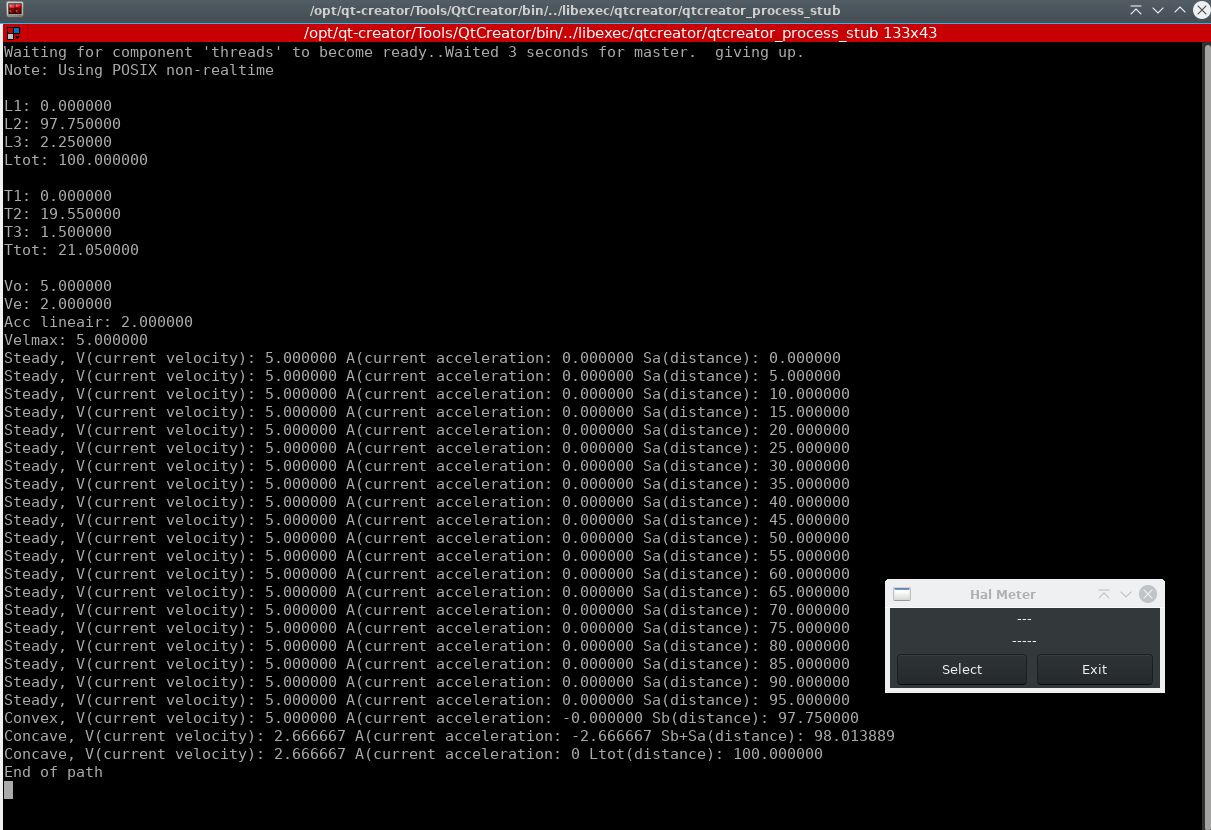
Mention the output resolution is quite low at a 1 sec interval.
Thank you for your reply.
I think you have to look at "V+=Traject.initialVelocity"
The plotted graph's at github show everything is printed ok when using vo and ve parameters.
If they where not ok. I would have seen that.
I spotted and repaired a rtapi print output with empty value's when T1, T2, T3 are 0.
Now it print's only when T1>0 , T2>0, T3>0.
Initial velocity and end velocity are just working. It was printing a empty value at line 0 of the rtapi print output.
So it was looking like a bug.
Here a function input as :
Code:
scurve(5, // velmax
2, // accmax
5, // vo
2, // ve
0, // xs
0, // ys
0, // zs
100, // xe
0, // ye
0, // ze
1, // time output resolution in sec, for example 0.001 is a point every ms
1); // debug 0 or 1
Mention the output resolution is quite low at a 1 sec interval.
Last edit: 5 years 4 months ago by Grotius.
Please Log in or Create an account to join the conversation.
Time to create page: 5.129 seconds