Advanced Search

Search Results (Searched for: )

  • partec
  • partec
09 Dec 2024 11:12
Replied by partec on topic camera resolution doesn' fit

camera resolution doesn' fit

Category: Qtvcp
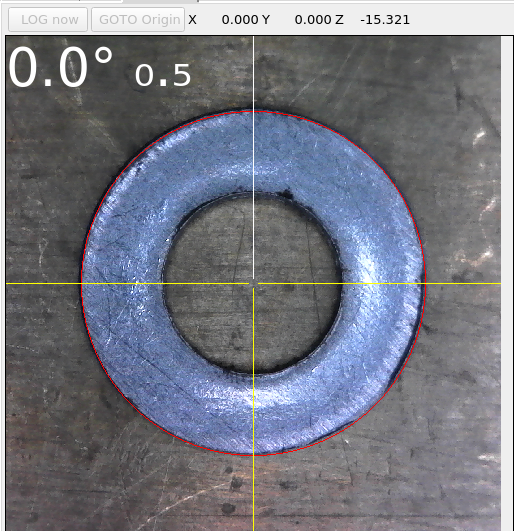
 

substituted with cam_align.ui and cam_align_handler.py from github source shows nicely that the correction works perfectly

thank you, Chris
 
  • my1987toyota
  • my1987toyota's Avatar
09 Dec 2024 10:49
FreeCAD 1.0 Who's using it? was created by my1987toyota

FreeCAD 1.0 Who's using it?

Category: CAD CAM

So not that long ago FreeCAD V0.22 AKA V1.0 was released.as the stable version. I have been using Autodesk Fusion 360.
for years now and for the most part it works fine. That said with Windows 10 being EOL this coming October and Fusion 360
not officially released for Linux ( plus all the B.S. with Win.11 NO THANK YOU! )  I started fumbling my way around FreeCAD.
I have played with the program in the past V0.19, V0.20, V0.21 but no real motivation to truly learn it. Going from one to the
other definitely has a learning curve. How about everyone else what has been your experience using the new FreeCAD?
  • vibram
  • vibram
09 Dec 2024 09:36 - 09 Dec 2024 09:36
Replied by vibram on topic Ethercat-conf.xml with beckhoff el1008

Ethercat-conf.xml with beckhoff el1008

Category: EtherCAT
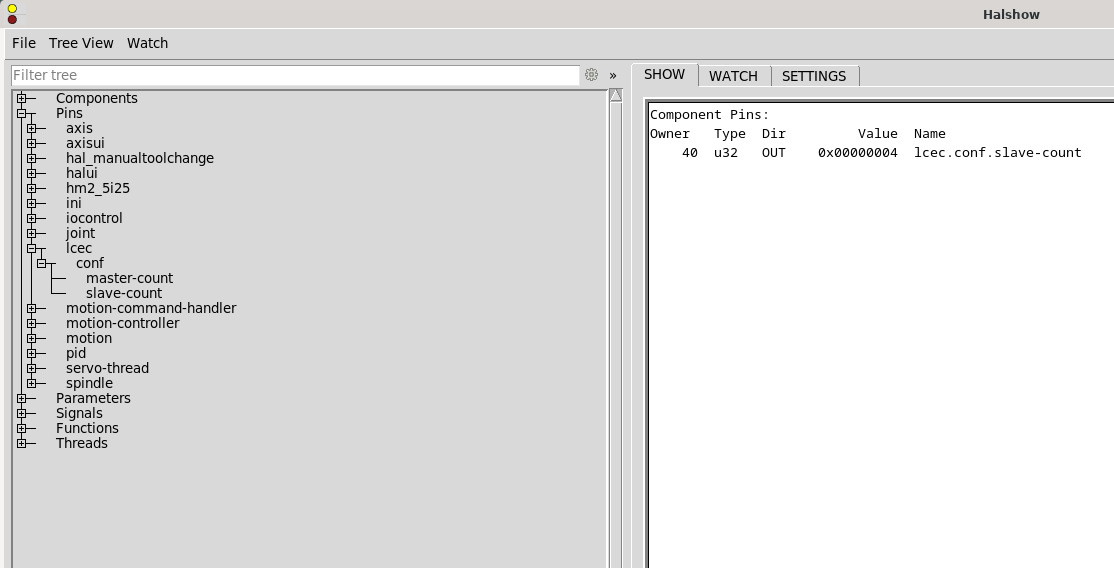
Thank you for your reply. Then I should have an issue with my config I guess

here is my result of ethercat slaves:

0 0:0 PREOP + EK1100 EtherCAT-Koppler (2A E-Bus)
1 0:1 PREOP + EL2008 8K. Dig. Ausgang 24V, 0.5A
2 0:2 PREOP + EL1008 8K. Dig. Eingang 24V, 3ms
3 0:3 PREOP + EL1018 8K. Dig. Eingang 24V, 10�s


my xml file is attached

and a print screen of what I have in Hal show. My pins are not visible
 
  • abdulasis12
  • abdulasis12
09 Dec 2024 08:55

Feedback control XY not full speed run G1 when curve or Arc

Category: General LinuxCNC Questions

Hi Tommy
This is my ini file .

File Attachment:

File Name: 217-4x_2024-12-09.ini
File Size:9 KB
  • meister
  • meister
09 Dec 2024 08:41

LinuxCNC-RIO - RealtimeIO for LinuxCNC based on FPGA (ICE40 / ECP5)

Category: Computers and Hardware

i have removed the IO_TYPE from the cst pinfile generation,
you need to checkout the newest dev branch and generate the files new
  • MirkoCNC
  • MirkoCNC
09 Dec 2024 08:23

LinuxCNC-RIO - RealtimeIO for LinuxCNC based on FPGA (ICE40 / ECP5)

Category: Computers and Hardware

Ups, I have just seen the correct IO standard can be configured /edit in the plugin of the blink module in the riocore software. Hence, it is not necessary to do it manually in the pins.cst file.
  • partec
  • partec
09 Dec 2024 08:18 - 09 Dec 2024 10:46
Replied by partec on topic camera resolution doesn' fit

camera resolution doesn' fit

Category: Qtvcp

have tried to get linuxcnc from buildbot 
... any such change will see no buildbot to help, or that help is delayed ... 
so I have to build LinuxCNC from source


qtvcp_panel_preferences already work perfectly here 

 
  • MirkoCNC
  • MirkoCNC
09 Dec 2024 08:16

LinuxCNC-RIO - RealtimeIO for LinuxCNC based on FPGA (ICE40 / ECP5)

Category: Computers and Hardware

I did not know about the LED on the FPGA board. Now it makes sense.

However, as the bank 3 of the FPGA is powered by 1.8V, the IO_TYPE should not be LVCMO33, which is in conflict with the power of bank 3 causing an error during place & route.

I have not tried the toolchain of the riocore, as Compile does not work with my Windows setup. I may look into it later as I can live with the Gowin IDE.

File pins.cst:

// ### blink3 ###
IO_LOC "PINOUT_BLINK3_LED" 10;
IO_PORT "PINOUT_BLINK3_LED" IO_TYPE=LVCMOS33 DRIVE=8;

IO_TYPE=LVCMOS18 solves the problem.

Pins of bank 3 are 3 to 11, 13 to 16 and 79 - 88 (some of the pins are used for the right sight of the board)

Just for the case that somebody else uses the IDE....
  • cmorley
  • cmorley
09 Dec 2024 04:26
Replied by cmorley on topic qtvismach, a axis toolpath

qtvismach, a axis toolpath

Category: Qtvcp

If you create a component (called comp, with a float pin named length) in your script, you can use this for the box:

Box(comp, 60, -30, -30, 'length', 30, 30)

or with no component in the script this should work:
Box(60, -30, -30, 'comp_name.length', 30, 30)

All the other entries can use a string to force evaluation of a HAL pin too.

Chris
  • snowgoer540
  • snowgoer540's Avatar
09 Dec 2024 04:11
Replied by snowgoer540 on topic M67 - Issue

M67 - Issue

Category: Advanced Configuration

Spammer and their post removed.  
  • fully_defined
  • fully_defined's Avatar
09 Dec 2024 01:18
Star Grounding was created by fully_defined

Star Grounding

Category: General LinuxCNC Questions

I have decided to switch to LinuxCNC from EdingCNC. This weekend I got a Mesa 7i76s (and 7i73 for the pendant); I already had the inductive proximity sensors and Teknic Clearpath motors from before, but I have a lot of reading up to do!

I asked ChatGPT to help me figure out a new grounding scheme, because all of a sudden I need two separate power supplies for the sensors and board, and boy did it come through for me! Where would I be without AI?

File Attachment:
  • jmelson
  • jmelson
09 Dec 2024 00:53
Replied by jmelson on topic Kuka robot project - hardware choice

Kuka robot project - hardware choice

Category: Driver Boards

i don't have the electrical cabinet with the robot
i'd like to start with a second-hand 400 to 240V high-power three-phase autotransformer because it's “quite easy to find”. i'd like to share the phases and neutral to supply the drivers with 110V single-phase power.
i have 3xbig motor and 3xsmall motor so 1 phase for 1 big and 1 small.
after some research i managed to find some data on robot or control electrical power.
robot KR16(more recent than my robot but quite similar) = Installed motor capacity 8.8 KW
cabinet : Rated power input depending on the drive class: 7.3 -- 13.5 kVA.
I don't know which transformer power I should look for 12 KVA minimum? 400V/18.1A - 230V/31.4A

assuming that large motors will be at a maximum of 50%-60% of their maxspeed (110V instead of 180V)

KR16 powerKW
 

This browser does not support PDFs. Please download the PDF to view it: Download PDF


KRC2 power KW
 

This browser does not support PDFs. Please download the PDF to view it: Download PDF


Note that with Pico Systems servo amps, the supply MUST be isolated from the mains, an autotransformer must not be used.  This is because there is no isolation barrier between the control logic and the main transistors to keep cost down.
Jon
  • JT
  • JT's Avatar
09 Dec 2024 00:47
Replied by JT on topic LinuxCNC 32 BITS

LinuxCNC 32 BITS

Category: General LinuxCNC Questions

I'm running Ubuntu 10.04 on my Hardinge CHNC lathe with no problems on an old PC. Been running it for years and don't need to upgrade what is not broken.

JT
  • jmelson
  • jmelson
09 Dec 2024 00:46
Replied by jmelson on topic Kuka robot project - hardware choice

Kuka robot project - hardware choice

Category: Driver Boards

In Europe you can get toroidal transformes for any secondary voltage, that is the easy part, the 5.4A rating is most probably the long term current the motor can withstand, peak current will be much higher so the drives are usually 20A or 30A rated, hence the power supply must be rated accordingly, in your case at a guess at least 60A transformer and rectifier. Or have 2 of the big motors on one power supply and 4 smaller on another power supply, at 30A to 40A each are easier to manage and find and might even be cheaper. You might easily make do with much less as it is a small weight, and use moderate accelerations.
Does the control box have power info on it? Should be in KW,
 

Yes, two toroid supplies might be the best solution.  Note that these transformers can be overloaded for short intervals, and that the PWM servo amps are switching power supplies, so that power input is just a little over power out, so they can deliver large output currents when the motor is moving slowly, while drawing MUCH smaller current from the DC supply.
Jon
  • jmelson
  • jmelson
09 Dec 2024 00:42
Replied by jmelson on topic Kuka robot project - hardware choice

Kuka robot project - hardware choice

Category: Driver Boards

ok, so the 160 V on your website corresponds to a peak voltage?
For the input voltage, for reasons of economy, a DC power supply to manage the 6 motors is likely to be expensive.
What's more, being in Europe, I have to manage with 240/400 volts. It's easier to find an auto-transformer to output 110V and add a 3-phase bridge rectifier with capacitor.
is it possible to supply your amps with RMS voltage?


Sorry, I really ought to change that.  The amps won't blow up at that voltage, but you have a high probability of having nuisance trips of the overcurrent fault logic.  So, I really recommend 122 V as the highest DC supply voltage.
for resolvers, is there a way to manage robot position data with batteries (like kuka) without continuously powering the computer with linuxcnc open? because manually homing robot axes could take a long time ..

For the input voltage, for reasons of economy, a DC power supply to manage the 6 motors is likely to be expensive.

A simple power supply can be built with a transformer, rectifier and capacitor bank.  In the US, there are commonly-used "step down transformers" that have split primary and secondary windings.  These can be strapped to give various voltages, and are used in large machine tool controls to provide 120 and 240 V from 480 V mains. These can often be found at scrapyards for the salvage metal price. To get 122 V DC with a capacitor-input filter, you would want about 86 VAC from the transformer.  Possibly this can be arranged with a buck-boost autotransformer before the isolation transformer.  If you can find suitable tranformer(s) surplus, this can be done quite cheaply.  The amps definitely need isolation from the mains, and DC input.

for resolvers, is there a way to manage robot position data with batteries (like kuka) without continuously powering the computer with linuxcnc open? because manually homing robot axes could take a long time ...


Our resolver converters have no way to provide absolute position via quadrature output.  That's one of the reasons why some vendors use exotic absolute encoders.  Also, most robots have gearing on the joints, so the motors make many turns for the full motion range.  Fanuc serial encoders, for instance, report # of full turns from the home position, but need a backup battery..
Homing should not be a huge issue, especially if the robot is placed in a good pre-home stance when LinuxCNC is shut down. LinuxCNC can do a sequenced home procedure where each joint is homed in a specified order to be safe.

Jon
 
Displaying 21976 - 21990 out of 22114 results.
Time to create page: 0.444 seconds
Powered by Kunena Forum