
- Posts: 12170
- Thank you received: 4153
Post Processor for LinuxCNC and PlasmaC
- rodw
- Offline
- Platinum Member
-

Less
More
7 years 3 months ago #139099
by rodw
Replied by rodw on topic Post Processor for LinuxCNC and PlasmaC
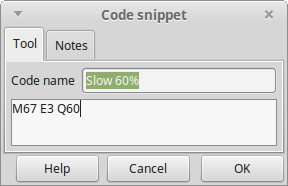
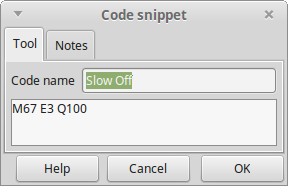
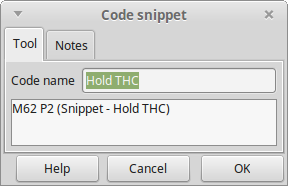
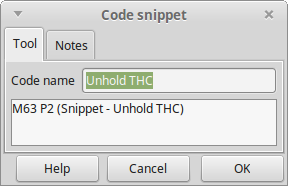
This is where my current post processor is. I've included screen dumps of all of my main Sheetcam code Snippets and my setup for the centrepunch. Keep the name exactly as shown. To tell you the truth, I can't quite remember how the centerpunch works. I think becasue I have a pierce delay of 0.0 seconds, it will stop as soon as it sees an ArcOK. (That assumes you import the sheetcam tools to plasmac)

The following user(s) said Thank You: bevins, tommylight, crowloy
Please Log in or Create an account to join the conversation.
- docwelch
- Offline
- Senior Member
-

Less
More
- Posts: 58
- Thank you received: 25
7 years 3 months ago #139919
by docwelch
Replied by docwelch on topic Post Processor for LinuxCNC and PlasmaC
Guys,
I've been working on a post processor for Fusion 360 to use with plasmac. I've had a couple of thoughts I'd like to throw out for others to give me some feedback. I suspect the following could be implemented on other post processors as well without too much effort.
With respect to slowing down for small holes, what I am doing is having the post processor look to see if the arc being cut is a full circle and if that circle's diameter is <37 mm. If it meets those criteria, it will insert code to slow down the cut rate to 60%. I chose to use
instead of the the M67 E3 Q60 simply because the feed rate will be reset "automatically" at the next move (another F#<_hal[plasmac.cut-feed-rate]> is sent with the next move which will get you back to the baseline).
Along those same lines, I'm sure the kerf width will change when the speed is slowed but I don't know how much (still building my machine). If it is enough to be significant, I have a potential solution for that as well. If you are using offsets (G41.1 or G42.1), you should be able to adjust the offset when you adjust the speed for the smaller circle - something like
would add 0.25 to the kerf width. Obviously, you would need to reset the kerf width before moving to the next cut.
I'd appreciate any thoughts - maybe you guys are already doing this but I have not seen it in any of the post processors.
Thanks,
Steven
I've been working on a post processor for Fusion 360 to use with plasmac. I've had a couple of thoughts I'd like to throw out for others to give me some feedback. I suspect the following could be implemented on other post processors as well without too much effort.
With respect to slowing down for small holes, what I am doing is having the post processor look to see if the arc being cut is a full circle and if that circle's diameter is <37 mm. If it meets those criteria, it will insert code to slow down the cut rate to 60%. I chose to use
Code:
F[#<_hal[plasmac.cut-feed-rate]> * 0.6]
Along those same lines, I'm sure the kerf width will change when the speed is slowed but I don't know how much (still building my machine). If it is enough to be significant, I have a potential solution for that as well. If you are using offsets (G41.1 or G42.1), you should be able to adjust the offset when you adjust the speed for the smaller circle - something like
Code:
G42.1 D[#<_hal[plasmac_run.kerf-width-f]> + 0.25]
I'd appreciate any thoughts - maybe you guys are already doing this but I have not seen it in any of the post processors.
Thanks,
Steven
Please Log in or Create an account to join the conversation.
- rodw
- Offline
- Platinum Member
-
Less
More
- Posts: 12170
- Thank you received: 4153
7 years 3 months ago #139939
by rodw
Replied by rodw on topic Post Processor for LinuxCNC and PlasmaC
Steven, my only concern was that using the plasmac feed rate may not be real time but it probably is.
Sheetcam outputs compensated code so you can't use offsets as you are.
You can't really adjust for speed from gcode as there is no way of knowing what the trajectory planner chooses to run plus it is all buffered so that line was read well before the motion occurs. There is an experimental branch called State tags that sends additional info about speeds back to motion that might help here. I really would like to see this incorporated into master for plasma users as I think it would close out some gaps. But don't hold your breath. Its 5 years old!
Please Log in or Create an account to join the conversation.
- phillc54
- Offline
- Platinum Member
-
Less
More
- Posts: 5711
- Thank you received: 2100
7 years 3 months ago #139941
by phillc54
Again, I think this should work ok.
Replied by phillc54 on topic Post Processor for LinuxCNC and PlasmaC
I think this should work ok.With respect to slowing down for small holes, what I am doing is having the post processor look to see if the arc being cut is a full circle and if that circle's diameter is <37 mm. If it meets those criteria, it will insert code to slow down the cut rate to 60%. I chose to use
F[#<_hal[plasmac.cut-feed-rate]> * 0.6]
instead of the the M67 E3 Q60 simply because the feed rate will be reset "automatically" at the next move (another F#<_hal[plasmac.cut-feed-rate]> is sent with the next move which will get you back to the baseline).
You will probably need quite a few test cuts to calculate the change in kerf width vs velocity. It would be really nice if the change was linear, then you could just use one formula.Along those same lines, I'm sure the kerf width will change when the speed is slowed but I don't know how much (still building my machine). If it is enough to be significant, I have a potential solution for that as well. If you are using offsets (G41.1 or G42.1), you should be able to adjust the offset when you adjust the speed for the smaller circle - something like
G42.1 D[#<_hal[plasmac_run.kerf-width-f]> + 0.25]
would add 0.25 to the kerf width. Obviously, you would need to reset the kerf width before moving to the next cut.
Again, I think this should work ok.
Please Log in or Create an account to join the conversation.
- docwelch
- Offline
- Senior Member
-
Less
More
- Posts: 58
- Thank you received: 25
7 years 3 months ago #139951
by docwelch
Replied by docwelch on topic Post Processor for LinuxCNC and PlasmaC
Rod,
Interesting that Sheetcam only outputs compensated code. Fusion 360 can do that (called "in computer compensation") but it can also output the exact path as if the tool has a 0 width and allow compensation to occur using the G41.1 and G42.1 codes (called "in machine compensation"). I have always used in computer compensation but finally found a potential reason to use the in machine compensation. Reading the Autodesk forum, they seem to indicate that most of the "high end" machines use in machine compensation.
Phill,
It would definitely require a lot of test cuts for the automated kerf width adjustment. I had not really thought about a formula (was just allowing the user to input a value) but that seems like an interesting idea. There should be some relationship to kerf width as the velocity changes. I'm sure the material thickness matters as well. I'm definitely going to do some experimenting when I get my machine up and going. Here's another thought: Since you are already parsing the g-code in plasmac, is there a way to build one or both of these functions into plasmac as options? I have the luxury of built in functions in my post processor to determine if a full circle is being cut and what the diameter is, but it shouldn't be that hard to recreate those functions. The kerf width would be adjusted if the feed rate is adjusted. I had thought about the possibility of adding a "kerf width offset when cutting slow" (must be a more succinct name) entry to the material table but a formula would be nice if we can find the relationship).
Thank you both for the input.
Steven
Please Log in or Create an account to join the conversation.
- phillc54
- Offline
- Platinum Member
-
Less
More
- Posts: 5711
- Thank you received: 2100
7 years 3 months ago #139952
by phillc54
Replied by phillc54 on topic Post Processor for LinuxCNC and PlasmaC
A while ago I did add arcs as an experiment, I didn't worry about full circles at the time, just any arc and had four or five sizes that would change the feed rate. Also it was only for absolute X/Y coords. It seemed to work ok but I didn't go any further with it. I can post the code if you are interested.Since you are already parsing the g-code in plasmac, is there a way to build one or both of these functions into plasmac as options?
Please Log in or Create an account to join the conversation.
Moderators: snowgoer540
Time to create page: 0.421 seconds