
- Posts: 12170
- Thank you received: 4153
"Origami" CNC Plasma Build - folding 1200 x 600mm cut area
- rodw
- Offline
- Platinum Member
-

Less
More
5 years 6 months ago #204690
by rodw
20mm per rev will be perfect. Acceleration is nice on corners. I think the spaceship can get to 2 m/sec which is a normal speed for 2mm mild steel in < 7 ms.
Replied by rodw on topic "Origami" CNC Plasma Build - folding 1200 x 600mm cut area
Joco wrote: Rod - good call out on the travel distance. The 3:1 gearing with the drive pulley will give me 20mm of travel per motor revolution. If I need to I can get down to 16mm of travel with a new set of drive pulleys. Hopefully I will be able to get enough rpm from the steppers to get good cut speeds on thin material. Quick rapids wiouild be nice but not necessary. This isn't a production environment after all. But time will tell. The experiemtning and learning is half the fun.
Re the NEMA17 motor, yes will need a light gantry. Plan is to use aluminium on as much as practical. My plan was to use an M6 or M8 lead screw to start with. It should provide plenty of effective torque for lifting the Z and its dirt cheap to source. The down side might be the speed of travel given the ~1mm pitch. We shall see. I can always change to one of the common 3d printer lead screws later. Similar to what tommylight has used in his very compact Z assembly.
Cheers - J.

20mm per rev will be perfect. Acceleration is nice on corners. I think the spaceship can get to 2 m/sec which is a normal speed for 2mm mild steel in < 7 ms.
- Joco
- Offline
- Platinum Member
-
Less
More
- Posts: 532
- Thank you received: 327
5 years 6 months ago #204830
by Joco
Replied by Joco on topic "Origami" CNC Plasma Build - folding 1200 x 600mm cut area
Been fighting with design ideas and have come up with this one. I am still working out the best place to put the cross frame supports. But given how things hinge there are limited options.
Overall dimensions are roughly 1500-1600 on the long length where the gantry will span. Gantry will be 75x50mm Aluminium with a 4mm wall.
About 1000mm wide from outside of each support frame. Support frames about 670mm wide.
Steel SHS is 65mm with a 3mm wall. Standard construction stocked size here in NZ. Should be pretty cheap.
View showing "locked" position. There is the potential with this shape to have locking pins at the top outer edges of the support frames.
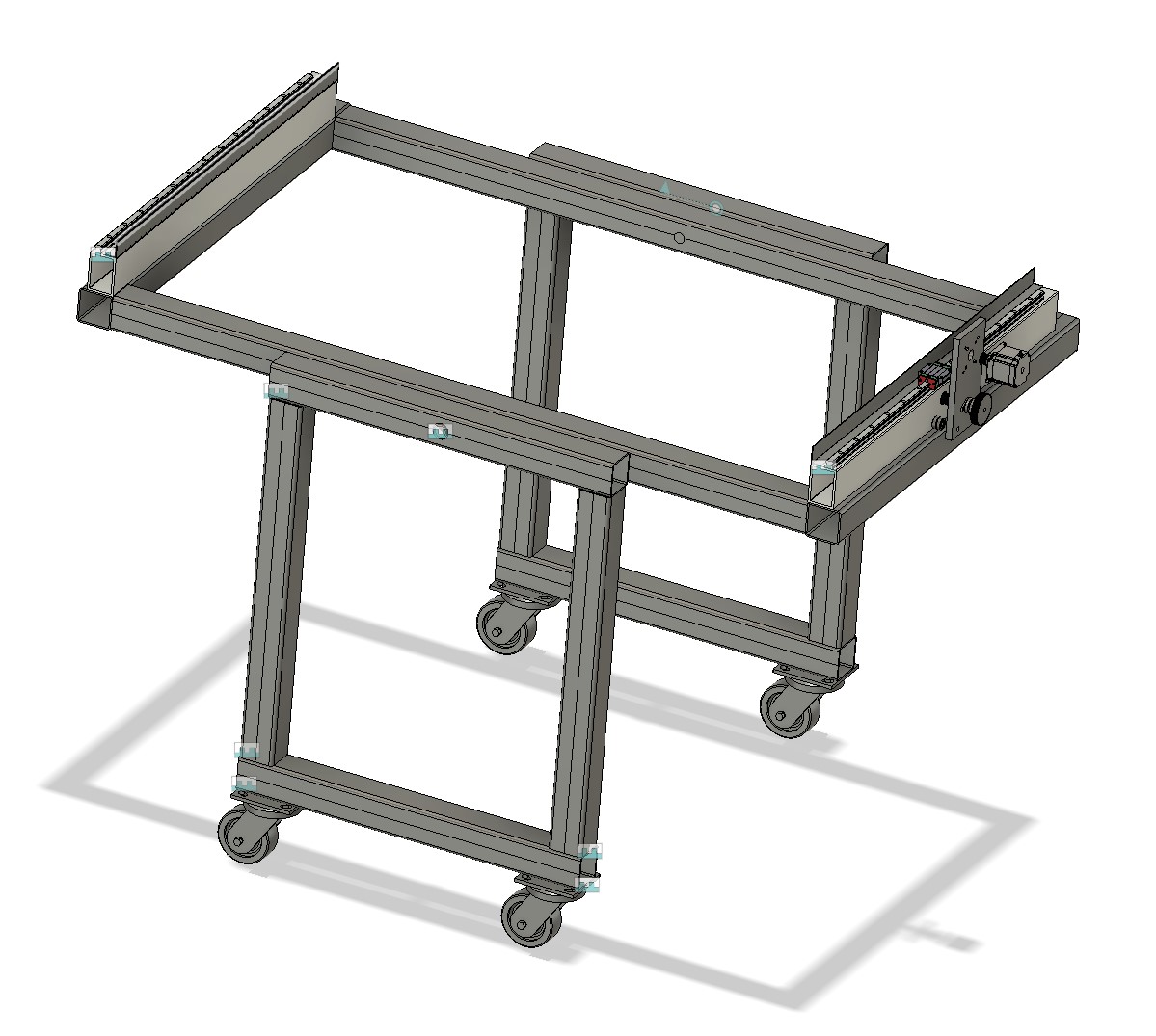
View showing storage position:
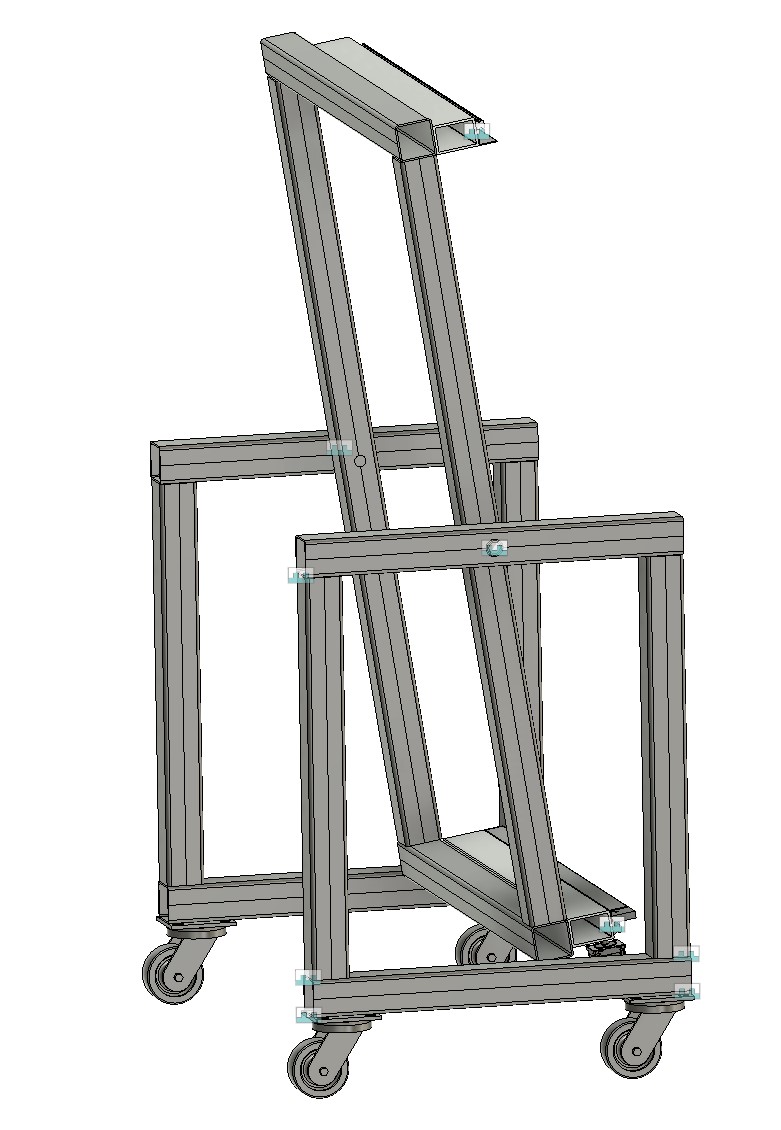
Cheers - J
Overall dimensions are roughly 1500-1600 on the long length where the gantry will span. Gantry will be 75x50mm Aluminium with a 4mm wall.
About 1000mm wide from outside of each support frame. Support frames about 670mm wide.
Steel SHS is 65mm with a 3mm wall. Standard construction stocked size here in NZ. Should be pretty cheap.
View showing "locked" position. There is the potential with this shape to have locking pins at the top outer edges of the support frames.
View showing storage position:
Cheers - J
- rodw
- Offline
- Platinum Member
-
Less
More
- Posts: 12170
- Thank you received: 4153
5 years 6 months ago #204831
by rodw
Replied by rodw on topic "Origami" CNC Plasma Build - folding 1200 x 600mm cut area
Why not like this?
The following user(s) said Thank You: hairy
- Joco
- Offline
- Platinum Member
-
Less
More
- Posts: 532
- Thank you received: 327
5 years 6 months ago #204834
by Joco
Replied by Joco on topic "Origami" CNC Plasma Build - folding 1200 x 600mm cut area
I had thought about a vertical table but I have no wall space left to place one. If it was free standing in the slot I plan to use then I will still need it to be on wheels and no more than 1000mm wide. I need it to be on wheels so I can play the reposition dance to work around space limitations.
The other part that looked fiddly to me was when dealing with odd shaped or small cut off parts as the stock to be cut from. This vertical model works super well when doing full or half sheets. Way more fiddly when dealing with small bits. I'm sure doable, just more fiddly. And as a hobby shop I will not be dealing with full/half sheets that often.
Did that do any videos of how they dealt with , say 300mm square bits or a circular offcut that was to be the used to get 3-4 small parts from?
Thanks for the ideas - J.
- rodw
- Offline
- Platinum Member
-
Less
More
- Posts: 12170
- Thank you received: 4153
5 years 6 months ago #204877
by rodw
Replied by rodw on topic "Origami" CNC Plasma Build - folding 1200 x 600mm cut area
Not sure about NZ but over here, we need to buy full sheets. Plasmac has a good feature that allows you to sever a sheet so I use that to get rid of the scrap. When I started I cut sheets in half to suit my 1200 x 1200 table but more recently I just index the sheet as required as you get more efficient use of material. If you look around, a few people have modified vice grips so they hook around a slat to hold sheets down to stop warping. You could use those on scraps.
Also from another of your threads, I would just upgrade to V2.9 and run QTplasmac. Once you understand the features, you could use your qtpyvcp skills to flesh out monokrom as I don't think its gone anywhere.
Also from another of your threads, I would just upgrade to V2.9 and run QTplasmac. Once you understand the features, you could use your qtpyvcp skills to flesh out monokrom as I don't think its gone anywhere.
- Joco
- Offline
- Platinum Member
-
Less
More
- Posts: 532
- Thank you received: 327
5 years 6 months ago #204943
by Joco
The other part with that vertical table is the need for the extraction fans when inside. Those are big units based on the tube sizes. I did some measuring yesterday and i can actually fit my flipping table in its open position inside the shop if I roll the welding table back a bit. So with a water table installed I could operate in the garage during crap weather. No need to source one or two big suction fans and find a place to store them. Also in the flip table design I worked out where I could put a water tank that could hold the water table fluid. Using low pressure air to push up up into the table and gravity drain. If i can get that all working then I would have a very self contained unit. Yes I know a “pressure vessel”, but for my use I dont have to get it certified and the plan is to use the lowest air pressure I can get away with. Im ok for a slow fill of the table as a compromise on keeping the air pressure down. Hmm, wonder how much pressure would be needed ...
Thanks for responding Rod, I do appreciate the ideas and dialog.
Replied by Joco on topic "Origami" CNC Plasma Build - folding 1200 x 600mm cut area
Depends on the supplier. I can buy full or half sheets. But agree that full sheet is most common.rodw wrote: Not sure about NZ but over here, we need to buy full sheets.
I had read about that sever feature which looked rather nice. I will do a snoop for how those vice grips look.Plasmac has a good feature that allows you to sever a sheet so I use that to get rid of the scrap. When I started I cut sheets in half to suit my 1200 x 1200 table but more recently I just index the sheet as required as you get more efficient use of material. If you look around, a few people have modified vice grips so they hook around a slat to hold sheets down to stop warping. You could use those on scraps.
The other part with that vertical table is the need for the extraction fans when inside. Those are big units based on the tube sizes. I did some measuring yesterday and i can actually fit my flipping table in its open position inside the shop if I roll the welding table back a bit. So with a water table installed I could operate in the garage during crap weather. No need to source one or two big suction fans and find a place to store them. Also in the flip table design I worked out where I could put a water tank that could hold the water table fluid. Using low pressure air to push up up into the table and gravity drain. If i can get that all working then I would have a very self contained unit. Yes I know a “pressure vessel”, but for my use I dont have to get it certified and the plan is to use the lowest air pressure I can get away with. Im ok for a slow fill of the table as a compromise on keeping the air pressure down. Hmm, wonder how much pressure would be needed ...
Plan was to use QTplasmac to start I just had some unfortunate experiences yesterday with 2.9pre seg faulting. Nothing to do with QTplasmac. I was running off HEAD so maybe I was a little too bleeding edge. I have also been reading how the plasmac guis hook up to and use the HAL plasmac component. So maybe I will push monokrome forward once I learn more. I really like being able to tweak or build a GUI that fits how I work and the specific design, limits and needs of my kit.Also from another of your threads, I would just upgrade to V2.9 and run QTplasmac. Once you understand the features, you could use your qtpyvcp skills to flesh out monokrom as I don't think its gone anywhere.
Thanks for responding Rod, I do appreciate the ideas and dialog.
Time to create page: 0.531 seconds