Flash a XC6SLX9 dev board as a 7i90HD

More
2 years 11 months ago #286025 by Gene1934
I see no evidence in the drawings here that this will give the screw terminal i/o to wire up the machine from, in the manner of mesa's 7i42TA's.

Is that planned to be a separate probably passive board? The 50 pin idc sockets on the real 7i90HD are a pita, only really usable as take off points to connect the 7i42TA's with 2 or 4" long cables. Since I do not currantly have a fully functional 7i90HD, one of the stepgens is blown, I would be interested in such a setup that would also function with a bananapi-m5, which can run at 2GHz, has no radio, but all 4 usb portrs are usb3. Currently using a pile of them to drive 3d printers. I have visions of a tool changer that would need the 4th stepgen. I'm currently running on an rpi4b, a 7i90HD, and 3 7i42TA's with a Spin-X1 driving a vfd for spindle control.

Please keep me advised.

Cheers, Gene Heskett
--
"There are four boxes to be used in defense of liberty:
soap, ballot, jury, and ammo. Please use in that order."
-Ed Howdershelt (Author)
Genes Web page < geneslinuxbox.net:6309/gene >

Please Log in or Create an account to join the conversation.

More
2 years 11 months ago #286026 by Cant do this anymore bye all
I only linked to this thread as Pete mentions that 7i90 have FET bus switches, as do the 7i92 and 7c81, which the schematics have been shared by Pete. This gives a basic 3.3v to 5v translation. According to the Spartan 6 data sheets the inputs are tolerant up to 4.1v.

Have you tried one of the banana 5 boards with a 7i90 using the hm2_spi driver. I tried with the latest Raspberry Pi 5 and it keep erroring with SPI timeouts. The hm2_rpspi driver doesn't work at all.
I hooked back up to my RP-400 and the hm2_spi driver ok. The hm2_rpspi does work on it fine.
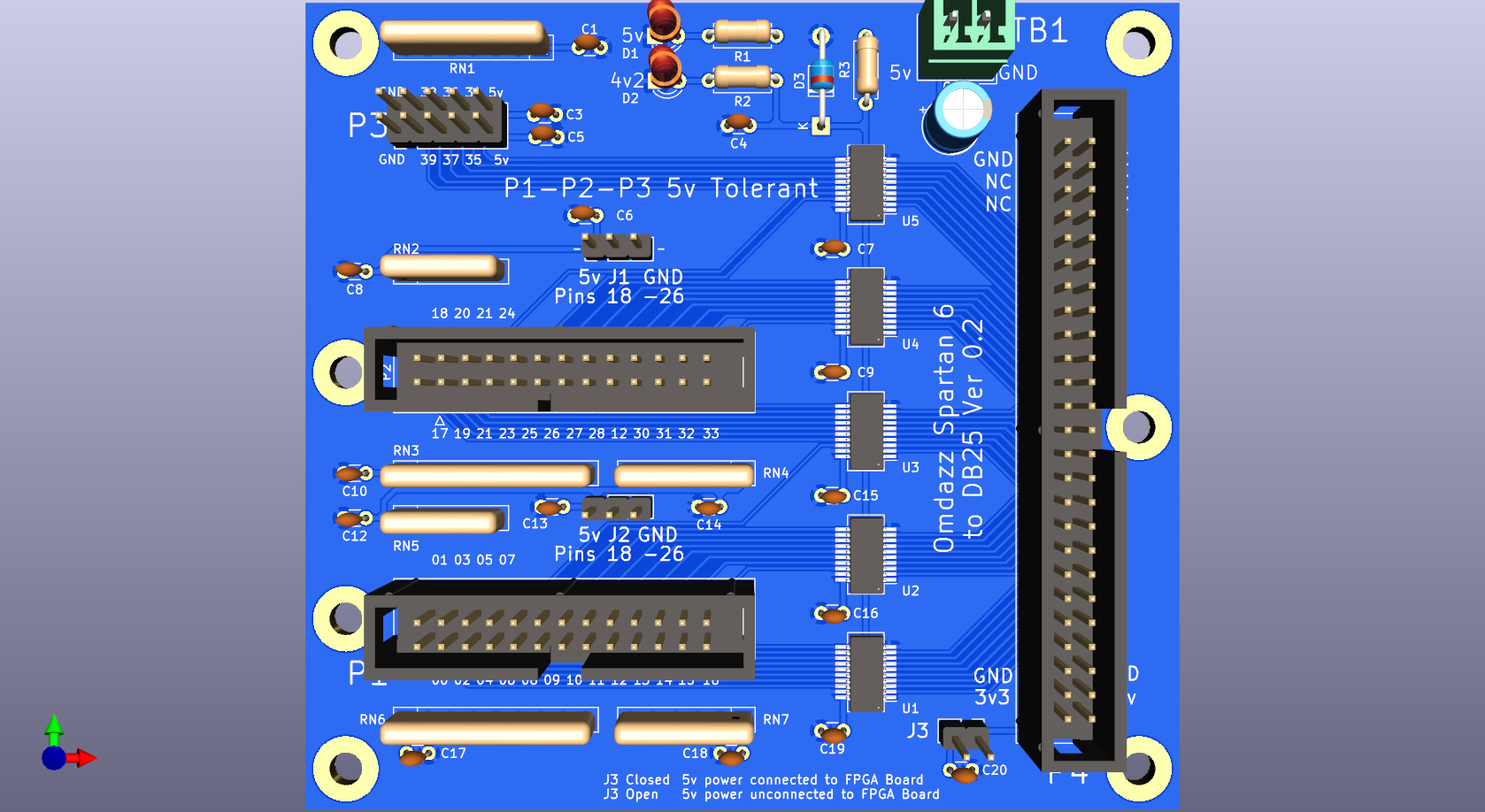
I've got a couple of prototype boards that work with the same Dev board which is about AUD $70 dollars now. It has the FET bus switches and has 2xDB25 connectors that will work with a standard Parallel Port breakout board or with the Mesa DB25 boards. There's also a 2*5 pin header that gives you 6 extra GPIOs with GND & 5v. That's the board that connects to the left hand header if you look at the dev board with the USB connector at the top.
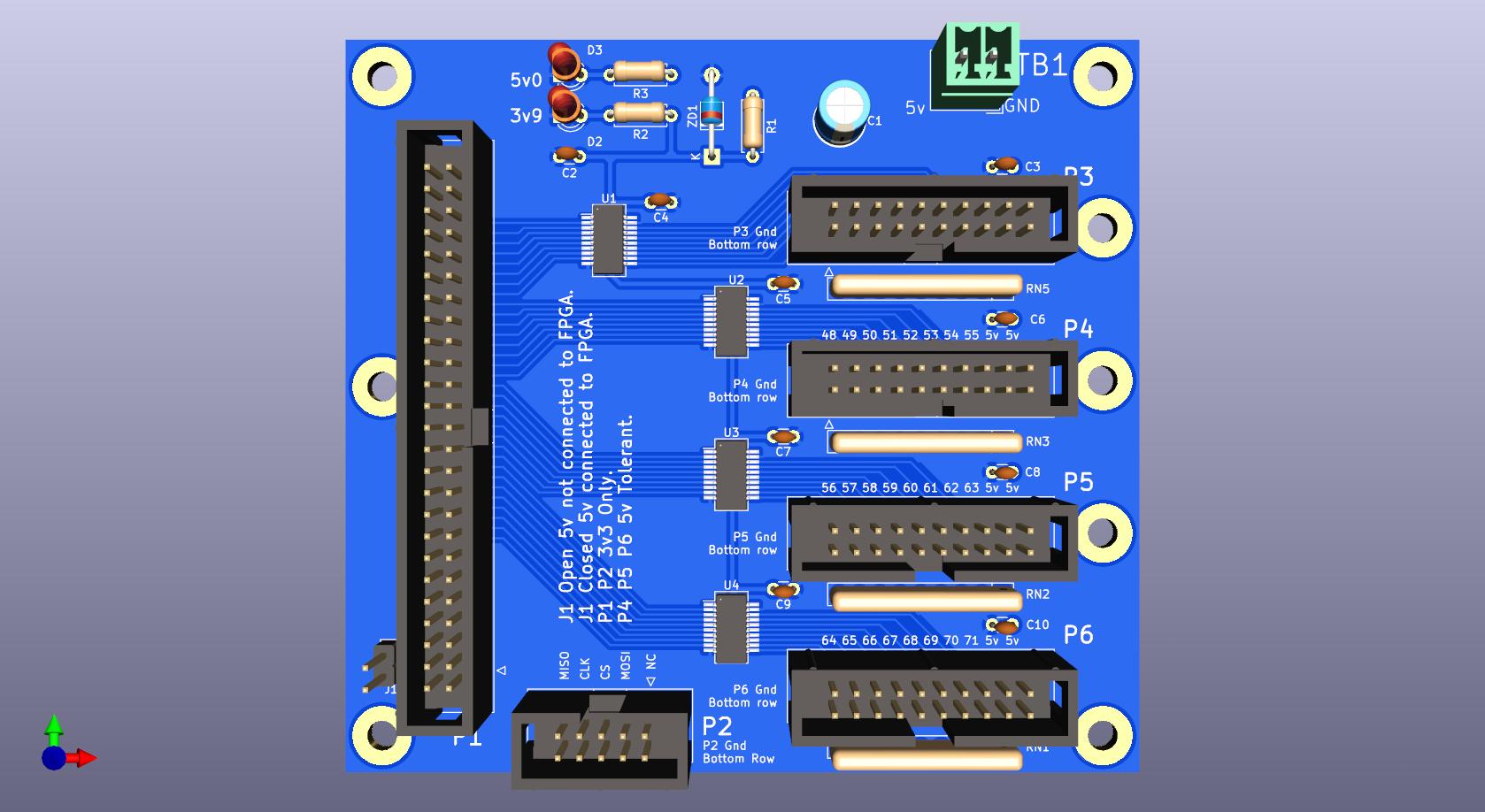
The second board has the SPI connector 2x5 so that there's a ground wire between each signal. Then there's 4 of 2x10 connectors that have 8 GPIOs 5v power on the top 10 pins and ground on the bottom 10 pins.

On all boards the signal from the FPGA are routed through a get bus switch running on a 3.9v power rail, and on the "world side" pulled up to 5v, this gives about 3.2~ volts on the FPGA side . Pretty much the way Mesa do things.
The only smd parts are the bus switches everything else is through hole, makes assembly easier. Too many dollars to get the PCB fab house to assemble the board.

Please Log in or Create an account to join the conversation.
More
2 years 11 months ago #286031 by Gene1934
>Have you tried one of the banana 5 boards with a 7i90 using the hm2_spi driver. I >tried with the latest Raspberry Pi 5 and it keep erroring with SPI timeouts. The >hm2_rpspi driver doesn't work at all.

That I suspect is because the address of the gpio controller doesn't match the rpi4b address. With a genuine rpi4b the rpspi driver works flawlessly. Bertho Stultans, a cs prof at a swedish uni was kind enough to write that driver, and rewrite for the rpi4b when it came out. Perhaps he would supply an include file to make it work with the bpi5, IDK and have not had any correspondence with him since, no need to as it just works, sending 32 bit packet at 42 megabaud and receiving the replies from the 7i90HD at 25 megabaud. My spi cable is maybe 1.25" long as I turned the pi upside down so the connecters were pin aligned. And old 12 volt fan, borrowed from a defunct video card running on 5 volts and mounted under the pi is all the cooling its needed in around 5 years. And my copy of the docs says its directly connected to the fpga, no buffers.

If Peter has since modified it to provide 5 v tolerant buffers, he hasn't told me.

Cheers, Gene Heskett
--
"There are four boxes to be used in defense of liberty:
soap, ballot, jury, and ammo. Please use in that order."
-Ed Howdershelt (Author)
Genes Web page < geneslinuxbox.net:6309/gene >

Please Log in or Create an account to join the conversation.
More
2 years 11 months ago - 2 years 11 months ago #286034 by Cant do this anymore bye all
All the "low speed" interfaces have been moved off the cpu to the new RP1 io chip, this connects via the PCIe bus, and according to the docs introduces 1us latency, don't know how of an issue this may actually be.

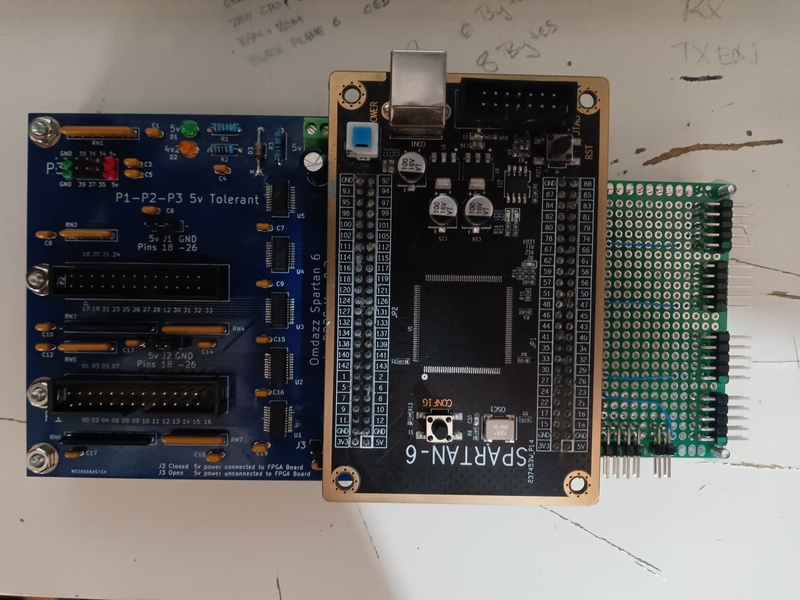
Some rendering of the boards I described, the dev board had the header pins changed to female and located on the underside.

Board 1:
 
Board 2:


Dev board with board 1 & prototype board 2
 
Last edit: 2 years 11 months ago by Cant do this anymore bye all.
The following user(s) said Thank You: tommylight

Please Log in or Create an account to join the conversation.
More
2 years 11 months ago #286047 by Gene1934
It probably works, but I'd still have to invent something to replace the convenience of the 7i42TA's for connection to the real world. I may have been the first user of the 7i90HD, doing it just to see if t could be done. Peter hasn't said. And because I mentioned an rt kernel I'm banned from the pi forum. So I had to compile it myself, and figure out how to install it, which actually turned out to be a piece of cake. The uncompressed tarball is about 28 megs, and installed by untaring its two directors to the same directories in the sd card the pi boots from. Done and apt doesn't mess with it.

Cheers, Gene Heskett
--
"There are four boxes to be used in defense of liberty:
soap, ballot, jury, and ammo. Please use in that order."
-Ed Howdershelt (Author)
Genes Web page < geneslinuxbox.net:6309/gene >

Please Log in or Create an account to join the conversation.

Moderators: PCW, jmelson
Time to create page: 0.297 seconds
Powered by Kunena Forum
