LinuxCNC S-Curve Accelerations

More
9 months 5 days ago - 9 months 5 days ago #342009 by endian

Sounds all sensible to me but I really don't feel competent to comment on the proposed path.
I certainly like the structured approach of your initiative, that is something that has been sorely lacking in other attempts.
I think/hope that Rob will be able to give an educated opinion on it and shape it into a concrete roadmap.

Note that Mitsubishi SSCNET requires a servo cycle <= 222us
forum.linuxcnc.org/9-installing-linuxcnc...cnet?start=70#256576
 
defenetly is great to have something faster then 1ms .. ethercat can run at 50us with 16axis but this complex calculations are far slower for now 

I think 250us is very pretty goal (common industrial standard) at any hardware and then reduce it based at used hardware 


Note than many ethercat drives are also limited to 1khz in position mode. lichuan is, stepperonline/jss i think is and Im pretty sure the delta b3 is. My omrons I think are restricted to 2khz in csp mode.

For 4khz or 8khz usually you are restricted to other modes. At least in the drives I have. There definitely are (much) faster ones, but they are more specialised gear vs generic milling cnc applications.

Point being, 250us sounds great, but I don't know it needs to be any sort of priority cause only few people could use it. But then maybe those few people are important (like the people I know wanting to nanometer scale optical things and MUST have the higher "loop" speed so can't entertain linuxcnc right now)
 
You are right, I agree with you 100%, main goal is get lcnc with curves at 1khz ... Timig is very wide and difficult topic but faster code means more play to some latency or timig issues of something, stability, rigidity etc...

I think it is reachable timing .. faster tick means better final result of movement and better regulation feedback with velocity or current control.. 

Then we can say isolated cpu to sleep if it will runs at longer timing then 250us .. finally we can use more masters at other network interface to run it with different timing if it is needed and then let cpu to sleep

I think Luca's goal are very very well definied .. from my point of view there is missing just pos(t+1) or pos(t-1) for position commands to any drivers which is not using the velocity setpoint(its cosmetic to not see the ferror during movement with position setpoint)

We can runs 16khz with beckhoff but there is latency restictions... for now... I am running 0.5khz with profibus equidistant and it works well but with trapeziodal its was pain.. now with scurve its smooth like butter... lower timing than 1khz are for gentelmen which they know what they are doing.. its advanced I think
Last edit: 9 months 5 days ago by endian. Reason: editor messing
The following user(s) said Thank You: grandixximo, akb1212, tommylight, rodw

Please Log in or Create an account to join the conversation.

More
9 months 5 days ago #342015 by ruediger123
@grandixximo

Very good work!
I've started testing.
I've noticed that the track speed is very low with G2/G3, but significantly higher with G64 Pxx.

More tomorrow.
The following user(s) said Thank You: grandixximo, akb1212, tommylight, rodw, endian

Please Log in or Create an account to join the conversation.

More
9 months 4 days ago #342069 by endian

Sounds all sensible to me but I really don't feel competent to comment on the proposed path.
I certainly like the structured approach of your initiative, that is something that has been sorely lacking in other attempts.
I think/hope that Rob will be able to give an educated opinion on it and shape it into a concrete roadmap.

Note that Mitsubishi SSCNET requires a servo cycle <= 222us
forum.linuxcnc.org/9-installing-linuxcnc...cnet?start=70#256576
 
defenetly is great to have something faster then 1ms .. ethercat can run at 50us with 16axis but this complex calculations are far slower for now 

I think 250us is very pretty goal (common industrial standard) at any hardware and then reduce it based at used hardware 


Note than many ethercat drives are also limited to 1khz in position mode. lichuan is, stepperonline/jss i think is and Im pretty sure the delta b3 is. My omrons I think are restricted to 2khz in csp mode.

For 4khz or 8khz usually you are restricted to other modes. At least in the drives I have. There definitely are (much) faster ones, but they are more specialised gear vs generic milling cnc applications.

Point being, 250us sounds great, but I don't know it needs to be any sort of priority cause only few people could use it. But then maybe those few people are important (like the people I know wanting to nanometer scale optical things and MUST have the higher "loop" speed so can't entertain linuxcnc right now)
 
You are right, I agree with you 100%, main goal is get lcnc with curves at 1khz ... Timig is very wide and difficult topic but faster code means more play to some latency or timig issues of something, stability, rigidity etc...

I think it is reachable timing .. faster tick means better final result of movement and better regulation feedback with velocity or current control.. 

Then we can say isolated cpu to sleep if it will runs at longer timing then 250us .. finally we can use more masters at other network interface to run it with different timing if it is needed and then let cpu to sleep

I think Luca's goal are very very well definied .. from my point of view there is missing just pos(t+1) or pos(t-1) for position commands to any drivers which is not using the velocity setpoint(its cosmetic to not see the ferror during movement with position setpoint)

We can runs 16khz with beckhoff but there is latency restictions... for now... I am running 0.5khz with profibus equidistant and it works well but with trapeziodal its was pain.. now with scurve its smooth like butter... lower timing than 1khz are for gentelmen which they know what they are doing.. its advanced I think
 

Gentelmen, I am sorry for talking about editing and adding the positionCmd(t+1) or positionCmd(t-1) to active creating planner but there is a problem of unsynchronized movement or synchronized(t+-x) motion ... it is common issue of any outsourced position control stuff

if somebody has stuff for example running at ethercat with CSP, he/she will be still in lag for cycle or two cycles(if he/she will not has reference cycle negative) behind stuff at same control master for example CSV which will have PID- with FF1 set to 1.0 ... feedforward compensation will not be present and lagging axis will create(during higher speed motion) unsynchronization and it could influence final shape during some 3d pathing or finishing...  with higher speed it will create higher lag (I am talking about ethercat because I can test it myself at my HW)

this is just my ideas, please let me know your point of view ... 

thanks

Please Log in or Create an account to join the conversation.
More
9 months 4 days ago #342073 by grandixximo
@endian I discussed this with YangYang who attends the EtherCAT consortium meetings. AitalMAC is part of the consortium and we design I/O for EtherCAT, so we're not guessing here.
The standard already solves this problem. You don't need pos(t+1).
The 1 cycle delay is real, but it's identical for all axes. With Distributed Clocks everything executes on the same SYNC edge, synchronized to ~100ns. Every axis is "late" by the same amount, so the path shape is correct. Calculate it last week, execute it this week, the part is the same.
The CiA 402 standard provides feedforward objects exactly for this: 0x60B1 (velocity offset) and 0x60B2 (torque offset). The master can send position plus velocity feedforward so the drive can anticipate acceleration. This is the standard's solution, it just needs to be mapped in lcec.
Also, good drives interpolate internally. The servo loop runs faster than the bus cycle (Maxon runs 0.4ms internal vs 1ms bus). The drive doesn't jump between positions, it interpolates. That's what 0x60C2 configures.
If you're seeing ferror correlate with velocity in halscope, that's likely a display artifact. The ferror compares "commanded from 1 cycle ago" with "actual now", so it shows an offset proportional to velocity. It's not a real machining error.
What does your actual part surface look like? Any real deviation you can measure?
The following user(s) said Thank You: akb1212, tommylight, besriworld, endian

Please Log in or Create an account to join the conversation.

More
9 months 4 days ago - 9 months 4 days ago #342082 by Aciera
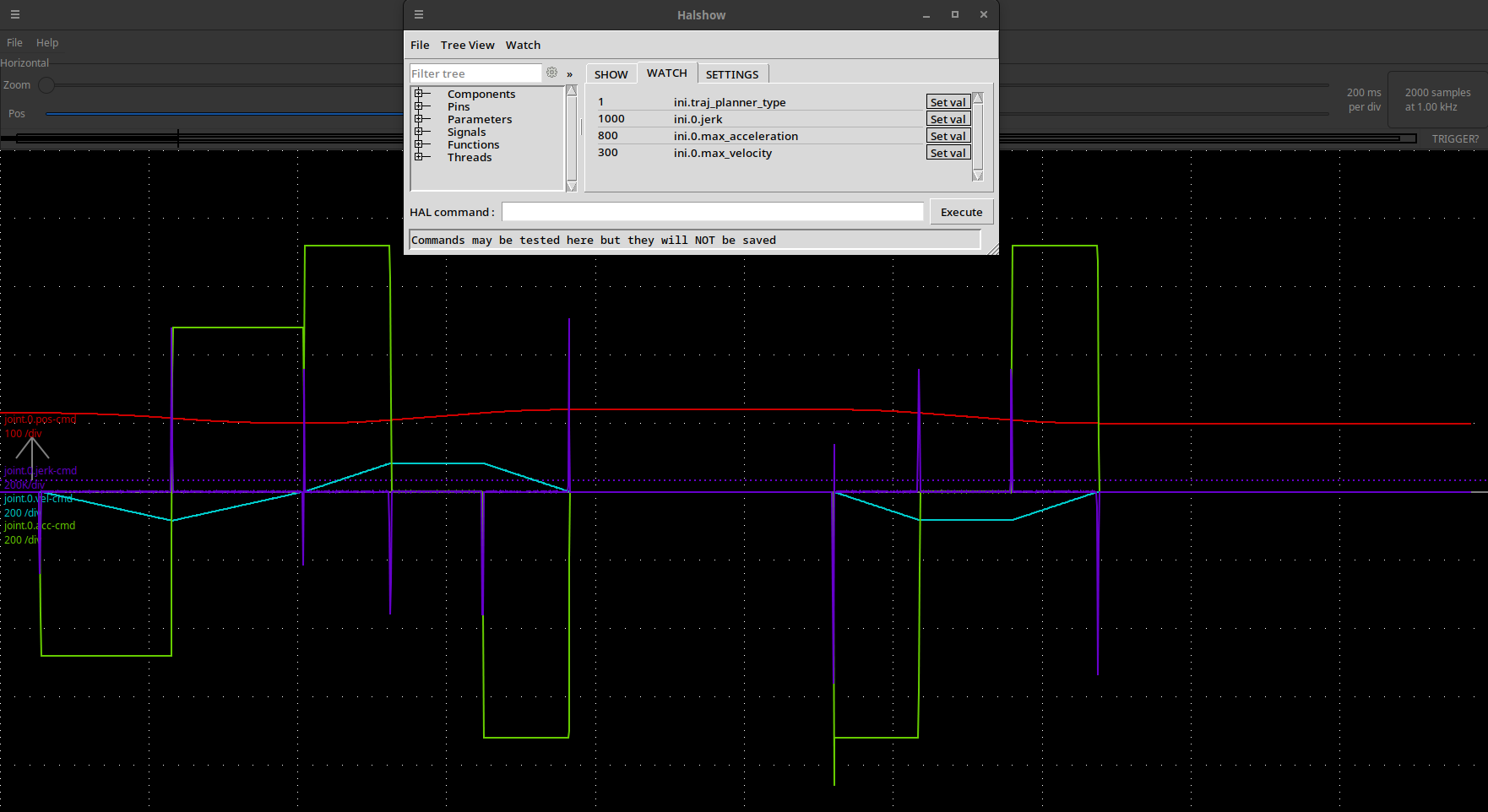
I've been trying to test this on real hardware using Mesa but I cannot seem to get the new planner to work at all.

- [TRAJ] section has 'MAX_LINEAR_JERK = 1000.0'
- both [JOINT_0] and [JOINT_1] have 'MAX_JERK = 1000.0'
- ini.planner_type = 1


Yet running this code in G61.1 mode
Code:
G21 F5000 G0 x0 y0 g1 x20 y20 x0 y0 m2

I get this:


here is my ini file:
Warning: Spoiler!


What am I missing?
Last edit: 9 months 4 days ago by Aciera.
The following user(s) said Thank You: akb1212

Please Log in or Create an account to join the conversation.

More
9 months 4 days ago #342085 by Aciera
A word of caution to anyone testing the new planner on real hardware:

I would strongly recommend to NOT activate the new planner in the ini file.
I dropped my homing velocities to 20% and my real hardware setup still runs into the hard stops on homing.

Users should leave ini.planner_type = 0, home the machine and use halshow to set ini.planner_type = 1.
The following user(s) said Thank You: akb1212, endian

Please Log in or Create an account to join the conversation.

Time to create page: 0.098 seconds
Powered by Kunena Forum
