Help! Stepper stalls high speed problem?

More
3 years 11 months ago #257605 by tommylight
It does not make it correct info if it is on Geckodrive website, Rod.
I am sure Marius did not write that as he knows his stuff very good.
Marius, i think that was his name, is the owner of geckodrive.
A stepper motor at 2A will have the same power and torque, no matter how many volts you provide to the drive, at standstill and low RPM.
At higher RPM it will raise the power and torque by a lot.
Induction, i always mention here to get low inductance motors as they can spin faster with lower voltages.
Vexta and Oriental have some very good videos on youtube explaining that in great detail.
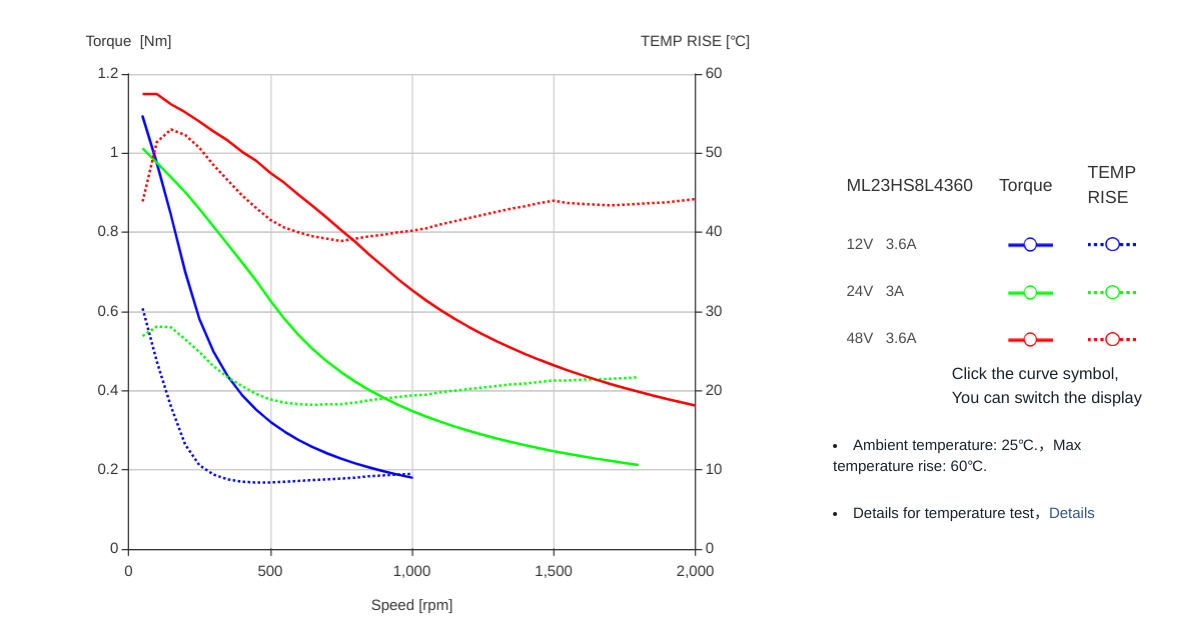
All stepper motors have torque charts, some will have those for 2 or 3 different voltages feed to the drive, it can be clearly seen how the torque remains the same at low RPM, but goes much higher at higher RPM with higher voltage.
And, higher and lower RPM in stepper systems is a relative term, some will do only 100RPM with usable torque, some 500RPM, with the same 24V and same drive. That is inductance, or visualy, a tank filling with water by a small tube, higher pressure/current = faster fill, smaller tank/inductance = faster fill, etc, etc.

Please Log in or Create an account to join the conversation.
More
3 years 11 months ago - 3 years 11 months ago #257619 by rodw
Tommy, sorry you are wrong. As you increase the voltage, the torque curve lifts as shown here for a random Moon Industries NEMA 23. Moon are an industrial quality manufacturer up there with Sanyo Denki
 
In this graph I added a 48 volt plot using Moon's cool customisable graphing module on the product web page. Compare that with the 24 volt plot. You will note torque has increased
www.moonsindustries.com/p/nema-23-standa...0-000004611110011248
But yes, you definitely increase the top end speed as well as torque so you can harness more of that torque  with reduction gearing.
The temperature goes up by 44 deg but if you add 35 deg ambient to 44, we end up with 79 deg well below the maximum temp of 130 deg the insulation is rated to.

As a general rule, low inductance motors perform better, but I am yet to be convinced it is the best parameter to design to.
In all of the 100s of drives I benchmarked in our stepper design model that was developed over several months, inductance is definitely not relevant. Its much more important to match the rotational inertia of the system with the motor's rotational inertia. Ideally, you want a 1:1 relationship and  it needs to be below 1:1 to prevent the motor from burning up. A low ratio implies the motor is underutilised (eg. too big for the application)

Take for example the amazing NEMA 24 Sanyo Denki  103H7823-5740, it has high inductance of 9.5 but a very high rotor inertia of 840 g/cm^2. I suspect the size of the rotor is the reason why this is only a 2 amp motor as there is not much room for the coil windings! But it outperforms all motors in its class. I've benchmarked it to over 60 m/min and  settled on a safe 5m/sec/sec accelleration with a 30mm pinion and 3:1 motor reduction.

What I did learn with all the benchmarking I did is that design of stepper motor motion systems is complex and poorly understood. Its much easier to design servo driven motion systems.
Last edit: 3 years 11 months ago by rodw.

Please Log in or Create an account to join the conversation.

More
3 years 11 months ago #257633 by tommylight
I am not wrong, read my post again and watch the graph, there is no change in torque at low RPM, at all, not even at 12V!
This is getting tedious, several times i said the exact same thing, it does not increase anything at low RPM, it increase everything at higher RPM.

Please Log in or Create an account to join the conversation.

More
3 years 11 months ago #257636 by JPL
@tommylight is right

See attached document. This is the older version made by Marius from Geckodrive. The first 3 pages explains this very well.

Basically:
- Torque vs Voltage curves clearly shows that voltage is irrevelant at low speed.
- Higher supply voltage will reduce current thus I2 x R loss. This apply ONLY to higher speed.
- Double 2x voltage will generate 2x torque at higher speed (theorically, although slightly less in real application)
- Inductance is the real enemy, this is why larger motor have a torque/speed curve dropiing much faster than smaller motor.


Your browser does not support embedded PDFs. Please download the file here: Download PDF.

The following user(s) said Thank You: tommylight, cakeslob

Please Log in or Create an account to join the conversation.

More
3 years 11 months ago #257641 by rodw
But we don't operate the motor below the corner frequency as the article says:

High initial torque at low speed does not mean efficient motor utilization. Usually power is the more important. Bias the motor’s operating point through power transmission gearing to operate the motor at its maximum power; normally just past its corner frequency.


This is why gearing is desired on a stepper motor to ensure it does not have to operate at low speed. Ideally you want to harness that low end torque above the corner frequency when the motor is accellerating. Once at constant velocity, the required torque could be 80% less.
The performance of larger motors it not so much affected by induction but by higher rotational inertia because the mass of the rotor is much larger. eg, you need more energy to turn the motor and overcome the detents.

In the OP's case, the simplest improvement he can make is to increase the motor voltage to move the torque curve upwards. Yes, he may still need to increase the size of his motor in the end, but using a 48v power supply is perfectly matchd with his motor drivers. Take the easy win first.

Please Log in or Create an account to join the conversation.

More
3 years 11 months ago #257643 by tommylight

In the OP's case, the simplest improvement he can make is to increase the motor voltage to move the torque curve upwards. Yes, he may still need to increase the size of his motor in the end, but using a 48v power supply is perfectly matchd with his motor drivers. Take the easy win first.
[/quote]
This is the answer the OP should have gotten, thank you.

Please Log in or Create an account to join the conversation.

Time to create page: 0.536 seconds
Powered by Kunena Forum
