
Search Results (Searched for: 7i76e)
- rodw
-

24 Jul 2026 08:21
Replied by rodw on topic using linuxcnc on a raspberry pi to control a boxford 250pc lathe
The Pi4b was marginal, sometimes requiring a slower servo thread but one guy I know says the Pi5 is flawless on real machines
I'd probably pair it with a mesa ethernet card. A Mesa 7i76eU has 5 axes, 16 outputs and 32 inputs but is extensible beyond that.
Linuxcnc supports 9 axes and 32 motors
Arduino is not useful for linuxcnc
There are several GUIs that support lathes but its always best to start with axis until you get everything functional.
Of course we are friendly!
You can mess with everything!
Check the docs as they list the GUI's available but you can write your own. Some support portrait mode.
I checked the other day, there's is over 1800 pages of docs but I always refer to the online docs.
There are no limits to motor size and it will control Ethercat and analog servo motors not just step and direction.
Linuxcnc is far more flexible than Centroid and is complete as opposed to Centroid where additional upgrades are required.
But it may require more effort from you because there are probably more decisions you need to make becsause of LinuxCNC's flexibility
Re Youtube not sure on Lathe specific videos but I have a channel which is trying to produce tutorial type material.
This one is designed to be a general introduction describing the various pathways through Linuxcnc
I'm currently working through a series of videos building a control panel from scratch using a parallel port (3rd one to be released tonight) with a couple more planned. Once fully functional, my plan was to replace the parallel port with other controller options. Sounds like I need to include a lathe walkthrough too!
I'd probably pair it with a mesa ethernet card. A Mesa 7i76eU has 5 axes, 16 outputs and 32 inputs but is extensible beyond that.
Linuxcnc supports 9 axes and 32 motors
Arduino is not useful for linuxcnc
There are several GUIs that support lathes but its always best to start with axis until you get everything functional.
Of course we are friendly!
You can mess with everything!
Check the docs as they list the GUI's available but you can write your own. Some support portrait mode.
I checked the other day, there's is over 1800 pages of docs but I always refer to the online docs.
There are no limits to motor size and it will control Ethercat and analog servo motors not just step and direction.
Linuxcnc is far more flexible than Centroid and is complete as opposed to Centroid where additional upgrades are required.
But it may require more effort from you because there are probably more decisions you need to make becsause of LinuxCNC's flexibility
Re Youtube not sure on Lathe specific videos but I have a channel which is trying to produce tutorial type material.
This one is designed to be a general introduction describing the various pathways through Linuxcnc
I'm currently working through a series of videos building a control panel from scratch using a parallel port (3rd one to be released tonight) with a couple more planned. Once fully functional, my plan was to replace the parallel port with other controller options. Sounds like I need to include a lathe walkthrough too!
- PCW
23 Jul 2026 13:40
Replied by PCW on topic 7i76EU Availibility ?
mesaus has one:
mesaus.com/product/7i76eu/
and our EU dealers have more
We should have the next build lot done in about 4 weeks
mesaus.com/product/7i76eu/
and our EU dealers have more
We should have the next build lot done in about 4 weeks
- my1987toyota
23 Jul 2026 11:18
Replied by my1987toyota on topic 7i76EU Availibility ?
Thank you I will give that a look
- Todd Zuercher
23 Jul 2026 10:00
Replied by Todd Zuercher on topic 7i76EU Availibility ?
There is one on ebay right now for $200.
www.ebay.com/itm/227441166265
www.ebay.com/itm/227441166265
- my1987toyota
23 Jul 2026 08:59
7i76EU Availibility ? was created by my1987toyota
I have a new build project coming up and I need a 7i76EU for the build. But as my luck
usually runs Mesa Electronics is sold out of them. Does anyone know when more
are expected to be in stock?
usually runs Mesa Electronics is sold out of them. Does anyone know when more
are expected to be in stock?
- rodw
-
20 Jul 2026 20:33
Replied by rodw on topic Jogwheels won´t jog
There is also a good MPG example in the docs except in Mesa land, you don't use the encoder component
linuxcnc.org/docs/stable/html/examples/mpg.html
Not sure on the 7i97 but there are some dedicated MPG pins on the Mesa 7i76e (and for the 7i96 if you use the right bit file and give up some pins.
linuxcnc.org/docs/stable/html/examples/mpg.html
Not sure on the 7i97 but there are some dedicated MPG pins on the Mesa 7i76e (and for the 7i96 if you use the right bit file and give up some pins.
- PCW
13 Jul 2026 19:09
Replied by PCW on topic Ethernet connection to Mesa 7i76e disconnecting on its own after one minute
I should note that I have a HP EliteDesk 800 G1 that could never run Ethernet cards reliably
for more than an hour or so UNTIL I upgraded the kernel to 7.x
It also requires:
disabling irq coalescing
isolcpus=3
and pinning the Ethernet IRQ to CPU 3
With these changes, I never get dropped packets even after months of uptime
with a PC used for compiling, youtube etc etc
for more than an hour or so UNTIL I upgraded the kernel to 7.x
It also requires:
disabling irq coalescing
isolcpus=3
and pinning the Ethernet IRQ to CPU 3
With these changes, I never get dropped packets even after months of uptime
with a PC used for compiling, youtube etc etc
- rodw
-
13 Jul 2026 10:58
Replied by rodw on topic Ethernet connection to Mesa 7i76e disconnecting on its own after one minute
So does that mean you are in business and have a PC for spare parts? Hope so!
If not, I might be able to work in another site visit but it would cost you some footage for a YouTube video... image missing /media/kunena/emoticons/cool.png
There is an email that gets me on my @MrRodW YouTube channel
If not, I might be able to work in another site visit but it would cost you some footage for a YouTube video... image missing /media/kunena/emoticons/cool.png
There is an email that gets me on my @MrRodW YouTube channel
- RMJ fabrication
12 Jul 2026 19:45
Replied by RMJ fabrication on topic Ethernet connection to Mesa 7i76e disconnecting on its own after one minute
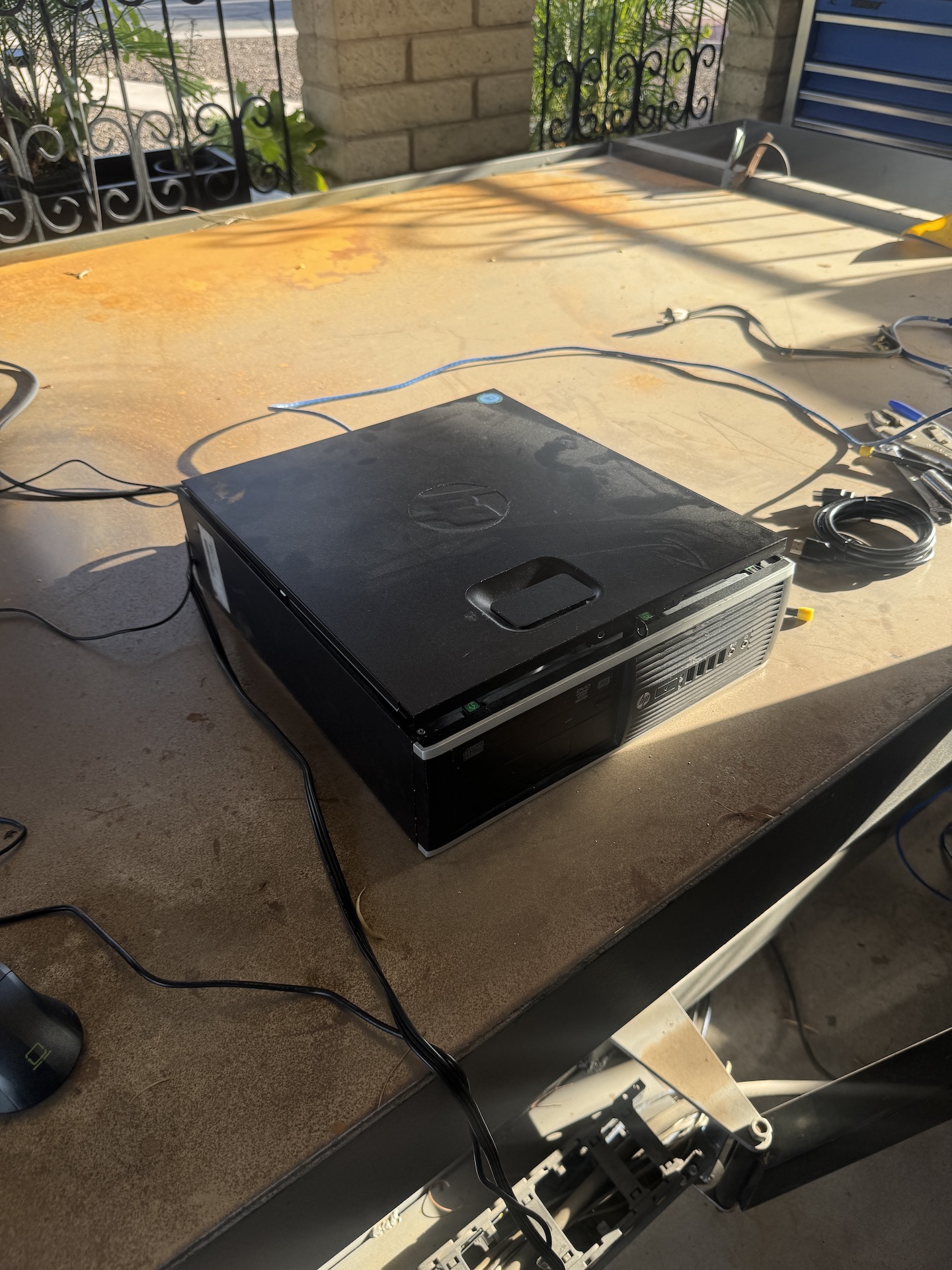
I connected a second PC to test wether the PC or the mesa board is dropping the connection. The result is the second PC works well for well over 20 minutes without interruptions or errors. it seems as the disconnected link was caused by the original PC.
- Rykagon
12 Jul 2026 19:06
Successful Raspberry Pi 4 Trixie LinuxCNC install. was created by Rykagon
Just completed a successful installation of LinuxCNC version 2.9.8 on a Pi 4 with 4 gig of RAM.
Thanks to forum user "NWE" for recommending the version to download, named below:
2026-01-21-raspios-lcnc-2.9.8-trixie-arm64.zip
After downloading and using balenaEtcher to flash a 256Gig micro SD card, it booted to a Debian 13 Trixie style desktop and opened a "boot wizard". After creating an account, the wizard recommended loading updates. There was trouble after that, the login dialog box wouldn't accept any userids/passwords.
After rebooting and choosing NOT to load s/w updates, everything worked fine.
I'm using LinuxCNC to retrofit a 1990's vintage Intelitek ProLight 3000 CNC lathe. The original lathe was controlled using proprietary h/w and PC-based s/w. I acquired a Mesa 7i76EU board as recommended by Mesa Technical Support so the journey is underway.
I see that LinuxCNC has a Mesa board config tool so I'll use that.
Any advice or coaching for me as an absolute LinuxCNC newbie is much appreciated.
Thanks to forum user "NWE" for recommending the version to download, named below:
2026-01-21-raspios-lcnc-2.9.8-trixie-arm64.zip
After downloading and using balenaEtcher to flash a 256Gig micro SD card, it booted to a Debian 13 Trixie style desktop and opened a "boot wizard". After creating an account, the wizard recommended loading updates. There was trouble after that, the login dialog box wouldn't accept any userids/passwords.
After rebooting and choosing NOT to load s/w updates, everything worked fine.
I'm using LinuxCNC to retrofit a 1990's vintage Intelitek ProLight 3000 CNC lathe. The original lathe was controlled using proprietary h/w and PC-based s/w. I acquired a Mesa 7i76EU board as recommended by Mesa Technical Support so the journey is underway.
I see that LinuxCNC has a Mesa board config tool so I'll use that.
Any advice or coaching for me as an absolute LinuxCNC newbie is much appreciated.
- NWE
-

07 Jul 2026 03:42 - 07 Jul 2026 04:10
Replied by NWE on topic Newbie asking for resources and advice
- Rykagon
06 Jul 2026 18:03
Newbie asking for resources and advice was created by Rykagon
Hello All,
I'm attempting to retrofit a 90's vintage Intelitek Prolight 3000 lathe. This is a small slant bed CNC lathe marketed to high school and technical college programs, and originally controlled by proprietary electronics and a desktop PC.
The plan is to use LinuxCNC on a Raspberry Pi 4, mated with a Mesa 7i76EU board, along with TB6600 stepper drivers to control and X- and Z-axes as well as a stepper driven 8 position tool changer. The spindle motor speed is analog controlled 0 - 10 volt signal input.
I have zero experience with most of this and would appreciate any coaching on:
- which Linux distro to load on the Pi 4.
- any resources for configurations, etc.
- any other stuff I don't even know that I don't know.
Thanks in advance!
I'm attempting to retrofit a 90's vintage Intelitek Prolight 3000 lathe. This is a small slant bed CNC lathe marketed to high school and technical college programs, and originally controlled by proprietary electronics and a desktop PC.
The plan is to use LinuxCNC on a Raspberry Pi 4, mated with a Mesa 7i76EU board, along with TB6600 stepper drivers to control and X- and Z-axes as well as a stepper driven 8 position tool changer. The spindle motor speed is analog controlled 0 - 10 volt signal input.
I have zero experience with most of this and would appreciate any coaching on:
- which Linux distro to load on the Pi 4.
- any resources for configurations, etc.
- any other stuff I don't even know that I don't know.
Thanks in advance!
- usmandeveloper
06 Jul 2026 08:57
Replacing RichAuto A11 handle with PC control (LinuxCNC/Mach/UCCNC) on AC servo was created by usmandeveloper
Hi everyone,
I'm working on a KEGEMA-branded CNC router (1300x2500mm working area) that currently runs on a RichAuto DSP A11 handheld controller. I'd like to bypass the handle and control the machine directly from a PC (jog, home, run G-code, start/pause) — similar to what was done in this thread:
forum.linuxcnc.org/30-cnc-machines/35371...troller-richauto-a11
I've read that thread carefully and it's been very helpful, but my setup differs in one important way: my machine uses AC servo motors, not steppers.
Machine specs
Working size: 1300x2500x200mm
Spindle: 6kw HQD air-cooled
Spindle inverter/VFD: 7.5kw Fuling (brand: Folinn on the unit itself)
Axis motors: Leadshine 750W AC servo motors + matching Leadshine AC servo drivers (model marking "L7", 750W, one per axis: X, Y1, Y2, Z — Y1/Y2 appear to be a dual-motor gantry setup)
Reducer: Shimpo (Japan)
Control: RichAuto DSP A11 handheld controller
What I've already confirmed
Inside the control cabinet, the A11's interface board has clearly labeled screw terminals (not just a blind 50-pin harness like in the thread above):
INPUT SIGNAL row: X1 (XH/X-home), X2 (YH/Y-home), X3 (ZH/Z-home), X4 (TS/tool setter), X5-X8 spare, 24V/GND/SHIELD
OUTPUT row: Y5-Y8 + GND (relay outputs — dust collector, water pump, etc.)
Separate 4-pin terminal blocks per axis labeled X_AXIS, Y_AXIS, Z_AXIS, C_AXIS, each with 5V / PULSE / DIR / SHIELD
Each axis terminal block has its own cable running directly to its Leadshine servo driver's CN1 connector
Since these are screw terminals (not a sealed connector), my plan is to add a second wire in parallel at each terminal (tap-off) rather than disturb the existing A11 wiring, so the A11 handle stays functional as a fallback.
What I'm unsure about / looking for help on
Pulse/Dir signal type from Leadshine 750W AC servo drivers (L7 series) — are these standard 5V single-ended step/dir inputs, or differential (like the RS422 signals in the referenced thread)? Trying to confirm from the datasheet before wiring anything.
Recommended motion controller for a 4-axis (X, Y1, Y2 as dual Y, Z) AC servo setup — Mesa 7i96 vs 7i76e vs something else? Do I need differential drivers (like the AM26L31CN used in the referenced thread) between the A11 board and the controller card?
Dual Y-axis (gantry) handling — should Y1 and Y2 be wired as one LinuxCNC axis with a single driver output, or does anyone have experience keeping them as two synced axes?
Spindle speed control — my board also has S0-S3 speed-select terminals (7-speed selection, not analog 0-10V). Anyone dealt with converting this to continuous VFD speed control from LinuxCNC/Mach, or is it easier to just leave spindle speed control on the VFD's own panel?
Any gotchas specific to RichAuto A11 + AC servo (vs. stepper) retrofits that I should know before starting?
Happy to share more photos of the interface board and servo drivers if useful. Any pointers, schematics, or "here's what worked/didn't work for me" experiences would be hugely appreciated.
Thanks in advance!
I'm working on a KEGEMA-branded CNC router (1300x2500mm working area) that currently runs on a RichAuto DSP A11 handheld controller. I'd like to bypass the handle and control the machine directly from a PC (jog, home, run G-code, start/pause) — similar to what was done in this thread:
forum.linuxcnc.org/30-cnc-machines/35371...troller-richauto-a11
I've read that thread carefully and it's been very helpful, but my setup differs in one important way: my machine uses AC servo motors, not steppers.
Machine specs
Working size: 1300x2500x200mm
Spindle: 6kw HQD air-cooled
Spindle inverter/VFD: 7.5kw Fuling (brand: Folinn on the unit itself)
Axis motors: Leadshine 750W AC servo motors + matching Leadshine AC servo drivers (model marking "L7", 750W, one per axis: X, Y1, Y2, Z — Y1/Y2 appear to be a dual-motor gantry setup)
Reducer: Shimpo (Japan)
Control: RichAuto DSP A11 handheld controller
What I've already confirmed
Inside the control cabinet, the A11's interface board has clearly labeled screw terminals (not just a blind 50-pin harness like in the thread above):
INPUT SIGNAL row: X1 (XH/X-home), X2 (YH/Y-home), X3 (ZH/Z-home), X4 (TS/tool setter), X5-X8 spare, 24V/GND/SHIELD
OUTPUT row: Y5-Y8 + GND (relay outputs — dust collector, water pump, etc.)
Separate 4-pin terminal blocks per axis labeled X_AXIS, Y_AXIS, Z_AXIS, C_AXIS, each with 5V / PULSE / DIR / SHIELD
Each axis terminal block has its own cable running directly to its Leadshine servo driver's CN1 connector
Since these are screw terminals (not a sealed connector), my plan is to add a second wire in parallel at each terminal (tap-off) rather than disturb the existing A11 wiring, so the A11 handle stays functional as a fallback.
What I'm unsure about / looking for help on
Pulse/Dir signal type from Leadshine 750W AC servo drivers (L7 series) — are these standard 5V single-ended step/dir inputs, or differential (like the RS422 signals in the referenced thread)? Trying to confirm from the datasheet before wiring anything.
Recommended motion controller for a 4-axis (X, Y1, Y2 as dual Y, Z) AC servo setup — Mesa 7i96 vs 7i76e vs something else? Do I need differential drivers (like the AM26L31CN used in the referenced thread) between the A11 board and the controller card?
Dual Y-axis (gantry) handling — should Y1 and Y2 be wired as one LinuxCNC axis with a single driver output, or does anyone have experience keeping them as two synced axes?
Spindle speed control — my board also has S0-S3 speed-select terminals (7-speed selection, not analog 0-10V). Anyone dealt with converting this to continuous VFD speed control from LinuxCNC/Mach, or is it easier to just leave spindle speed control on the VFD's own panel?
Any gotchas specific to RichAuto A11 + AC servo (vs. stepper) retrofits that I should know before starting?
Happy to share more photos of the interface board and servo drivers if useful. Any pointers, schematics, or "here's what worked/didn't work for me" experiences would be hugely appreciated.
Thanks in advance!
- FabLabRacing
04 Jul 2026 03:04
Mesa Ethernet / QtPlasmaC retrofit experience — lessons from a marginal mini PC was created by FabLabRacing
I wanted to share my experience from the last several days in case it helps someone else planning a Mesa Ethernet / QtPlasmaC plasma retrofit.
This is not a complaint about LinuxCNC, far from it. After working through the issues, I am still happy to be moving forward with LinuxCNC and QtPlasmaC because I think the plasma feature set is excellent. But I do think my experience shows that the “PC side” deserves more attention than I initially gave it.
My setup:
- Home-built plasma table conversion from MASSO to LinuxCNC / QtPlasmaC
- Mesa 7I76EU
- THCAD2 planned
- Ethernet Mesa connection
- QtPlasmaC
- Separate camera-assisted project running alongside LinuxCNC during some tests
One of my reasons for moving away from a closed standalone controller was that I wanted to experiment with a camera-assisted tracing/scanning workflow, somewhat similar in concept to SheetCam’s Scanything. I have been working on a small project I call FabScan, which uses a USB camera mounted to the machine to help trace parts/templates and eventually export geometry. That type of experimentation is much easier on an open PC/LinuxCNC system than it would be on a closed standalone controller such as MASSO.
I originally planned to use a small MeLe mini PC that I already had. It booted fine, LinuxCNC installed, QtPlasmaC launched, Mesa connected, and the machine homed and jogged. At first glance it seemed usable.
The problem was intermittent realtime/Mesa communication errors. I saw errors such as:
- Unexpected realtime delay
- hm2 error finishing read
- Watchdog has bit
- Smart Serial communication error / timeout
- Smart Serial Port 0 stopped
The PC had a Realtek RTL8111/8168 Ethernet controller using the r8169 driver. I tried the usual tuning steps:
- Dedicated Mesa Ethernet interface
- Static IP, no gateway, no DNS on the Mesa NIC
- Disabled Ethernet offloads
- Disabled EEE
- Disabled coalescing
- Disabled Wi-Fi during testing
- Disabled power-management options in Linux
- Increased servo period from 1 ms up to 3 ms and later 4 ms
- Switched from r8169 to r8168-dkms
The r8168 driver helped a lot. The system would run longer, but it still eventually produced realtime delay / watchdog / Smart Serial failures. In my case, the MeLe was simply not boring enough to trust as a control PC.
I also found a separate issue that was not the PC’s fault. My generated config had PID loops driving Mesa velocity-mode stepgens, with DEADBAND = 0.0 on the joints. After homing or jogging, the axes would twitch slightly because the PID loop was chasing sub-step position error. Adding deadband fixed that:
X/Y/Y2:
DEADBAND = 0.0008
Z:
DEADBAND = 0.00025
That stopped the axis twitching.
Eventually I replaced the MeLe with a used Dell OptiPlex 7060 Micro with Intel Ethernet. With the Dell, I tested QtPlasmaC, FabScan/camera load, and NoMachine remote desktop while watching Smart Serial. The Dell stayed clean at a 2 ms servo period. Smart Serial stayed at:
fault-count = 0
port_state = 3
run = TRUE
For over an hour, the takeaway for me:
LinuxCNC can run on modest hardware, but for Mesa Ethernet I would not say “any old PC” is good enough without testing. I would now strongly prefer:
- Used business-class Dell/Lenovo/HP mini PC
- Intel wired Ethernet
- Good BIOS power-management controls
- Dedicated Mesa NIC
- Long latency tests, not just short ones
- Real workload testing: QtPlasmaC, camera, remote desktop, Wi-Fi if used, etc.
I am not posting this to criticize LinuxCNC, again, far from it. QtPlasmaC is exactly why I am doing this conversion. I just think new users coming from MASSO, Mach, GRBL, etc. would benefit from clearer up-front guidance that the control PC needs to be “boring,” not just powerful enough.
In my experience, horsepower was not the issue so much as the details. The NIC, driver, BIOS/power-management behavior, and long-duration realtime stability mattered a lot. I wish I had understood those details better up front, so I am posting this in case it helps the next person avoid a few days of chasing intermittent gremlins.
This is not a complaint about LinuxCNC, far from it. After working through the issues, I am still happy to be moving forward with LinuxCNC and QtPlasmaC because I think the plasma feature set is excellent. But I do think my experience shows that the “PC side” deserves more attention than I initially gave it.
My setup:
- Home-built plasma table conversion from MASSO to LinuxCNC / QtPlasmaC
- Mesa 7I76EU
- THCAD2 planned
- Ethernet Mesa connection
- QtPlasmaC
- Separate camera-assisted project running alongside LinuxCNC during some tests
One of my reasons for moving away from a closed standalone controller was that I wanted to experiment with a camera-assisted tracing/scanning workflow, somewhat similar in concept to SheetCam’s Scanything. I have been working on a small project I call FabScan, which uses a USB camera mounted to the machine to help trace parts/templates and eventually export geometry. That type of experimentation is much easier on an open PC/LinuxCNC system than it would be on a closed standalone controller such as MASSO.
I originally planned to use a small MeLe mini PC that I already had. It booted fine, LinuxCNC installed, QtPlasmaC launched, Mesa connected, and the machine homed and jogged. At first glance it seemed usable.
The problem was intermittent realtime/Mesa communication errors. I saw errors such as:
- Unexpected realtime delay
- hm2 error finishing read
- Watchdog has bit
- Smart Serial communication error / timeout
- Smart Serial Port 0 stopped
The PC had a Realtek RTL8111/8168 Ethernet controller using the r8169 driver. I tried the usual tuning steps:
- Dedicated Mesa Ethernet interface
- Static IP, no gateway, no DNS on the Mesa NIC
- Disabled Ethernet offloads
- Disabled EEE
- Disabled coalescing
- Disabled Wi-Fi during testing
- Disabled power-management options in Linux
- Increased servo period from 1 ms up to 3 ms and later 4 ms
- Switched from r8169 to r8168-dkms
The r8168 driver helped a lot. The system would run longer, but it still eventually produced realtime delay / watchdog / Smart Serial failures. In my case, the MeLe was simply not boring enough to trust as a control PC.
I also found a separate issue that was not the PC’s fault. My generated config had PID loops driving Mesa velocity-mode stepgens, with DEADBAND = 0.0 on the joints. After homing or jogging, the axes would twitch slightly because the PID loop was chasing sub-step position error. Adding deadband fixed that:
X/Y/Y2:
DEADBAND = 0.0008
Z:
DEADBAND = 0.00025
That stopped the axis twitching.
Eventually I replaced the MeLe with a used Dell OptiPlex 7060 Micro with Intel Ethernet. With the Dell, I tested QtPlasmaC, FabScan/camera load, and NoMachine remote desktop while watching Smart Serial. The Dell stayed clean at a 2 ms servo period. Smart Serial stayed at:
fault-count = 0
port_state = 3
run = TRUE
For over an hour, the takeaway for me:
LinuxCNC can run on modest hardware, but for Mesa Ethernet I would not say “any old PC” is good enough without testing. I would now strongly prefer:
- Used business-class Dell/Lenovo/HP mini PC
- Intel wired Ethernet
- Good BIOS power-management controls
- Dedicated Mesa NIC
- Long latency tests, not just short ones
- Real workload testing: QtPlasmaC, camera, remote desktop, Wi-Fi if used, etc.
I am not posting this to criticize LinuxCNC, again, far from it. QtPlasmaC is exactly why I am doing this conversion. I just think new users coming from MASSO, Mach, GRBL, etc. would benefit from clearer up-front guidance that the control PC needs to be “boring,” not just powerful enough.
In my experience, horsepower was not the issue so much as the details. The NIC, driver, BIOS/power-management behavior, and long-duration realtime stability mattered a lot. I wish I had understood those details better up front, so I am posting this in case it helps the next person avoid a few days of chasing intermittent gremlins.
- Etced
30 Jun 2026 18:15
Can not connect to Mesa 7176eu was created by Etced
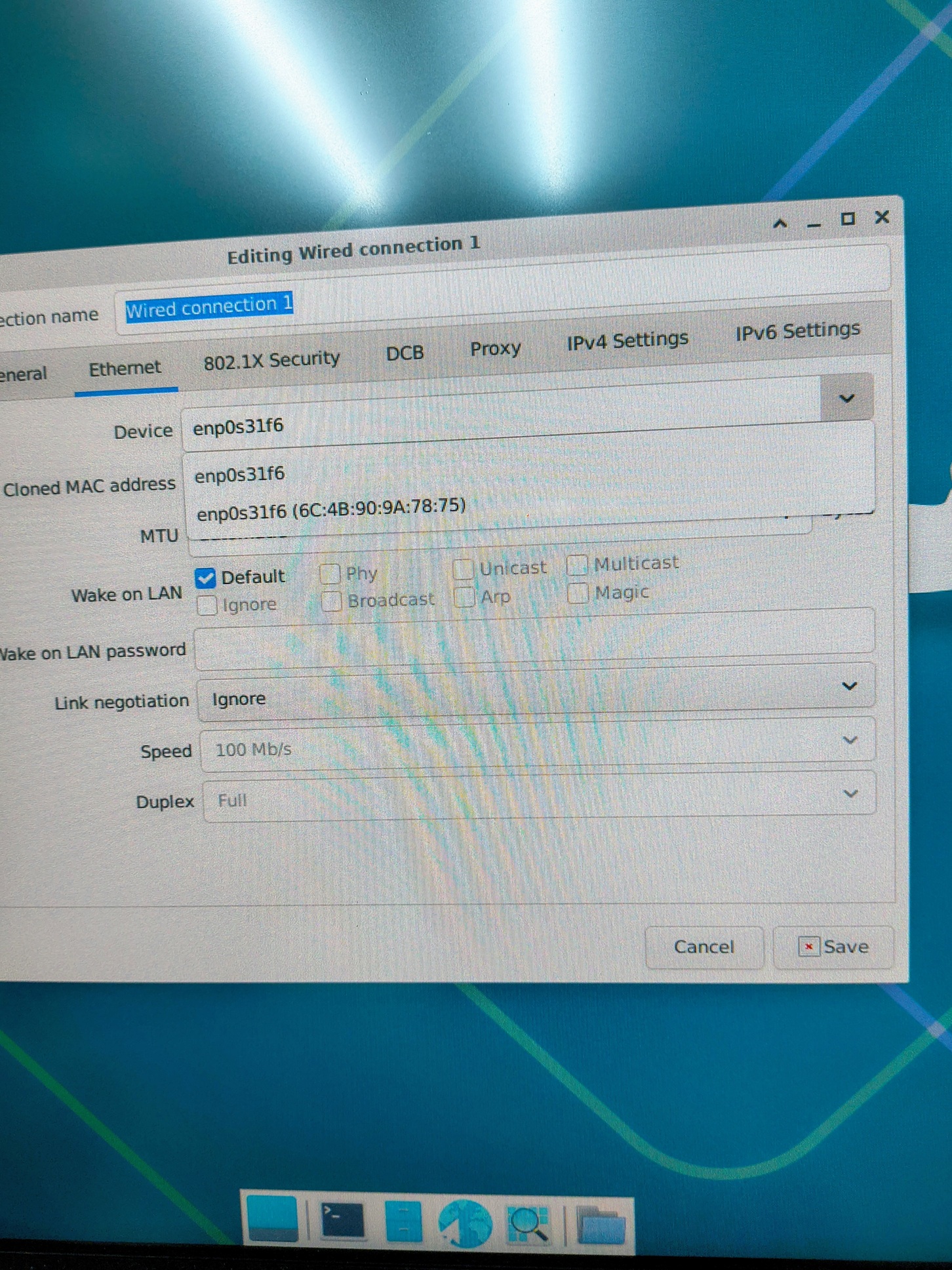
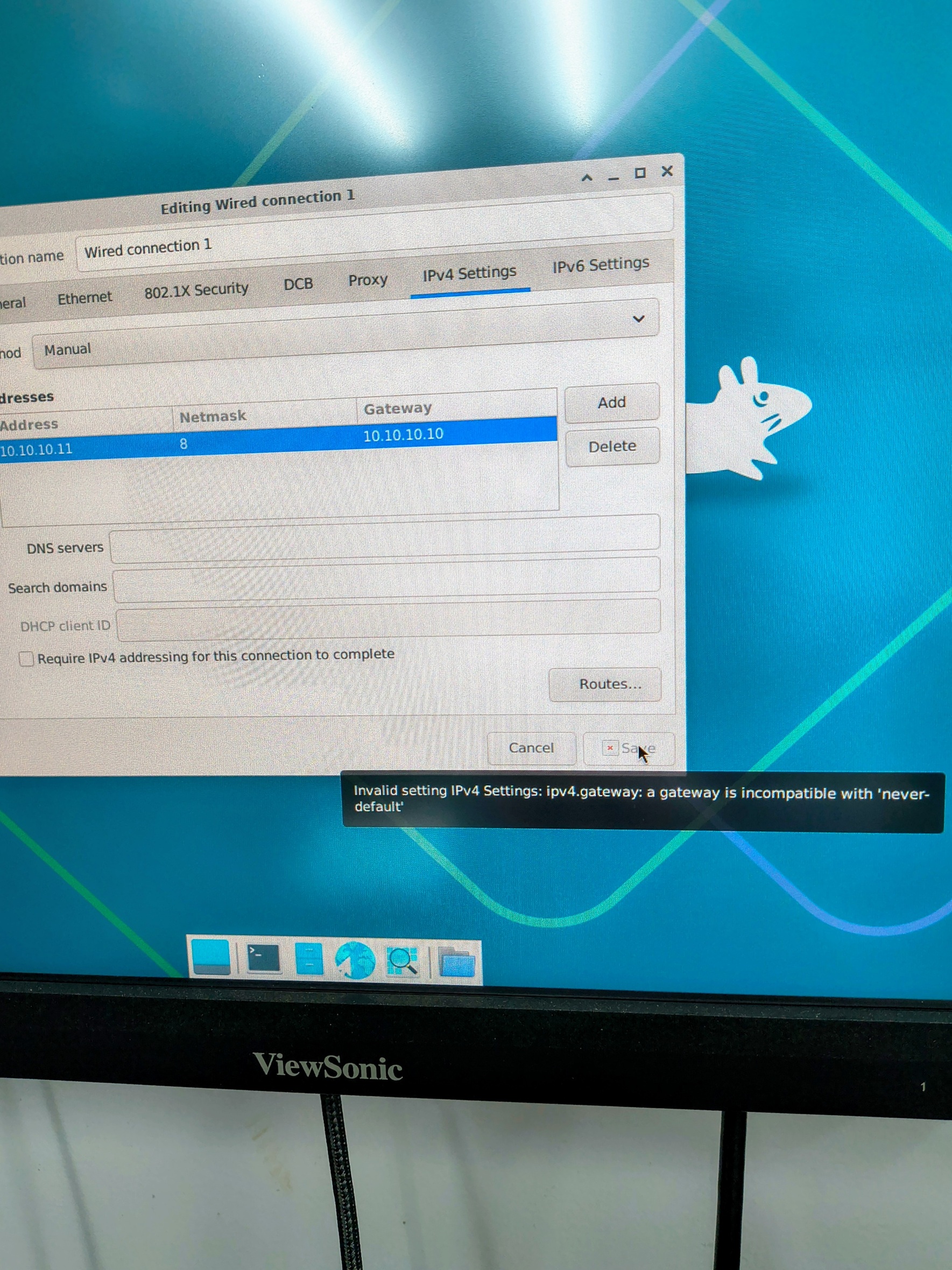
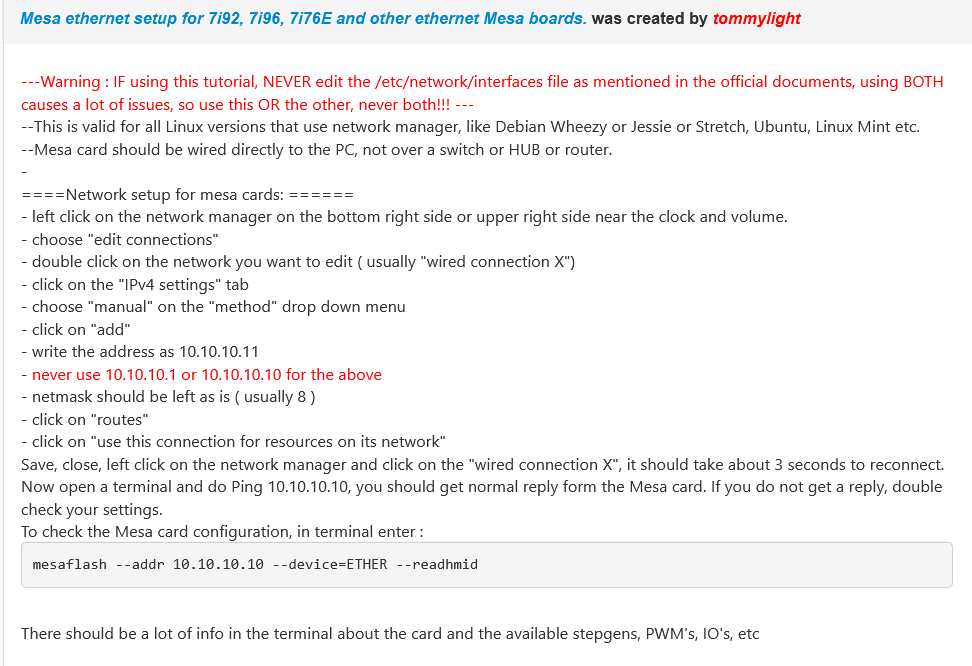
I have spent many hours searching posts and looking for answers. i just can't figure this out. I followed tommylight post on how to configure a wired ethernet connection. When I click save it comes up with a message "a gateway is incompatible with never-default.
The computer is a Lenovo m910q, Intel Core i5-7500T . I am a total newb at linuxcnc, but successfully completed 2 mach 3 machines in the past. please help this senior citizen. Thanks
The computer is a Lenovo m910q, Intel Core i5-7500T . I am a total newb at linuxcnc, but successfully completed 2 mach 3 machines in the past. please help this senior citizen. Thanks
Time to create page: 0.209 seconds