
Search Results (Searched for: raspberry)
- tommylight
-

01 Aug 2026 03:39
Replied by tommylight on topic using linuxcnc on a raspberry pi to prog and test steppers and servos
Yes
Yes
-yes
-yes
-yes, i did, to much for for not much use
Yes
Yes
-yes
-yes
-yes, i did, to much for for not much use
Yes
- tuxcnc
01 Aug 2026 03:20
Replied by tuxcnc on topic using linuxcnc on a raspberry pi to prog and test steppers and servos
You can build this, but it will be absolutely useless.I would like to potentially use linuxcnc on a Raspberry Pi to program and test steppers and servos
- Are there any solutions that I can see samples of or potential uses that are using a Raspberry Pi or Arduino and LinuxCNC to control and test servo and stepping motors?
- One plan is to have a test bench to play with ideas; this will have a controller board, some switches, sliders, connectors for motors, a variable power supply, etc..
- Could LinuxCNC be used for this? i.e can i program it with Python or similar to run my code snippets or a full program?
- When connecting motors that use pulse and direction, will I be able to connect any motor as long as the variable power supply is adjusted to give the right power to the motor?
- Has anyone done this before like this?
- Another plan is to create individual builds that will have one or more motors, sensors, switches, etc.. and will be all built into a case or item as a stand-alone solution. With a customised touch control screen. So when powered on, it boots up and is ready to use and be controlled from the touch control screen.
can linuxCNC be used like this?
- rodw
-

24 Jul 2026 08:21
Replied by rodw on topic using linuxcnc on a raspberry pi to control a boxford 250pc lathe
The Pi4b was marginal, sometimes requiring a slower servo thread but one guy I know says the Pi5 is flawless on real machines
I'd probably pair it with a mesa ethernet card. A Mesa 7i76eU has 5 axes, 16 outputs and 32 inputs but is extensible beyond that.
Linuxcnc supports 9 axes and 32 motors
Arduino is not useful for linuxcnc
There are several GUIs that support lathes but its always best to start with axis until you get everything functional.
Of course we are friendly!
You can mess with everything!
Check the docs as they list the GUI's available but you can write your own. Some support portrait mode.
I checked the other day, there's is over 1800 pages of docs but I always refer to the online docs.
There are no limits to motor size and it will control Ethercat and analog servo motors not just step and direction.
Linuxcnc is far more flexible than Centroid and is complete as opposed to Centroid where additional upgrades are required.
But it may require more effort from you because there are probably more decisions you need to make becsause of LinuxCNC's flexibility
Re Youtube not sure on Lathe specific videos but I have a channel which is trying to produce tutorial type material.
This one is designed to be a general introduction describing the various pathways through Linuxcnc
I'm currently working through a series of videos building a control panel from scratch using a parallel port (3rd one to be released tonight) with a couple more planned. Once fully functional, my plan was to replace the parallel port with other controller options. Sounds like I need to include a lathe walkthrough too!
I'd probably pair it with a mesa ethernet card. A Mesa 7i76eU has 5 axes, 16 outputs and 32 inputs but is extensible beyond that.
Linuxcnc supports 9 axes and 32 motors
Arduino is not useful for linuxcnc
There are several GUIs that support lathes but its always best to start with axis until you get everything functional.
Of course we are friendly!
You can mess with everything!
Check the docs as they list the GUI's available but you can write your own. Some support portrait mode.
I checked the other day, there's is over 1800 pages of docs but I always refer to the online docs.
There are no limits to motor size and it will control Ethercat and analog servo motors not just step and direction.
Linuxcnc is far more flexible than Centroid and is complete as opposed to Centroid where additional upgrades are required.
But it may require more effort from you because there are probably more decisions you need to make becsause of LinuxCNC's flexibility
Re Youtube not sure on Lathe specific videos but I have a channel which is trying to produce tutorial type material.
This one is designed to be a general introduction describing the various pathways through Linuxcnc
I'm currently working through a series of videos building a control panel from scratch using a parallel port (3rd one to be released tonight) with a couple more planned. Once fully functional, my plan was to replace the parallel port with other controller options. Sounds like I need to include a lathe walkthrough too!
- rodw
-
24 Jul 2026 07:55
Replied by rodw on topic using linuxcnc on a raspberry pi to prog and test steppers and servos
easisest way would be to create seperate configs for each option
- Todd Zuercher
23 Jul 2026 09:53
Replied by Todd Zuercher on topic using linuxcnc on a raspberry pi to control a boxford 250pc lathe
In my opinion, some model RPIs (4 or 5) are capable enough to make a control using Linuxcnc, but a PC will generally make a more robust and reliable system, and probably not cost significantly more.
- Zipdodar
23 Jul 2026 08:29 - 23 Jul 2026 08:29
using linuxcnc on a raspberry pi to prog and test steppers and servos was created by Zipdodar
Hi Group
I would like to potentially use linuxcnc on a Raspberry Pi to program and test steppers and servos
I would like to potentially use linuxcnc on a Raspberry Pi to program and test steppers and servos
- Are there any solutions that I can see samples of or potential uses that are using a Raspberry Pi or Arduino and LinuxCNC to control and test servo and stepping motors?
- One plan is to have a test bench to play with ideas; this will have a controller board, some switches, sliders, connectors for motors, a variable power supply, etc..
- Could LinuxCNC be used for this? i.e can i program it with Python or similar to run my code snippets or a full program?
- When connecting motors that use pulse and direction, will I be able to connect any motor as long as the variable power supply is adjusted to give the right power to the motor?
- Has anyone done this before like this?
- Another plan is to create individual builds that will have one or more motors, sensors, switches, etc.. and will be all built into a case or item as a stand-alone solution. With a customised touch control screen. So when powered on, it boots up and is ready to use and be controlled from the touch control screen.
can linuxCNC be used like this?
if so is ther any links to videos or projects that do similer?
Z
- Zipdodar
23 Jul 2026 08:11
using linuxcnc on a raspberry pi to control a boxford 250pc lathe was created by Zipdodar
hi Group
I just purchased a boxford 250pc lathe in a hardely used immaculate condition; however, as per the norm, it has no brain and the internal electronics, although pretty much unused, will be changed over to new stuff so I eliminate any issues and get going properly first time.
I will then likely use all the removed bits for other projects.
Z
I just purchased a boxford 250pc lathe in a hardely used immaculate condition; however, as per the norm, it has no brain and the internal electronics, although pretty much unused, will be changed over to new stuff so I eliminate any issues and get going properly first time.
I will then likely use all the removed bits for other projects.
- controllers
At the moment, I am considering LinuxCNC, Mach 3/4, poss arduino, and Centroid Acorn
So can anyone advise if LinuxCNC on a Raspberry Pi will be powerful enough and good enough to use on a Boxford 250PC lathe with 2-axis, a tool changer, homing limit switches, spindle encoder with z values for threading, spindle speed control, a pump, E-stops, and the potential for another two-axis as well?
- I like the idea of Raspberry Pi as it is small, adaptable, and can be built into cases, etc.. but would I be better off using a PC??
or is the Raspberry Pi the way to go?
or will Arduino be even better?
- I am pretty good at doing stuff, and learn quickly. I have had some experience programming steppers from an Arduino before, but with LinuxCNC is there lots of help information available on the web and youtube etc, and is the forum friendly, helpful, and resourceful when needed?
- What does the linuxCNC use for lathe control software (i.e like mach 3/4 or centroid CNC12)?
Does it work well?
is there any links to see it in action on YouTube?
can it be messed about with to map out the control screen as i would like?
Can the control screen running the lathe control software be used in portrait mode on a reasonable-sized screen?
- With LinuxCNC on a Raspberry Pi, are there any limits to motor sizes in both stepper and servo motors?
Z
- klopp
20 Jul 2026 18:08
lcncgui simple web based linuxcnc GUI was created by klopp
Hey,
I’ve been building a new GUI for LinuxCNC called lcncgui (mainly for my own use) and figured I’d throw it out here. It's a browser based, more "modern" looking UI.
Why browser?
Qt and the classic GUI stuff work fine, but design-wise a browser UI just gives you a lot more room — layouts, touch stuff, dialogs, etc. feel way less constrained (and I'm also not really proficient with qt).
On older PCs this might be an issue, but anyone something somewhat modern like a raspberry pi will be fine.
How it works
Python backend talks to LinuxCNC, frontend talks to the backend over WebSockets. Same role as gmoccapy — set `DISPLAY = lcncgui` and you’re good.
Because it’s network-based, you could also open and control it on another device, e.g. an iPad on the same network.
Control
It’s mainly meant for external buttons / hotkeys (and HAL panel inputs). Softkeys, keyboard, and physical buttons all do the same things.
If you don’t have a panel, there’s a virtual button sidebar so you can still run everything from the screen.
Things that are different from the classic linuxcnc GUI
- Macros — stack operations in a queue (drill, helical bore, face mill, patterns, …), hit go, gets turned into real G-code and opened in the program editor
- G/M-code tooltips — hover/click a code and you get a short explanation instead of digging through the manual
- Tool table — more info than the usual `.tbl` stuff, plus cut presets (RPM, feeds, etc.) so you can set cutting data quickly
- Shutdown — close the GUI, or close it and shut down the PC cleanly afterward
Plus the usual jog/home, DRO, program editor, MDI, overrides, etc.
Still WIP
Some things are missing or half-done (no machine visualization yet, not every macro tile actually generates G-code yet, etc.). Expect rough edges. Also coding was assisted a lot by AI.
Looking for feedback — what feels useful, what’s annoying, what’s missing for real use.
Repo: github.com/salomom/lcncgui
Install via release tarball + `install.sh`, no Node needed on the machine.
If you're running on an older machine, consider installing chromium as your default browser, as it's a bit more performative.
Happy to answer questions.
Cheers,
Tim
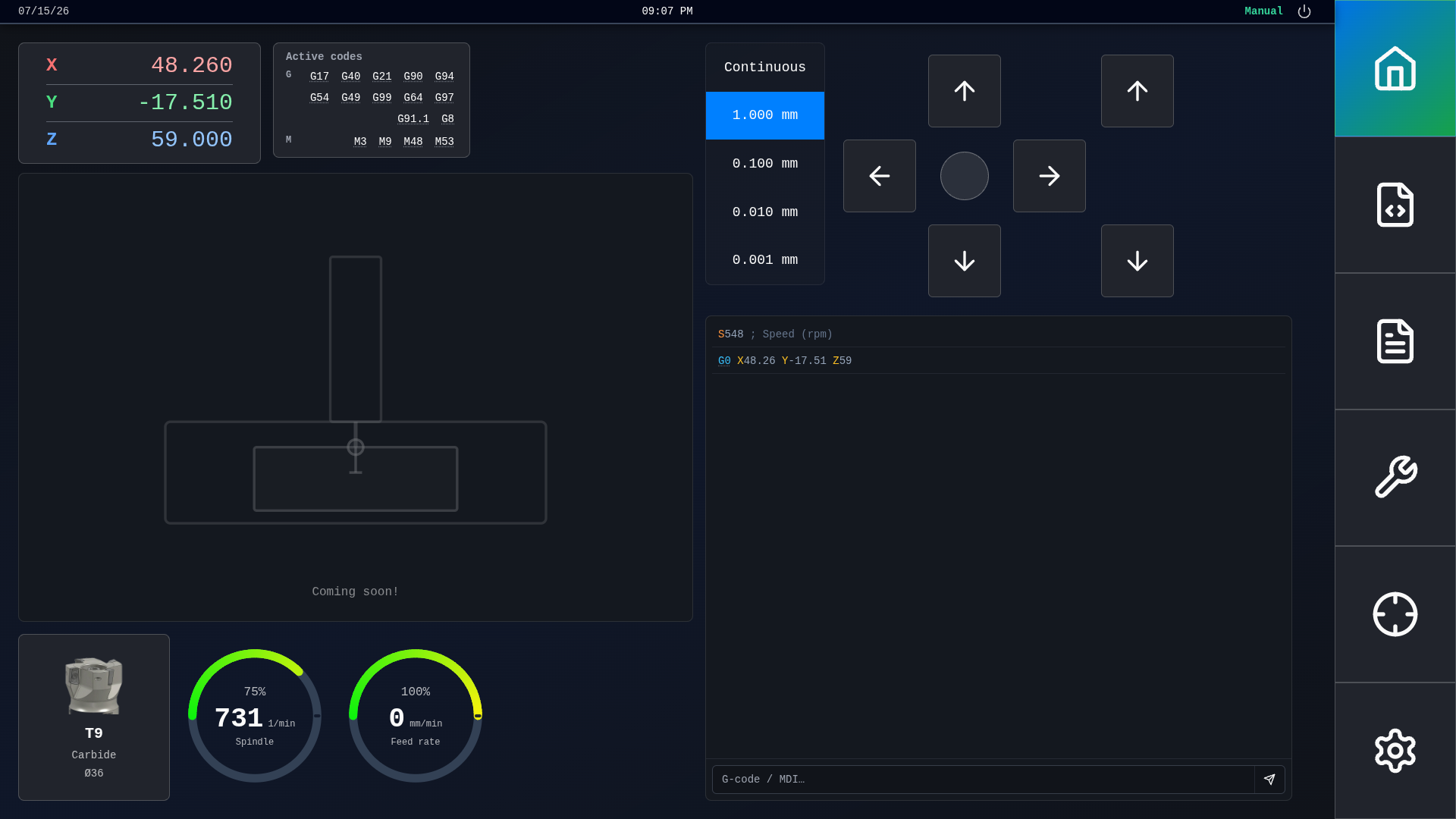
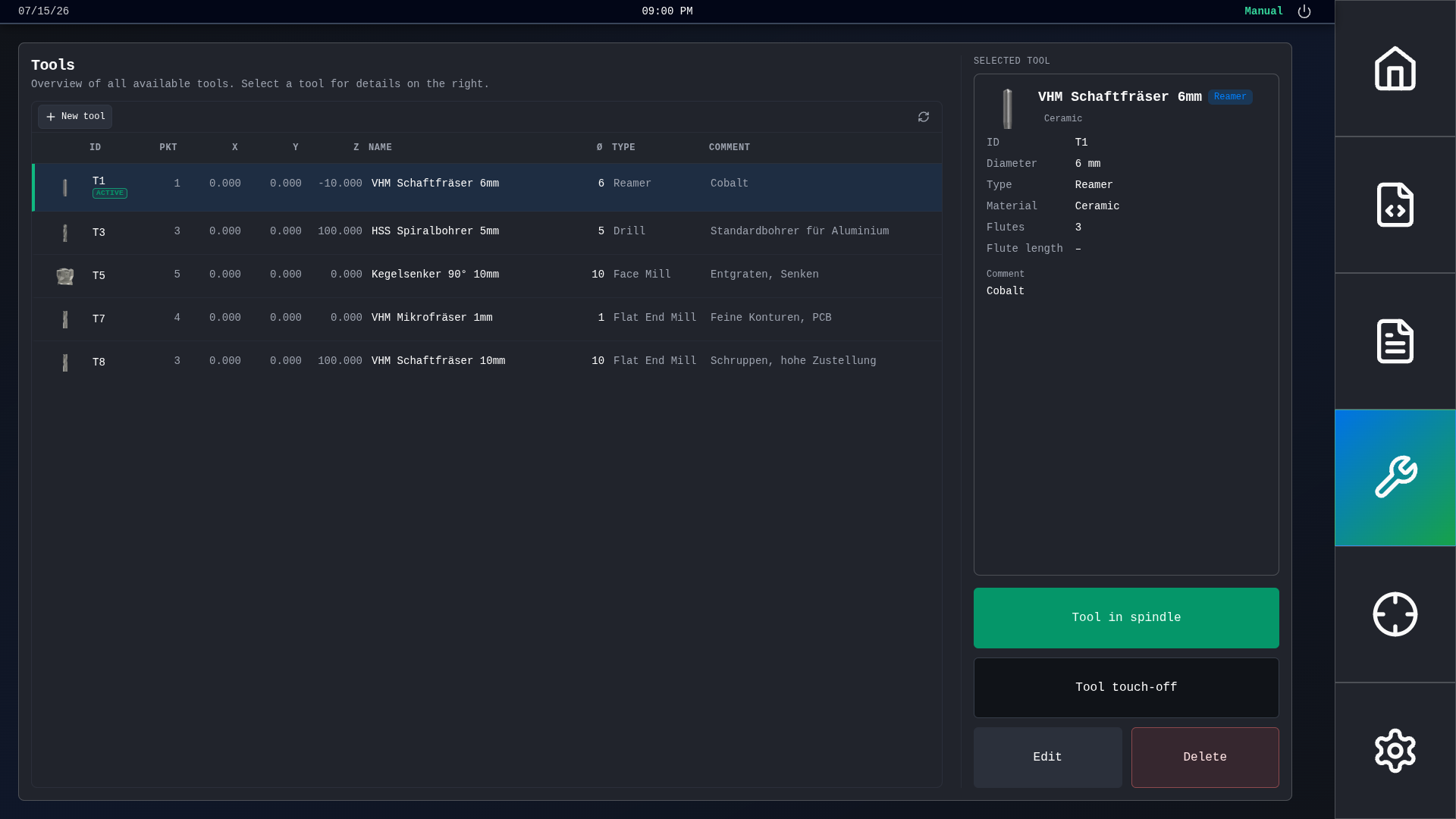
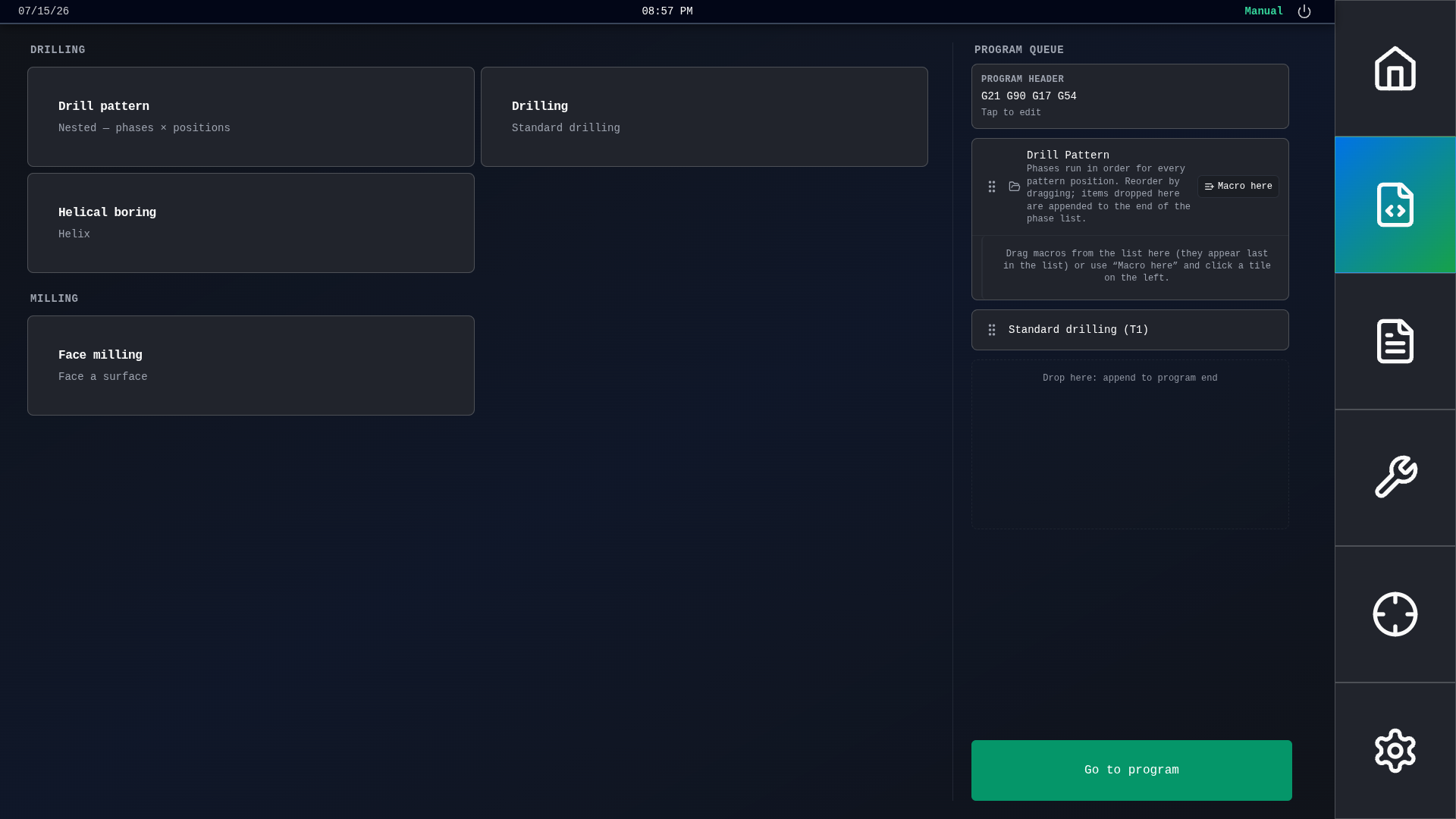
I’ve been building a new GUI for LinuxCNC called lcncgui (mainly for my own use) and figured I’d throw it out here. It's a browser based, more "modern" looking UI.
Why browser?
Qt and the classic GUI stuff work fine, but design-wise a browser UI just gives you a lot more room — layouts, touch stuff, dialogs, etc. feel way less constrained (and I'm also not really proficient with qt).
On older PCs this might be an issue, but anyone something somewhat modern like a raspberry pi will be fine.
How it works
Python backend talks to LinuxCNC, frontend talks to the backend over WebSockets. Same role as gmoccapy — set `DISPLAY = lcncgui` and you’re good.
Because it’s network-based, you could also open and control it on another device, e.g. an iPad on the same network.
Control
It’s mainly meant for external buttons / hotkeys (and HAL panel inputs). Softkeys, keyboard, and physical buttons all do the same things.
If you don’t have a panel, there’s a virtual button sidebar so you can still run everything from the screen.
Things that are different from the classic linuxcnc GUI
- Macros — stack operations in a queue (drill, helical bore, face mill, patterns, …), hit go, gets turned into real G-code and opened in the program editor
- G/M-code tooltips — hover/click a code and you get a short explanation instead of digging through the manual
- Tool table — more info than the usual `.tbl` stuff, plus cut presets (RPM, feeds, etc.) so you can set cutting data quickly
- Shutdown — close the GUI, or close it and shut down the PC cleanly afterward
Plus the usual jog/home, DRO, program editor, MDI, overrides, etc.
Still WIP
Some things are missing or half-done (no machine visualization yet, not every macro tile actually generates G-code yet, etc.). Expect rough edges. Also coding was assisted a lot by AI.
Looking for feedback — what feels useful, what’s annoying, what’s missing for real use.
Repo: github.com/salomom/lcncgui
Install via release tarball + `install.sh`, no Node needed on the machine.
If you're running on an older machine, consider installing chromium as your default browser, as it's a bit more performative.
Happy to answer questions.
Cheers,
Tim
- andreas0480
20 Jul 2026 16:41
7I96S isolated inputs (InM) stopped updating live — read fine at load, then froz was created by andreas0480
Hello,
I have a 7I96S that has developed a specific fault: the 11 isolated field inputs (TB3-01…11, the InM module) stopped updating during operation. They read the correct state once when the hostmot2 driver loads, and then freeze — actuating a switch or the E-stop no longer changes the value in software. The card's own input status LEDs do still follow the switches correctly.
Everything else on the card works normally: Ethernet comms are solid (no packet errors, no watchdog trips), all 5 stepgens drive motors correctly, PWM works.
Setup
- 7I96S, Smart Serial Firmware Version 43, BoardName MESA7I96 per mesaflash --readhmid
- LinuxCNC 2.9.10 (uspace), hostmot2 0.15, hm2_eth 0.2
- Raspberry Pi CM5, Debian 12, PREEMPT_RT kernel; card on a dedicated NIC at 192.168.1.121
- Standard 24 V field sensors; input common (TB3-12) tied to field 0 V
What I have established by testing
1. It worked, then stopped. Early on, inputs updated live (two limit inputs flipped TRUE→FALSE on halmeter when actuated). Later in the same session they froze and have not recovered.
2. Not comms/packet loss. With a stepgen commanded to move, stepgen.NN.position-fb updates live in the same read cycle that the InM inputs stay frozen. A lost/stale read packet would freeze position feedback too — it doesn't.
3. Not debounce. raw-input-NN (undebounced) is frozen as well, so the scan itself is not advancing (scan_rate/fast_scans/slow_scans at defaults).
4. Survives full cold power cycles. The card powers down completely with the Pi; it was fully powered off several times after the freeze and stayed frozen.
5. Firmware config intact. mesaflash --readhmid reads a complete, correct HostMot2 cM module (base 8500).
6. Adding hm2_7i96s.0.read-request to the servo thread did not change the behaviour.
Possible cause on my end: a contactor in the machine failed (fried) shortly before the inputs froze. Its coil ran on the 24V field power. I suspect a transient may have coupled into the input section via a shared ground.
My question: given the inputs read correctly at load but never update live, while thunctional and the firmware reads back intact — does this look like a damaged inputsection that needs repair/replacement, or is there something else I can test first?
Thank you,
Andreas
I have a 7I96S that has developed a specific fault: the 11 isolated field inputs (TB3-01…11, the InM module) stopped updating during operation. They read the correct state once when the hostmot2 driver loads, and then freeze — actuating a switch or the E-stop no longer changes the value in software. The card's own input status LEDs do still follow the switches correctly.
Everything else on the card works normally: Ethernet comms are solid (no packet errors, no watchdog trips), all 5 stepgens drive motors correctly, PWM works.
Setup
- 7I96S, Smart Serial Firmware Version 43, BoardName MESA7I96 per mesaflash --readhmid
- LinuxCNC 2.9.10 (uspace), hostmot2 0.15, hm2_eth 0.2
- Raspberry Pi CM5, Debian 12, PREEMPT_RT kernel; card on a dedicated NIC at 192.168.1.121
- Standard 24 V field sensors; input common (TB3-12) tied to field 0 V
What I have established by testing
1. It worked, then stopped. Early on, inputs updated live (two limit inputs flipped TRUE→FALSE on halmeter when actuated). Later in the same session they froze and have not recovered.
2. Not comms/packet loss. With a stepgen commanded to move, stepgen.NN.position-fb updates live in the same read cycle that the InM inputs stay frozen. A lost/stale read packet would freeze position feedback too — it doesn't.
3. Not debounce. raw-input-NN (undebounced) is frozen as well, so the scan itself is not advancing (scan_rate/fast_scans/slow_scans at defaults).
4. Survives full cold power cycles. The card powers down completely with the Pi; it was fully powered off several times after the freeze and stayed frozen.
5. Firmware config intact. mesaflash --readhmid reads a complete, correct HostMot2 cM module (base 8500).
6. Adding hm2_7i96s.0.read-request to the servo thread did not change the behaviour.
Possible cause on my end: a contactor in the machine failed (fried) shortly before the inputs froze. Its coil ran on the 24V field power. I suspect a transient may have coupled into the input section via a shared ground.
My question: given the inputs read correctly at load but never update live, while thunctional and the firmware reads back intact — does this look like a damaged inputsection that needs repair/replacement, or is there something else I can test first?
Thank you,
Andreas
- Rykagon
12 Jul 2026 19:06
Successful Raspberry Pi 4 Trixie LinuxCNC install. was created by Rykagon
Just completed a successful installation of LinuxCNC version 2.9.8 on a Pi 4 with 4 gig of RAM.
Thanks to forum user "NWE" for recommending the version to download, named below:
2026-01-21-raspios-lcnc-2.9.8-trixie-arm64.zip
After downloading and using balenaEtcher to flash a 256Gig micro SD card, it booted to a Debian 13 Trixie style desktop and opened a "boot wizard". After creating an account, the wizard recommended loading updates. There was trouble after that, the login dialog box wouldn't accept any userids/passwords.
After rebooting and choosing NOT to load s/w updates, everything worked fine.
I'm using LinuxCNC to retrofit a 1990's vintage Intelitek ProLight 3000 CNC lathe. The original lathe was controlled using proprietary h/w and PC-based s/w. I acquired a Mesa 7i76EU board as recommended by Mesa Technical Support so the journey is underway.
I see that LinuxCNC has a Mesa board config tool so I'll use that.
Any advice or coaching for me as an absolute LinuxCNC newbie is much appreciated.
Thanks to forum user "NWE" for recommending the version to download, named below:
2026-01-21-raspios-lcnc-2.9.8-trixie-arm64.zip
After downloading and using balenaEtcher to flash a 256Gig micro SD card, it booted to a Debian 13 Trixie style desktop and opened a "boot wizard". After creating an account, the wizard recommended loading updates. There was trouble after that, the login dialog box wouldn't accept any userids/passwords.
After rebooting and choosing NOT to load s/w updates, everything worked fine.
I'm using LinuxCNC to retrofit a 1990's vintage Intelitek ProLight 3000 CNC lathe. The original lathe was controlled using proprietary h/w and PC-based s/w. I acquired a Mesa 7i76EU board as recommended by Mesa Technical Support so the journey is underway.
I see that LinuxCNC has a Mesa board config tool so I'll use that.
Any advice or coaching for me as an absolute LinuxCNC newbie is much appreciated.
- HIBA
10 Jul 2026 21:46
Flexi-HAL – “hard limits tripped”, home inputs read as permanently triggered was created by HIBA
Hi, I bought a used Rat Rig StrongHold that ran fine for the previous owner. I re-flashed a fresh Flexi-Pi image and now I’m stuck. Setup: • Rat Rig StrongHold, Flexi-HAL (STM32F4, SPI), Raspberry Pi 4• LinuxCNC 2.9.8, QtDragon_hd 1.5• remora-flexi config (~/linuxcnc/configs/flexi-hal/)• Gantry: TWO Y motors (joint.1 + joint.3), but only ONE Y limit sensor• Sensors: Heschen SN04-N2 (inductive, NPN, NC) Problem: • Status shows “hard limits tripped”, machine won’t turn ON• HOME X / HOME Y / HOME Z read as triggered (red) permanently in the INPUTS panel, machine sitting free in the middle• The separate “LIMIT” input does NOT light up Key finding — this is the important part: • If I DISCONNECT a limit switch, NOTHING changes — the home input stays triggered.• So the input reads as permanently active regardless of whether a sensor is connected or not.• Toggling .not on the home-sw-in lines in the HAL does nothing either. Commenting the lines out completely also changes nothing.• The sensors themselves work fine (LED on sensor and breakout board switches with metal, they have power). I did NOT change any wiring — it’s exactly as it ran for the previous owner. So it seems the inversion/logic is not on the LinuxCNC side at all. My question: Where does the limit/home input polarity get set for the Flexi-HAL? Is it a grblHAL firmware setting on the board itself (like $5 invert limit pins, or an NC/NO setting), separate from the LinuxCNC HAL/INI? If so, how do I read and change it — through LinuxCNC, or do I need to connect to the board another way? Since disconnecting the switch doesn’t change the input at all, I suspect the board is configured to expect the opposite switch type (or the pins are inverted at the firmware level). Also (probably separate): MODBUS ERRORS counter keeps climbing (was ~174, rising), FAULT 0x0 — that’s the VFD/RS485 side (vfdmod, set for Durapulse GS10 by default). Happy to post photos of the board, breakout PCB, INPUTS panel, and my full HAL/INI. Thanks a lot!
- Rykagon
06 Jul 2026 18:03
Newbie asking for resources and advice was created by Rykagon
Hello All,
I'm attempting to retrofit a 90's vintage Intelitek Prolight 3000 lathe. This is a small slant bed CNC lathe marketed to high school and technical college programs, and originally controlled by proprietary electronics and a desktop PC.
The plan is to use LinuxCNC on a Raspberry Pi 4, mated with a Mesa 7i76EU board, along with TB6600 stepper drivers to control and X- and Z-axes as well as a stepper driven 8 position tool changer. The spindle motor speed is analog controlled 0 - 10 volt signal input.
I have zero experience with most of this and would appreciate any coaching on:
- which Linux distro to load on the Pi 4.
- any resources for configurations, etc.
- any other stuff I don't even know that I don't know.
Thanks in advance!
I'm attempting to retrofit a 90's vintage Intelitek Prolight 3000 lathe. This is a small slant bed CNC lathe marketed to high school and technical college programs, and originally controlled by proprietary electronics and a desktop PC.
The plan is to use LinuxCNC on a Raspberry Pi 4, mated with a Mesa 7i76EU board, along with TB6600 stepper drivers to control and X- and Z-axes as well as a stepper driven 8 position tool changer. The spindle motor speed is analog controlled 0 - 10 volt signal input.
I have zero experience with most of this and would appreciate any coaching on:
- which Linux distro to load on the Pi 4.
- any resources for configurations, etc.
- any other stuff I don't even know that I don't know.
Thanks in advance!
- galmiklos
24 Jun 2026 14:14 - 24 Jun 2026 14:21
Replied by galmiklos on topic Cannot get out of Estop
I found the culprit! 
Apparently, the customized component that handles the SPI communication with the customized remora-spi firmware is not compatible with trixie.
This is the part in the code that breaks it.
The soc ranges path is different in trixie.
I modified the component so, that when the path does not exist, I just consider it as a Raspberry Pi 5 with RP1 chip, and now it works!
I know it's just a quick and dirty workaround, but works for me.
Apparently, the customized component that handles the SPI communication with the customized remora-spi firmware is not compatible with trixie.
This is the part in the code that breaks it.
Code:
int rt_peripheral_init(void)
{
int memfd;
FILE *fp;
// assume were only running on >RPi3
if ((fp = fopen("/proc/device-tree/soc/ranges" , "rb")))
{
The soc ranges path is different in trixie.
Code:
root@raspberrypi:~# hd /proc/device-tree/soc\@107c000000/ranges
00000000 00 00 00 00 00 00 00 10 00 00 00 00 80 00 00 00 |................|
00000010
I modified the component so, that when the path does not exist, I just consider it as a Raspberry Pi 5 with RP1 chip, and now it works!
Code:
if ((fp = fopen("/proc/device-tree/soc/ranges" , "rb")))
{
. . . . . . . . .
}
else
{
DEBUG_PRINT("Raspberry Pi 5, using RP1 driver\n\n");
rp1 = true;
}
I know it's just a quick and dirty workaround, but works for me.
- emmaleo
03 Jun 2026 00:32
What PC or Hardware Works Best for LinuxCNC? was created by emmaleo
Hey everyone!
I'm pretty new to LinuxCNC and I'm trying to figure out what kind of computer or hardware setup works best for running it smoothly.
I've been reading some posts about latency issues and it got me kinda confused lol. Like, does it matter a lot what CPU or motherboard you use? And is a regular desktop PC always better than something like a mini PC or a single board computer (like Raspberry Pi)?
Here's kind of my situation:
- I don't have a huge budget, so I want something reliable but not super expensive
- I'll mostly be using a parallel port or maybe Ethernet-based motion controller
- Low latency is really important I think, but I don't fully understand how to test for it yet
I've been browsing some options online, maybe these can help others too:
www.amazon.com/s?k=mini+pc+intel+n100
www.ebay.com/sch/i.html?_nkw=dell+optiplex+linuxcnc
etechdevices.com/collections/pc-servers-software
If anyone can share what PC or hardware setup they're using and whether it runs well, that would be super awesome! Even just a quick "this works great" or "avoid this" would help a lot.
Thanks so much in advance, you guys seem really helpful here!
I'm pretty new to LinuxCNC and I'm trying to figure out what kind of computer or hardware setup works best for running it smoothly.
I've been reading some posts about latency issues and it got me kinda confused lol. Like, does it matter a lot what CPU or motherboard you use? And is a regular desktop PC always better than something like a mini PC or a single board computer (like Raspberry Pi)?
Here's kind of my situation:
- I don't have a huge budget, so I want something reliable but not super expensive
- I'll mostly be using a parallel port or maybe Ethernet-based motion controller
- Low latency is really important I think, but I don't fully understand how to test for it yet
I've been browsing some options online, maybe these can help others too:
www.amazon.com/s?k=mini+pc+intel+n100
www.ebay.com/sch/i.html?_nkw=dell+optiplex+linuxcnc
etechdevices.com/collections/pc-servers-software
If anyone can share what PC or hardware setup they're using and whether it runs well, that would be super awesome! Even just a quick "this works great" or "avoid this" would help a lot.
Thanks so much in advance, you guys seem really helpful here!
- Muecke
-

31 May 2026 18:16
LinuxCNC 2.9 / Debian 12 RT – EtherCAT Master Setup für 750W Servo gesucht was created by Muecke
Hallo zusammen,
ich versuche aktuell einen StepperOnline 750W EtherCAT AC-Servomotor (17-bit Absolutencoder, ohne Bremse) in mein LinuxCNC System zu integrieren.
Der Motor ist bereits mechanisch und elektrisch angeschlossen (Netzfilter, Treiber, Motor + Encoder), soweit ist die Hardware grundsätzlich lauffähig.
Mein Ziel ist es, LinuxCNC als EtherCAT Master einzurichten, um zunächst den einzelnen Motor in Betrieb zu nehmen und später mehrere Achsen meiner Maschine schrittweise auf EtherCAT umzubauen.
Ich hatte bereits einen ersten Installationsversuch mit EtherCAT (vermutlich IgH oder SOEM / LinuxCNC Integration), dabei traten jedoch wiederholt Fehler auf. Nach meiner (mehr GPT) Analyse waren vermutlich noch Reste einer früheren (nicht sauberen) Installation bzw. evtl. Raspberry-Pi-bezogene Pakete oder Konfigurationen im System vorhanden, die Konflikte verursacht haben könnten. Diese habe ich inzwischen entfernt bzw. bereinigt, mit GPT.
Aktuell möchte ich deshalb bewusst mit einer sauberen und nachvollziehbaren Schritt-für-Schritt Anleitung neu beginnen, da ich vermeiden möchte, erneut eine fehlerhafte Konfiguration aufzubauen, die ich nicht verstehe.
Ziel ist es zunächst:
- einen einzelnen EtherCAT Servo in LinuxCNC zu betreiben
- einfache Bewegungen und Tests durchzuführen
- später schrittweise weitere Motoren der Maschine (Masacard/Alt-System) auf EtherCAT umzubauen
- langfristig die gesamte Anlage auf EtherCAT umzustellen
---
## Systeminformationen
Distribution:
Debian GNU/Linux 12 (bookworm)
Kernel:
6.1.0-48-rt-amd64 (PREEMPT_RT)
LinuxCNC:
2.9.8 (linuxcnc-uspace)
CPU:
Intel Core i3-6100 @ 3.70 GHz (4 Threads)
RAM:
8 GB
Storage:
Toshiba SSD ~120 GB (ext4)
Network:
- enp1s0: Realtek RTL8111/8168/8411 (r8168 driver) – DOWN
- enp2s0: Realtek RTL8111/8168/8411 (r8168 driver) – UP (100 Mbit/s)
Kernel Modules:
r8168 driver is used for both NICs
PCI:
Intel H110 chipset system
---
## Kernel / RT Status
PREEMPT_RT kernel is active and confirmed.
---
## Frage
Ich suche eine saubere, empfohlene Vorgehensweise zur Installation und Konfiguration von EtherCAT (z. B. IgH EtherCAT Master oder alternative Lösung) in Kombination mit LinuxCNC 2.9.x auf Debian 12 RT.
Wichtig ist mir vor allem:
- stabile Echtzeitfähigkeit
- keine “versteckten” alten Pakete oder Konflikte
- möglichst nachvollziehbare Schritt-für-Schritt Installation
- Empfehlung für Netzwerkinterface (Realtek vs. alternative NIC falls nötig)
Vielen Dank für jede Hilfe!
Mücke
ich versuche aktuell einen StepperOnline 750W EtherCAT AC-Servomotor (17-bit Absolutencoder, ohne Bremse) in mein LinuxCNC System zu integrieren.
Der Motor ist bereits mechanisch und elektrisch angeschlossen (Netzfilter, Treiber, Motor + Encoder), soweit ist die Hardware grundsätzlich lauffähig.
Mein Ziel ist es, LinuxCNC als EtherCAT Master einzurichten, um zunächst den einzelnen Motor in Betrieb zu nehmen und später mehrere Achsen meiner Maschine schrittweise auf EtherCAT umzubauen.
Ich hatte bereits einen ersten Installationsversuch mit EtherCAT (vermutlich IgH oder SOEM / LinuxCNC Integration), dabei traten jedoch wiederholt Fehler auf. Nach meiner (mehr GPT) Analyse waren vermutlich noch Reste einer früheren (nicht sauberen) Installation bzw. evtl. Raspberry-Pi-bezogene Pakete oder Konfigurationen im System vorhanden, die Konflikte verursacht haben könnten. Diese habe ich inzwischen entfernt bzw. bereinigt, mit GPT
.Aktuell möchte ich deshalb bewusst mit einer sauberen und nachvollziehbaren Schritt-für-Schritt Anleitung neu beginnen, da ich vermeiden möchte, erneut eine fehlerhafte Konfiguration aufzubauen, die ich nicht verstehe.
Ziel ist es zunächst:
- einen einzelnen EtherCAT Servo in LinuxCNC zu betreiben
- einfache Bewegungen und Tests durchzuführen
- später schrittweise weitere Motoren der Maschine (Masacard/Alt-System) auf EtherCAT umzubauen
- langfristig die gesamte Anlage auf EtherCAT umzustellen
---
## Systeminformationen
Distribution:
Debian GNU/Linux 12 (bookworm)
Kernel:
6.1.0-48-rt-amd64 (PREEMPT_RT)
LinuxCNC:
2.9.8 (linuxcnc-uspace)
CPU:
Intel Core i3-6100 @ 3.70 GHz (4 Threads)
RAM:
8 GB
Storage:
Toshiba SSD ~120 GB (ext4)
Network:
- enp1s0: Realtek RTL8111/8168/8411 (r8168 driver) – DOWN
- enp2s0: Realtek RTL8111/8168/8411 (r8168 driver) – UP (100 Mbit/s)
Kernel Modules:
r8168 driver is used for both NICs
PCI:
Intel H110 chipset system
---
## Kernel / RT Status
PREEMPT_RT kernel is active and confirmed.
---
## Frage
Ich suche eine saubere, empfohlene Vorgehensweise zur Installation und Konfiguration von EtherCAT (z. B. IgH EtherCAT Master oder alternative Lösung) in Kombination mit LinuxCNC 2.9.x auf Debian 12 RT.
Wichtig ist mir vor allem:
- stabile Echtzeitfähigkeit
- keine “versteckten” alten Pakete oder Konflikte
- möglichst nachvollziehbare Schritt-für-Schritt Installation
- Empfehlung für Netzwerkinterface (Realtek vs. alternative NIC falls nötig)
Vielen Dank für jede Hilfe!
Mücke
Time to create page: 0.740 seconds