
Search Results (Searched for: stepper spindle)
- fmueller
- fmueller
Standalone LinuxCNC machine simulator using the Stepper-Ninja HAL interface
Category: General LinuxCNC Questions
- If LinuxCNC requests tool T5 but the operator installs the wrong tool, the simulator should use the geometry of the tool that was actually installed.
- If the physical tool length differs from the value in LinuxCNC's tool table, that difference should affect the machining result.
- A virtual toolsetter should be able to detect the actual tool length, just like a real toolsetter.
- Incorrect offsets, incorrect tools, or incorrect workpiece positioning should be capable of producing incorrect machining results or collisions.
- fmueller
- fmueller
Standalone LinuxCNC machine simulator using the Stepper-Ninja HAL interface
Category: General LinuxCNC Questions
I've been working on a standalone CNC machine simulator for LinuxCNC and have now published the first experimental version.
The main idea is that the simulator does NOT interpret G-code itself.
LinuxCNC remains responsible for G-code interpretation, trajectory planning, coordinate systems, offsets and compensation. The simulator sits behind LinuxCNC where real motion hardware would normally be connected.
Currently I use the original Stepper-Ninja HAL driver and its UDP protocol as the interface:
G-code
|
v
LinuxCNC
|
v
Trajectory planner / compensation
|
v
Original Stepper-Ninja HAL driver
|
| UDP
v
linuxcnc-sim
|
+-- virtual machine motion
+-- virtual digital inputs
+-- limit switches
+-- probe input
+-- OpenGL visualization
+-- voxel workpiece
+-- material removal
The important part of this approach is that the simulator sees the motion that LinuxCNC actually sends to the virtual hardware instead of trying to reproduce LinuxCNC's trajectory planner.
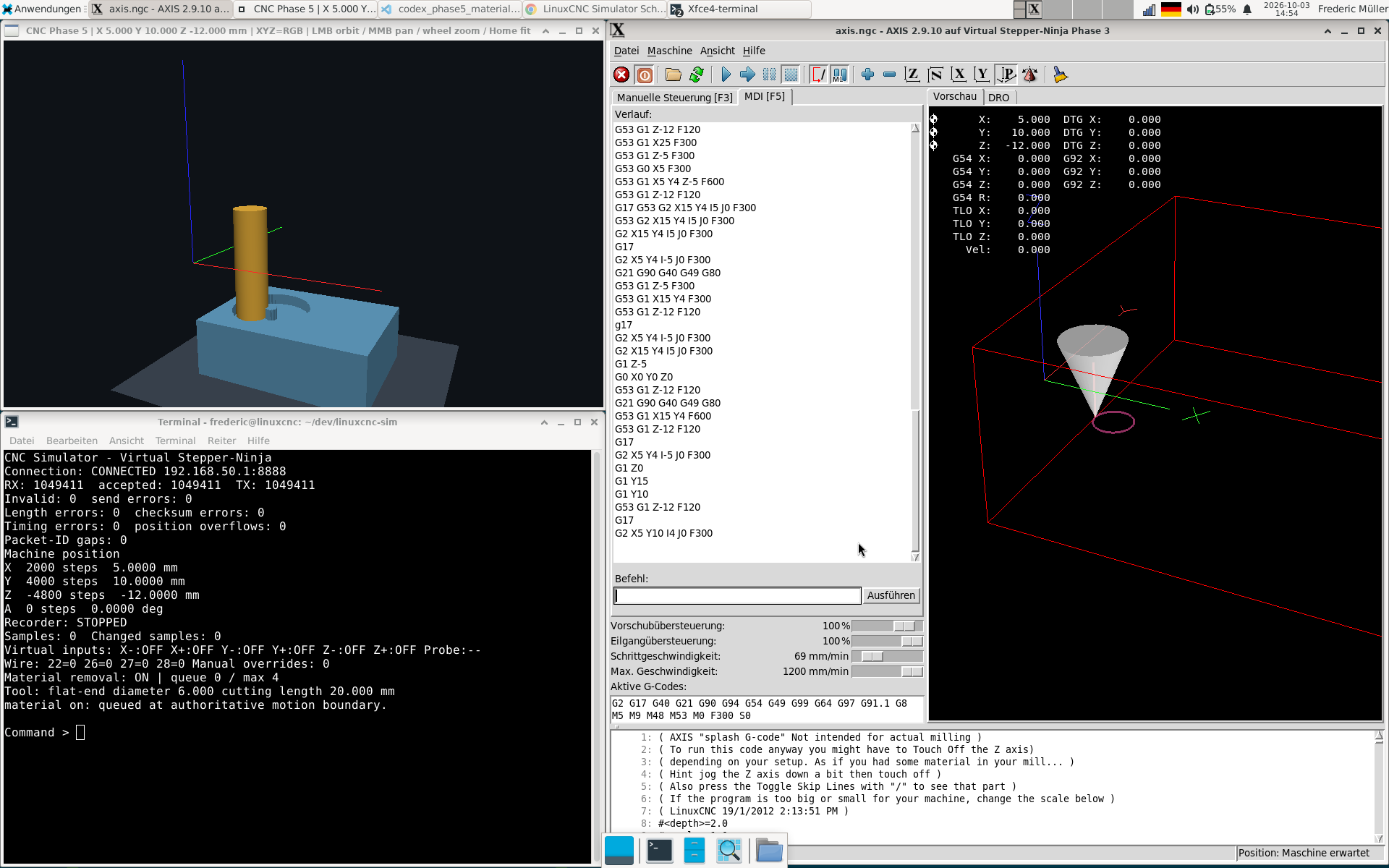
Communication is bidirectional. The simulator can also send virtual machine inputs back to LinuxCNC. I can already use this for limit switches, homing and a simple configurable probe plane.
The current version also contains a sparse voxel workpiece and persistent material removal. Tool movement is processed as continuous swept volumes rather than just removing material at individual sampled positions.
One interesting problem was performance during curved motion. LinuxCNC can generate many small motion segments. Instead of approximating those segments with a larger chord, I batch the actual swept segments for a short time window and calculate the union of their removal volumes. This keeps the resulting voxel state identical while greatly reducing repeated work.
At the moment the simulation is still quite limited:
- flat-end cutter only
- no geometric stock probing yet
- no toolsetter yet
- no spindle/holder model
- no general collision detection
- no rotary material transform
The next area I would like to work on is geometric contact detection. My idea is to use the same contact system later for workpiece probing, a machine-fixed toolsetter and eventually collision detection.
Stepper-Ninja is currently just the interface between LinuxCNC and the simulator. A physical machine does not need to use Stepper-Ninja hardware. I chose it because an existing LinuxCNC HAL driver and a small bidirectional protocol already existed, so I did not have to invent another LinuxCNC hardware interface.
This is my first public release and I consider it experimental development software, not a machine safety system.
Source and v0.1.0:
github.com/FredericM88/linuxcnc-sim
I would be particularly interested in feedback about the architecture. Does placing the simulator behind LinuxCNC at the hardware interface make sense to you? Are there LinuxCNC behaviours or use cases that would be especially useful to test with this approach?
Frederic
- BreadMonkey
- BreadMonkey
New User Lichuan CL3 57E and Stepper Online A6 - Problems
Category: EtherCAT
I am trying to get a 3 axis mill up and running. I am using three CL3 57E drivers for the axis(es) and have a A6 750w Servo motor for the spindle.
Debian is up and working and Ethercat is installed. The cia402 is also integrated. Everything boots and looks good. I am running Linuxcnc 2.9.10.
UI is qt_dragon. Slaves are all there and go over to OP when linuxcnc starts... There are no errors other than a 5000 ns time out for the CL3 57Es no time out error for the A6 though? The Stepper motors do not energize... No buzzing, nothing and can be moved by hand.
Button for the coolant work in the UI but the motors will not (just the CL3 57Es) activate and move. I don't know if I have missed something... I have spent the last 3 days searching the forum looking for answers and trying different things. It would be great if you guys could take a look at my config files and let me know what I missed.
Thanks
- rodw

External ESTOP trouble
Category: Installing LinuxCNC
on a home machine, often a 2 pole estop button is used. one pole cuts mains power to spindle and stepper motors and the other is low voltage circuit wired to linuxcnc to tell the controller estop has been pressed. But this does not safely bring heavy machines to a stop so it gets more complicated. Also its not helpful if you have the control panel at one end of a plasma table and you want to place an estop at the other end where the console is. One approach might be to run a pull rope right around the table but running mains power to another distant switch clearly adds its own safety risks.
I suspect estop-latch predates the standards but it does allow you to create an estop chain in software. It is somewhat complicated to understand initially and I find its best to draw it on paper as a series of boxes (one for each estop-latch) each of these boxes has an OK-out pin which needs to connect to the reset pin on the next in the chain with the last OK-out connected to iocontrol.emc-enable
Each latch will have either a fault-in or ok-in pin attached to the estop button or door latch or whatever that needs to be safe before the machine will start. Finally, the iocontrol.user-request-enable pin is attached to the reset pin on the very first latch. So when the user requests the machine to be enabled (usually the orange button in axis), a short pulse is sent to the first reset and if all faults are clear, the sigal to start the machine arrives at linuxcnc. The beauty of this approach is that you can just as easily use a momentary push button to act as that reset signal if you wish.
Taking that into the standards says the controller can have no part in the safety circuit, and every sub-circuit and every contactor needs to have dual redundancy so a fault will not trigger anything and both circuits need to work before something's enabled. Also if there is a power outage, the machine cannot become live again when power is restored. You need to press that reset button. Also every contactor and every relay needs to be a force guided one where a non conducting pin is forced between relay contacts to guard against them welding closed from an arc.. Aside from that the safety circuit or safety relay does the same thing as estop-latch. It won't enable the machine until every component being monitored is safe.
- tommylight

Trying to figure out all the Mesa cards and stepper drivers for Clausing Kondia
Category: Milling Machines
-most often and by far the main reason such transformers fail is incorrect wiring, and no i do not mean messing the 3 wire plus ground wiring, i mean the input wiring on such transformers, reason being they all have multiple input voltages that can and should be set by moving metal bars on certain screw posts for certain voltages, giving two failure options:
1. incorrect voltage selection set - when set lower than actual voltage causes higher current draw and subsequent heat, so failure is slow and usually ignored until to late
2. incorrect windings set with the metal bars causing huge current draw and distinct buzzing noise from the transformer, leading to overheating and burning of the windings in a short time.
The thing is, in both cases the machine works, and due to the noises all machines make drowns the transformer noise, leading to failed transformer noticed only when it is to late to do anything about it.
-
Personally from experience, that is the first thing i check on any machine with input transformer, seen to many go to waste as local "experts" will never learn that we do not have 3x220V here, we have 3x380V here, only when using neutral we have 220V. It is sickening the amount of transformers and spindles/VFD and servo motors/drives i have seen burned here because of that.
- cyborg-pete
- cyborg-pete
AXYZ 4008 retrofit – original steppers/drives + Mesa 7I95T + LinuxCNC
Category: CNC Machines

LinuxCNC PC
     |
   Ethernet
     |
 Mesa 7I95T
     |
     +---- STEP/DIR ---- original Pacific Scientific drives
     |                         |
     |                    original Vexta motors
     |
     +---- Inputs ------- limits/home/tool sensor
     |
     +---- Outputs ------ spindle enable / auxiliaries
     |
+---- 0–10 V interface ---- original VFD ---- spindle5VDC
GND
TOOL SENSOR
LIMIT SENSOR
1 ACTIVATE / 1 DOWN
2 ACTIVATE / 2 DOWN
3 ACTIVATE / 3 DOWN
4 ACTIVATE / 4 DOWN
SPINDLE
INPUT 3
INPUT 4- Get LinuxCNC communicating reliably with the 7I95T.
- Connect one original 6410 drive and establish STEP/DIR operation.
- Jog X/Y/Z correctly.
- Identify and interface the existing home/limit sensors.
- Implement a proper hardware E-stop.
- Start/stop the existing VFD/spindle.
- Add 0–10 V spindle-speed control.
- Make the first test cut.
- Todd Zuercher

DIY CNC
Category: Milling Machines
There are even some special things that you can do using a parallel port that you can't really easily do with Mesa cards and hardware stepgens. I had a machine that I retrofitted to Linuxcnc, that I wanted to keep the ability to plug in and reuse the original control. It had it's own driver box for the step motors and used individual commands to directly trigger the stepper coils rather than traditional step/dir commands. I was able to directly replicate those signals using Linuxcnc's software stepgen and output them to a parallel port.
- NWE
DIY CNC 2
Category: Milling Machines
How many stepper drives? If 3, then we're looking at 4 amps per motor * 3 = 12 amps total. Your stepper drives will draw less than that. Now, cheap PSUs tend to be overly optimistic with their current rating. I think your PSUs are easily sized double what these specs require. Which I think is a good plan. Go for it. I would buy that.So based upon what I'm using you don't think I need to swap out for a different PSU that has said protections?
Your twisted pair cable looks great. I was just coming back with a suggestion 18 Gauge 4 Conductor Shielded when I noticed your post.
- dst
- dst
Prvomajska G301 Milling machine converting to CNC
Category: Milling Machines
More than10 years ago (at that time i just started my studies) my father found a great milling machine in a scrapyard, Prvomajska G301 D1 manufactured in 1973 , the machine seems to be almost not used at all, unfortunately it was subject to weather changes and most of the axis were locked up by rust, its spindle motor and holding bracket broken off and x axis gearbox with motor broken off. Back when he brought it home we started to disassemble, we removed some parts from its quill and then life happened we left it on the field covered with plastic sheets as there was no more space on the workshop.
Recently we removed some things from the shop and got some place for the mill and we placed it inside, past week we were working very hard to clean up the rest of the machine and mount it back, so far the worst part is that its spindle bearing are quite rusty and once we get the rest sorted out will have to be replaced (altho, i still dont know where we could find it).
Attached are images of before and after cleanup and a picture of a machine we found online.
Couple of decisions weve come up with so far regarding the mechanical parts are as following:
Z-Axis: The Z-Axis has 36mm trapezoidal screw moved through bevel gears from the handle and the nut is bolted on the base of the machine offset by an iron piece, maybe can be seen from a picture when the saddle traverse was removed. Since we couldnt find a neat way to put a ball screw, also, were assuming the ball screw having less friction forces the z axis will just fall down, weve decided to leave the original screw and return back to it if we find any issue later on, following This Old Tony's conversion of his Maho and leaving its Z axis with trapezoidal screw, we're expecting the same...
X/Y-Axis: Both have 28mm trapeziodal screws with anti-backlash nut with pitch of 5mm. The nuts hole on the casting for both sides is 40mm which to our research matches the 25mm ballscrew so it is more or less the driving factor to chose 25mm ballscrews.
Issue #0: Throughout this project we always find it challenging to transport anything to place where we live due to some political issues and locally there is no store that sells parts. One of the solution we've found is a middleman in Germany that transports things to here so more or less we always have to check for delivery to Germany and goods that arent subject to VAT...
Question #1: We plan to travel to a nearby country that has ballscrews however im a little bit confused by Dynamic load rating and Static load rating related to price. A low price offers C(dyn) ~ 1100kgf and C(0) ~ 2700kgf, while a 5 times the low price C(dyn) ~ 1700kgf and C(0) ~ 5000kgf, but a 6 times the low price we can get a C(dyn) ~ 14900kgf and C(0) ~ 41500kgf... I'd appreciate a suggestion if going with the low price option is sufficient, as the 5 times the price seems to not gain much for the added cost and the last option seems like a straight up overkill..
Question #2: For the Motors to drive the axis of the machine, were planning to place stepperonline servo motors rated at 1kW ( link ) but interestingly they seem to have EtherCAT servos as well so im kinda on a edge here.. I was originally planning to go with mesa cards prior to seeing the EtherCAT options, but now i kinda dont mind the added cost for EtherCAT, however, my father hopes to use the machine as a manual mill but he isnt very technophile so we will have to add quite some buttons and dials rather than use the keyboard/mouse to control the machine manually and for this we will need some IO, so, is there any EtherCAT IO that i can daisy chain to the system? I have no experience with EtherCAT so i dont know what im getting into... does LinuxCNC need to support the mentioned drive? Do we have to expect support from the manufacturer for the application? Is it doable?
Question #3: If i was to go with normal drives, i cant really decide on the loop's of the system and therefore the cards. I dont have any experience with Mesa cards, but i do have some experiences with parallel port LinuxCNC and Raspberry GPIO LinuxCNC. Should i go straight to position loop on mesa cards and velocity loop on the drive (hence analog mesa cards) or shall i take it slow and get a step/dir card and later on get an analog card if im happy with it?
Question #3.1:This leads to does Mesa official store shipment to Germany include VAT and complicated transportation or is it simple drop off?
Question #3.2: Can you suggest a good card match up for 4 Axis movement + Spindle + Lots of IO for control panel?
Question #4: Since Servos offer modbus and you can read the position of its absolute encoder im assuming that you can skip the homing procedures on LinunxCNC and fetch position from drives directly, am i correct?
Question #5: How important is spindle encoder for a milling machine? I cant seem to find a proper place to seat it...
Any suggestion, question or comment welcomed!
Thanks in advance!
- Logthor
- Logthor
DIY CNC 2
Category: Milling Machines
I meant to say steppers my mind just slipped I guess.Nomenclature nitpick: Unless you've got encoders on there, those are stepper motors, not servos. And even steppers + encoders are typically referred to as "closed-loop steppers", not servos.
Noted. The geckodrives are a bit too expensive for me to consider. If you have an recommendations for a good PSU I'm all ears. Additionally, regarding the drivers I have picked out, I assume it is RMS current right in that documentation?PSU: If you're going to use a switch-mode PSU, make sure you get a big (uF rating, voltage rating) capacitor to put on it. Motors dump energy into the PSU on deceleration, which can lead to voltage spikes and blown stepper drives and/or PSU. A toroidal/transformer based supply is often recommended instead for this reason.
If I use a CAT6a cable will the shielding on it provide enough insulation to avoid being influenced by EMI?Wire: You may want multi-conductor wire. If that's for the steppers, 4-conductor would be good. Running 4 separate wires to each motor seems unnecessarily obnoxious.
I'm probably just going to use a spray bottle with coolant for the mean time. Not sure what you mean by MPG, the machine I have has manual lead screw handles built in to jog it. I'm going to control the spindle with the 7I96S and hope it spins at the speeds I want while cutting. Touch probe's seem expensive unless there is a cheap one on amazon. Regarding a toolsetter, buttons, and rotary axis, all that seems quite far away atm. I'm going to worry about making it work first.-Coolant/air blast control
-MPG
-Spindle encoder
-Touch probe
-Toolsetter
-Hardware feed hold/single-step/pause/resume/etc. buttons
-Rotary axis
- dbtayl
- dbtayl
DIY CNC 2
Category: Milling Machines
PSU: If you're going to use a switch-mode PSU, make sure you get a big (uF rating, voltage rating) capacitor to put on it. Motors dump energy into the PSU on deceleration, which can lead to voltage spikes and blown stepper drives and/or PSU. A toroidal/transformer based supply is often recommended instead for this reason.
This may also be useful: www.geckodrive.com/support/power-supply-basics/
Wire: You may want multi-conductor wire. If that's for the steppers, 4-conductor would be good. Running 4 separate wires to each motor seems unnecessarily obnoxious.
Missing from your list: buttons, switches, fans, terminal blocks, enclosure, mounting hardware, connectors. Specifically, you'll probably want to put your parts in a box of some kind, and at the very least an e-stop is a good idea. Generally you want that wired such that it hard-cuts power to the motors+spindle of the machine or otherwise renders it in a safe state.
Drawing out everything you'll use and the connections between them can help identify gaps- eg, making sure you have enough terminal blocks. It's shockingly easy to run out of those. Ditto for enclosure space- a little planning goes a long way there, and also getting a bigger enclosure than you think you need.
Finally: I'm not familiar with all the mesa offerings (I've got a 7i76e on my mill, IIRC), but try to think about what you might want in the future and then you can decide whether it's worth buying something with spare I/Os to support it now or accepting you may need to upgrade the card later to add things. Things you might consider:
-Coolant/air blast control
-MPG
-Spindle encoder
-Touch probe
-Toolsetter
-Hardware feed hold/single-step/pause/resume/etc. buttons
-Rotary axis
IIRC you've got a Taig, and IIRC those use ER collets or equivalent... my experience is re-zeroing tools with ER collets gets old fast. I more than once trashed a tool and/or workpiece forgetting to do so... a toolsetter IMO would be worth planning for.
- Zipdodar
- Zipdodar
using linuxcnc on a raspberry pi to control a boxford 250pc lathe
Category: General LinuxCNC Questions
I just purchased a boxford 250pc lathe in a hardely used immaculate condition; however, as per the norm, it has no brain and the internal electronics, although pretty much unused, will be changed over to new stuff so I eliminate any issues and get going properly first time.
I will then likely use all the removed bits for other projects.
- controllers
At the moment, I am considering LinuxCNC, Mach 3/4, poss arduino, and Centroid Acorn
So can anyone advise if LinuxCNC on a Raspberry Pi will be powerful enough and good enough to use on a Boxford 250PC lathe with 2-axis, a tool changer, homing limit switches, spindle encoder with z values for threading, spindle speed control, a pump, E-stops, and the potential for another two-axis as well?
- I like the idea of Raspberry Pi as it is small, adaptable, and can be built into cases, etc.. but would I be better off using a PC??
or is the Raspberry Pi the way to go?
or will Arduino be even better?
- I am pretty good at doing stuff, and learn quickly. I have had some experience programming steppers from an Arduino before, but with LinuxCNC is there lots of help information available on the web and youtube etc, and is the forum friendly, helpful, and resourceful when needed?
- What does the linuxCNC use for lathe control software (i.e like mach 3/4 or centroid CNC12)?
Does it work well?
is there any links to see it in action on YouTube?
can it be messed about with to map out the control screen as i would like?
Can the control screen running the lathe control software be used in portrait mode on a reasonable-sized screen?
- With LinuxCNC on a Raspberry Pi, are there any limits to motor sizes in both stepper and servo motors?
Z
- Rykagon
- Rykagon
Newbie asking for resources and advice
Category: General LinuxCNC Questions
I'm attempting to retrofit a 90's vintage Intelitek Prolight 3000 lathe. This is a small slant bed CNC lathe marketed to high school and technical college programs, and originally controlled by proprietary electronics and a desktop PC.
The plan is to use LinuxCNC on a Raspberry Pi 4, mated with a Mesa 7i76EU board, along with TB6600 stepper drivers to control and X- and Z-axes as well as a stepper driven 8 position tool changer. The spindle motor speed is analog controlled 0 - 10 volt signal input.
I have zero experience with most of this and would appreciate any coaching on:
- which Linux distro to load on the Pi 4.
- any resources for configurations, etc.
- any other stuff I don't even know that I don't know.
Thanks in advance!
- usmandeveloper

Replacing RichAuto A11 handle with PC control (LinuxCNC/Mach/UCCNC) on AC servo
Category: General LinuxCNC Questions
I'm working on a KEGEMA-branded CNC router (1300x2500mm working area) that currently runs on a RichAuto DSP A11 handheld controller. I'd like to bypass the handle and control the machine directly from a PC (jog, home, run G-code, start/pause) — similar to what was done in this thread:
forum.linuxcnc.org/30-cnc-machines/35371...troller-richauto-a11
I've read that thread carefully and it's been very helpful, but my setup differs in one important way: my machine uses AC servo motors, not steppers.
Machine specs
Working size: 1300x2500x200mm
Spindle: 6kw HQD air-cooled
Spindle inverter/VFD: 7.5kw Fuling (brand: Folinn on the unit itself)
Axis motors: Leadshine 750W AC servo motors + matching Leadshine AC servo drivers (model marking "L7", 750W, one per axis: X, Y1, Y2, Z — Y1/Y2 appear to be a dual-motor gantry setup)
Reducer: Shimpo (Japan)
Control: RichAuto DSP A11 handheld controller
What I've already confirmed
Inside the control cabinet, the A11's interface board has clearly labeled screw terminals (not just a blind 50-pin harness like in the thread above):
INPUT SIGNAL row: X1 (XH/X-home), X2 (YH/Y-home), X3 (ZH/Z-home), X4 (TS/tool setter), X5-X8 spare, 24V/GND/SHIELD
OUTPUT row: Y5-Y8 + GND (relay outputs — dust collector, water pump, etc.)
Separate 4-pin terminal blocks per axis labeled X_AXIS, Y_AXIS, Z_AXIS, C_AXIS, each with 5V / PULSE / DIR / SHIELD
Each axis terminal block has its own cable running directly to its Leadshine servo driver's CN1 connector
Since these are screw terminals (not a sealed connector), my plan is to add a second wire in parallel at each terminal (tap-off) rather than disturb the existing A11 wiring, so the A11 handle stays functional as a fallback.
What I'm unsure about / looking for help on
Pulse/Dir signal type from Leadshine 750W AC servo drivers (L7 series) — are these standard 5V single-ended step/dir inputs, or differential (like the RS422 signals in the referenced thread)? Trying to confirm from the datasheet before wiring anything.
Recommended motion controller for a 4-axis (X, Y1, Y2 as dual Y, Z) AC servo setup — Mesa 7i96 vs 7i76e vs something else? Do I need differential drivers (like the AM26L31CN used in the referenced thread) between the A11 board and the controller card?
Dual Y-axis (gantry) handling — should Y1 and Y2 be wired as one LinuxCNC axis with a single driver output, or does anyone have experience keeping them as two synced axes?
Spindle speed control — my board also has S0-S3 speed-select terminals (7-speed selection, not analog 0-10V). Anyone dealt with converting this to continuous VFD speed control from LinuxCNC/Mach, or is it easier to just leave spindle speed control on the VFD's own panel?
Any gotchas specific to RichAuto A11 + AC servo (vs. stepper) retrofits that I should know before starting?
Happy to share more photos of the interface board and servo drivers if useful. Any pointers, schematics, or "here's what worked/didn't work for me" experiences would be hugely appreciated.
Thanks in advance!
- andypugh

Retrofitting Gerber Sabre 408 CNC Router
Category: General LinuxCNC Questions
What type of motors does this use? Steppers, DC Servos? Brushless servos? (linear motors?)
Are the existing drives working, and do you intend to keep them?
The same for the motors.
What feedback do the motors provide to the controller? Is there also feedback from the axes (linear scales, for example)
Is there a toolchanger? How many spindles does it have?
Maybe attach a picture to help us visualise the project.