
- Posts: 38
- Thank you received: 26

As I mentioned, this device was developed as part of my commercial control system, which is my source of income—it is purely a commercial endeavor (I make a living from designing and producing these devices). It operates similarly to other commercial solutions, such as MESA controllers. However, I am working on adapting the device to also be compatible with open-source projects, such as the excellent LinuxCNC.As for the price, it has not been precisely determined yet, as the project has been evolving for a long time and continues to change. In fact, I am not even 100% certain it will reach the market, as this is one of the most challenging projects I have worked on, and I am encountering many difficulties.If everything goes well, the initial promotional price is estimated to be $199 USD.very sad, i use linuxcnc for open-source, i like to develop my devices, as 99% of linuxcnc users. what is the price of your device?
Please Log in or Create an account to join the conversation.
Please Log in or Create an account to join the conversation.
that's not true RodRod wrote : Lukasz at Proma is very impatient! image missing /media/kunena/emoticons/tongue.png
 , I'm an extremely patient person.
Please Log in or Create an account to join the conversation.
Please Log in or Create an account to join the conversation.
I would be happy to buy your sensor, but delivery to our country does not work. If possible, share basic information about your developments (source code is not needed), this is very interesting and can motivate many to develop their own sensors. From simple ideas, study the BCL-AMP circuit and create on one board together with a fast microcontroller (like on BCS100) and EtherCAT on LAN9252.
Several people have analyzed BCL-AMP circuits – these are very simple LC generators built from just a few basic components like here:
BCL-AMP
Someone even posted a example schematic like the one below (not the same device but simply).
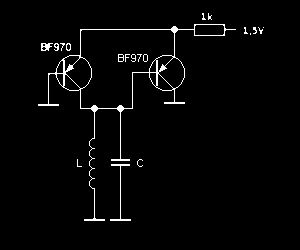
I tested it, and it works, but as you correctly pointed out, it requires advanced processing, like in BCS-100 controllers, for example, which is not a small cost. I had to look for other methods, and measuring the charging/discharging time of a capacitance with a very small variable current turned out to be a more effective approach, so I pursued that direction. The output interface is a completely separate matter – I chose a simple 0-10V signal and a variable frequency range of 20 kHz - 70 kHz.
Please Log in or Create an account to join the conversation.
delivery to our country does not work.
Please Log in or Create an account to join the conversation.

