
- Posts: 12170
- Thank you received: 4153
Hypersensing questions
- rodw
- Offline
- Platinum Member
-

Less
More
6 years 6 months ago #164577
by rodw
Replied by rodw on topic Hypersensing questions
Well, I went to work on a Sunday to have a play for you guys. I have a Thermal Dynamics A120 120 amp machine.
So at the start, everything was nice and normal as everything was dry. Then I used my finger to splash some water into the nozzle and sure enough the volts went up to about 21.6 volts. This is the result of a probe event. I am really interested to see the behaviour when the contact is broken.

So what I'm seeing is a definite downward slope as the connection breaks. This is what I was expecting to see.
And when we zoom in
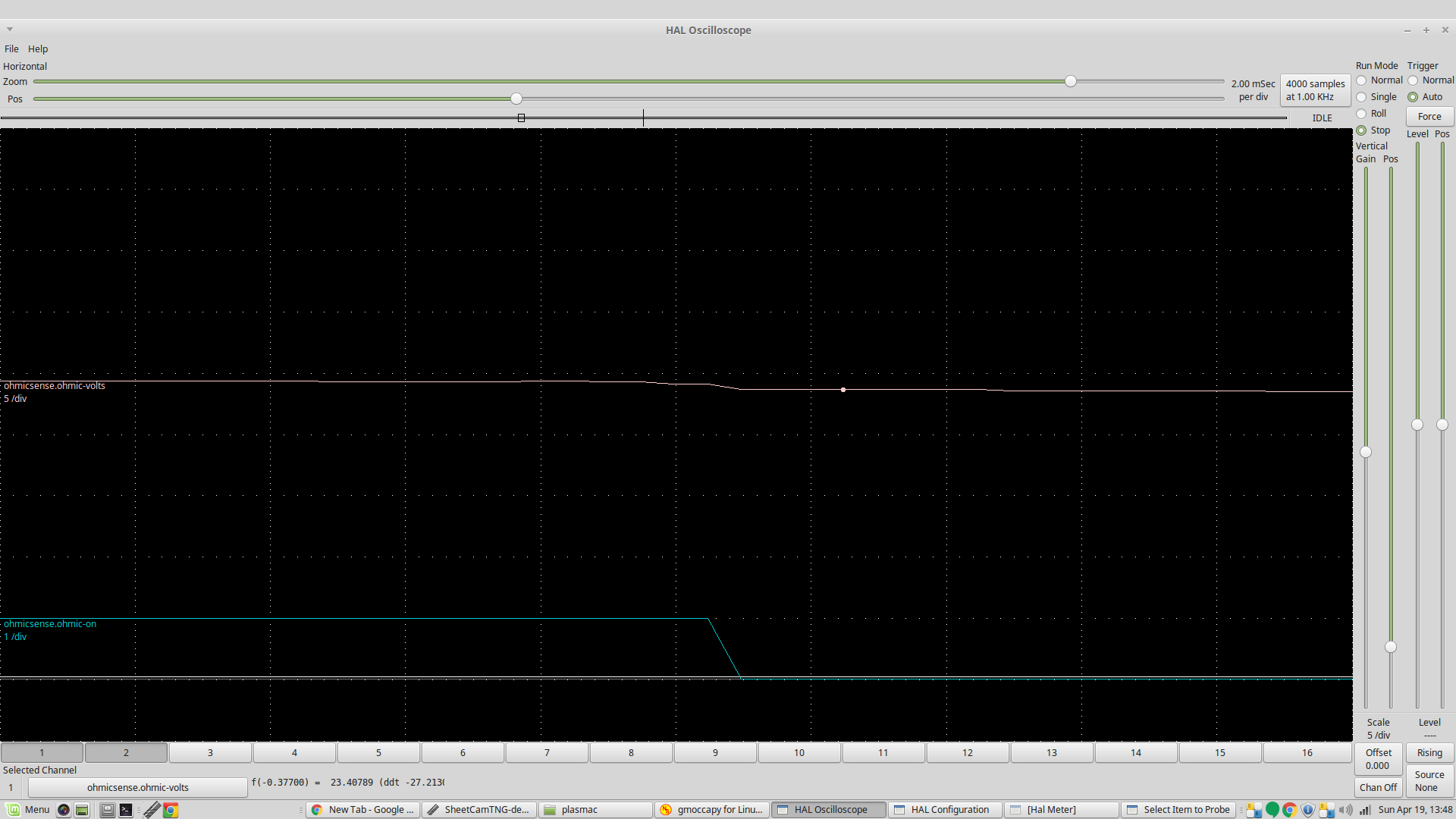
So it would be good if you guys could post similar screen dumps.
I'm still thinking about how best to proceed from here but clearly we can measure the ramp down as I expected.
I am wondering if the resting voltage could be sampled when is-probing goes true but I don't quite know what the next step would be.
I am assuming you guys are just seeing the 23.5 volts after the torch is wet and not on a dry machine. That is what I thought Uthayne said earlier. Can you confirm? All I hav eto do is blow some air through the torchand its clean again. But I have had to open the torch to dry it before.
So at the start, everything was nice and normal as everything was dry. Then I used my finger to splash some water into the nozzle and sure enough the volts went up to about 21.6 volts. This is the result of a probe event. I am really interested to see the behaviour when the contact is broken.
So what I'm seeing is a definite downward slope as the connection breaks. This is what I was expecting to see.
And when we zoom in
So it would be good if you guys could post similar screen dumps.
I'm still thinking about how best to proceed from here but clearly we can measure the ramp down as I expected.
I am wondering if the resting voltage could be sampled when is-probing goes true but I don't quite know what the next step would be.
I am assuming you guys are just seeing the 23.5 volts after the torch is wet and not on a dry machine. That is what I thought Uthayne said earlier. Can you confirm? All I hav eto do is blow some air through the torchand its clean again. But I have had to open the torch to dry it before.
- snowgoer540
- Away
- Moderator
-

Less
More
- Posts: 2581
- Thank you received: 907
6 years 6 months ago #164583
by snowgoer540
This resistor is in addition to the 390K 1/4 watt already there?
Replied by snowgoer540 on topic Hypersensing questions
PCW wrote: if you change the circuit to put a resistor between the probe and table
you can lower the sensitivity to water contamination
Note that this resistor should be able to handle a short to the plasma voltage
as I mention before a 10K 10W resistor would work and raise the sensing current to 2.4
mA (vs 50 uA for the THCAD5 directly)
Note the the 24V supply should be turned off when not probing to prevent electrolytic corrosion
This resistor is in addition to the 390K 1/4 watt already there?
- rodw
- Offline
- Platinum Member
-
Less
More
- Posts: 12170
- Thank you received: 4153
6 years 6 months ago #164590
by rodw
I'm not going there yet. Try this instead.Works here for me.:
Note the component is now named ohmic2.comp
you need to halcompile --install ohmic2.comp (non source code guys will need ot use sudo and you may need to install the linux_dev stuff. I'm not really up with deb installs.
Install as per my attached spaceship_ohmic.hal
There is a new mode pin to set the mode 0 = existing, 1 = new algorithm)
Also there is a pin called num_readings that determines how many readings it should average. I chose 5 to start with.
So this only uses the ohmic-threshold (high voltage)
After it triggers, It will wait until the average of the last 5 readings < ohmic_ threshold. Set this pin to suit your setup
If this works, its a cool bit of code
Replied by rodw on topic Hypersensing questions
snowgoer540 wrote:
PCW wrote: if you change the circuit to put a resistor between the probe and table
you can lower the sensitivity to water contamination
Note that this resistor should be able to handle a short to the plasma voltage
as I mention before a 10K 10W resistor would work and raise the sensing current to 2.4
mA (vs 50 uA for the THCAD5 directly)
Note the the 24V supply should be turned off when not probing to prevent electrolytic corrosion
This resistor is in addition to the 390K 1/4 watt already there?
I'm not going there yet. Try this instead.Works here for me.:
Note the component is now named ohmic2.comp
you need to halcompile --install ohmic2.comp (non source code guys will need ot use sudo and you may need to install the linux_dev stuff. I'm not really up with deb installs.
Install as per my attached spaceship_ohmic.hal
There is a new mode pin to set the mode 0 = existing, 1 = new algorithm)
Also there is a pin called num_readings that determines how many readings it should average. I chose 5 to start with.
So this only uses the ohmic-threshold (high voltage)
After it triggers, It will wait until the average of the last 5 readings < ohmic_ threshold. Set this pin to suit your setup
Code:
setp ohmicsense.ohmic-threshold 23.8
If this works, its a cool bit of code
- rodw
- Offline
- Platinum Member
-
Less
More
- Posts: 12170
- Thank you received: 4153
6 years 6 months ago #164609
by rodw
Replied by rodw on topic Hypersensing questions
I'm keen to get some feedback here becasue I had another idea which I will look at once we have some feedback..
That is to add a mode 3 being auto mode. In this mode, every time we commence probing, we sample the voltage as we start probing. Then during probing we monitor the voltage and remember the maximum voltage value seen.
So then we could set the probing threshold to be say half way between the two values and use that on the next probe. The worst case if probing fails because water got in the nozzle, it would right itself on Plasmac's re-probe because we would have re-calibrated on the failed probe.
Let me know your thoughts...
The following user(s) said Thank You: tommylight
- Uthayne
- Offline
- Premium Member
-

Less
More
- Posts: 147
- Thank you received: 49
6 years 6 months ago #164636
by Uthayne
Thanks! Your signal looks so clean even when it's not contacting, I'm jealous. Are you using shielded cable for your ohmic wire?
I'll get out to the garage and capture some data.
Yes, on dry cuts not over water, no issue. Voltage goes right back to 0v. Maybe the hypertherm torches trap more water than TD. Because a trigger pulse definitely does not dry it out enough when it's really wet. It helped when it was 15-16v "wet", but not 23v. Haha kinda a weird thing to say.
I'll capture the data as is and then I'll install ohmic2 and give that a go.
Replied by Uthayne on topic Hypersensing questions
rodw wrote: Well, I went to work on a Sunday to have a play for you guys. I have a Thermal Dynamics A120 120 amp machine.
So at the start, everything was nice and normal as everything was dry. Then I used my finger to splash some water into the nozzle and sure enough the volts went up to about 21.6 volts. This is the result of a probe event. I am really interested to see the behaviour when the contact is broken.
So what I'm seeing is a definite downward slope as the connection breaks. This is what I was expecting to see.
And when we zoom in
So it would be good if you guys could post similar screen dumps.
I'm still thinking about how best to proceed from here but clearly we can measure the ramp down as I expected.
I am wondering if the resting voltage could be sampled when is-probing goes true but I don't quite know what the next step would be.
I am assuming you guys are just seeing the 23.5 volts after the torch is wet and not on a dry machine. That is what I thought Uthayne said earlier. Can you confirm? All I hav eto do is blow some air through the torchand its clean again. But I have had to open the torch to dry it before.
Thanks! Your signal looks so clean even when it's not contacting, I'm jealous. Are you using shielded cable for your ohmic wire?
I'll get out to the garage and capture some data.
Yes, on dry cuts not over water, no issue. Voltage goes right back to 0v. Maybe the hypertherm torches trap more water than TD. Because a trigger pulse definitely does not dry it out enough when it's really wet. It helped when it was 15-16v "wet", but not 23v. Haha kinda a weird thing to say.
I'll capture the data as is and then I'll install ohmic2 and give that a go.
- Uthayne
- Offline
- Premium Member
-
Less
More
- Posts: 147
- Thank you received: 49
6 years 6 months ago #164641
by Uthayne
Replied by Uthayne on topic Hypersensing questions
Took same data, here it is.
First off, a dry run. Water has not touched the torch, just going down and probing. Nice and clean.

Then I pulsed the torch over water (not close) to get some voltage. Torch was reading 19v, but still probed happily.

Close up view of the previous.

Then I simulated the end of a cutout where the torch is close to the water and gets drenched. 23v+ is what the torch is sitting at now, rapidly triggering ohmic.

I did a probe event and you can see where it made contact because the ohmic-on signal is true for a bit longer

Close up of previous

I then tried installing ohmic2 but it would not let me probe successfully as it was being triggered before moving to probe height. The reason I was able to in the previous picture is because I modified my own ohmic component to let it, but it was only for troubleshooting.
My "ON" signal for ohmic-volts is nice and clean. When it is floating and water logged, it is quite messy. Perhaps I should investigate wiring or employ some low pass filters?
First off, a dry run. Water has not touched the torch, just going down and probing. Nice and clean.
Then I pulsed the torch over water (not close) to get some voltage. Torch was reading 19v, but still probed happily.
Close up view of the previous.
Then I simulated the end of a cutout where the torch is close to the water and gets drenched. 23v+ is what the torch is sitting at now, rapidly triggering ohmic.
I did a probe event and you can see where it made contact because the ohmic-on signal is true for a bit longer
Close up of previous
I then tried installing ohmic2 but it would not let me probe successfully as it was being triggered before moving to probe height. The reason I was able to in the previous picture is because I modified my own ohmic component to let it, but it was only for troubleshooting.
My "ON" signal for ohmic-volts is nice and clean. When it is floating and water logged, it is quite messy. Perhaps I should investigate wiring or employ some low pass filters?
Moderators: snowgoer540
Time to create page: 1.370 seconds