
- Posts: 2581
- Thank you received: 907
Hypersensing questions
- snowgoer540
- Away
- Moderator
-

Less
More
6 years 6 months ago - 6 years 6 months ago #164692
by snowgoer540
@PCW
Is the placement of the RED resistor in the attached diagram screen shot what you mean?
Also, What would be the difference between a 10K 10W resistor mentioned previously and the 24K 5W resistor mentioned here?
Replied by snowgoer540 on topic Hypersensing questions
PCW wrote: With no load (other than the THCAD-5) the sense current is 50 uA full scale
If you wanted 20X that (1 mA) , 24K would work.
Assuming that it needs to withstand 300V faults, (where it would dissipate 3.75W)
a 24K 5W resistor would be a good choice
@PCW
Is the placement of the RED resistor in the attached diagram screen shot what you mean?
Also, What would be the difference between a 10K 10W resistor mentioned previously and the 24K 5W resistor mentioned here?

Last edit: 6 years 6 months ago by snowgoer540.
- tommylight
- Offline
- Moderator
-
Less
More
- Posts: 22011
- Thank you received: 7491
6 years 6 months ago #164696
by tommylight
Replied by tommylight on topic Hypersensing questions
That should do just fine.
Then again, i would try it with a smaller one, see if it burns to a crisp!
Normally it should not burn as it is isolated from the nozzle and the electrode, but PCW is right, during firing more voltage would be induced/conducted through water, and that is a risk not to be taken lightly.
Then again, i would try it with a smaller one, see if it burns to a crisp!
Normally it should not burn as it is isolated from the nozzle and the electrode, but PCW is right, during firing more voltage would be induced/conducted through water, and that is a risk not to be taken lightly.
- tommylight
- Offline
- Moderator
-
Less
More
- Posts: 22011
- Thank you received: 7491
6 years 6 months ago #164697
by tommylight
Replied by tommylight on topic Hypersensing questions
It would take twice as much current to trip, in this case might be even better.snowgoer540 wrote: [
Also, What would be the difference between a 10K 10W resistor mentioned previously and the 24K 5W resistor mentioned here?
- PCW
- Offline
- Moderator
-
Less
More
- Posts: 18115
- Thank you received: 5334
6 years 6 months ago #164699
by PCW
Replied by PCW on topic Hypersensing questions
Sorry I got it wrong the new resistor goes between +24V and the torch
The following user(s) said Thank You: tommylight, snowgoer540
- Uthayne
- Offline
- Premium Member
-

Less
More
- Posts: 147
- Thank you received: 49
6 years 6 months ago #164704
by Uthayne
Well I went and did the measurements again on a dry torch and got the same that you did. Open circuit, infinite resistance on all readings. It's possible I wasn't careful while measuring last time and was touching the probes. It's quite likely to be honest remembering how much it was varying, or it was with a wet torch? That's embarrassing.
Nozzle to work clamp I got 16.33Kohm. So that checks out.
Replied by Uthayne on topic Hypersensing questions
snowgoer540 wrote:
Code:Turned off all power to everything. Plasma cutter still plugged into wall, but off. 24v isolated psu is unplugged Thcad-5 input and output connectors, unplugged Wire on cap, resistance between torch shield and table: infinite resistance (open circuit) Wire removed from cap, torch shield to table, resistance is still infinite as the circuit is open Work clamp removed from table, open circuit, infinite resistance (open curcuit) Plasma torch to work clamp resistance is 16.54K(I assume you mean from teh nozzle to the clamp
I dont see how it's possible you were getting 2.3M ohms with everything unplugged from the THCAD, unless you were touching the meter probes with your fingers. Otherwise, assuming everything was bone dry, there is literally no connection between the shield and the ground of the either the machine, or the table with the input and output disconnected from the THCAD.
Try this for me, remove your shield, exposing the nozzle, and measure from the nozzle to the ground clamp of the hypertherm. This is how I am getting 16.54K ohm.
Well I went and did the measurements again on a dry torch and got the same that you did. Open circuit, infinite resistance on all readings. It's possible I wasn't careful while measuring last time and was touching the probes. It's quite likely to be honest remembering how much it was varying, or it was with a wet torch? That's embarrassing.
Nozzle to work clamp I got 16.33Kohm. So that checks out.
The following user(s) said Thank You: snowgoer540
- Uthayne
- Offline
- Premium Member
-
Less
More
- Posts: 147
- Thank you received: 49
6 years 6 months ago #164706
by Uthayne
Replied by Uthayne on topic Hypersensing questions
Did a few more tests and its looking good!
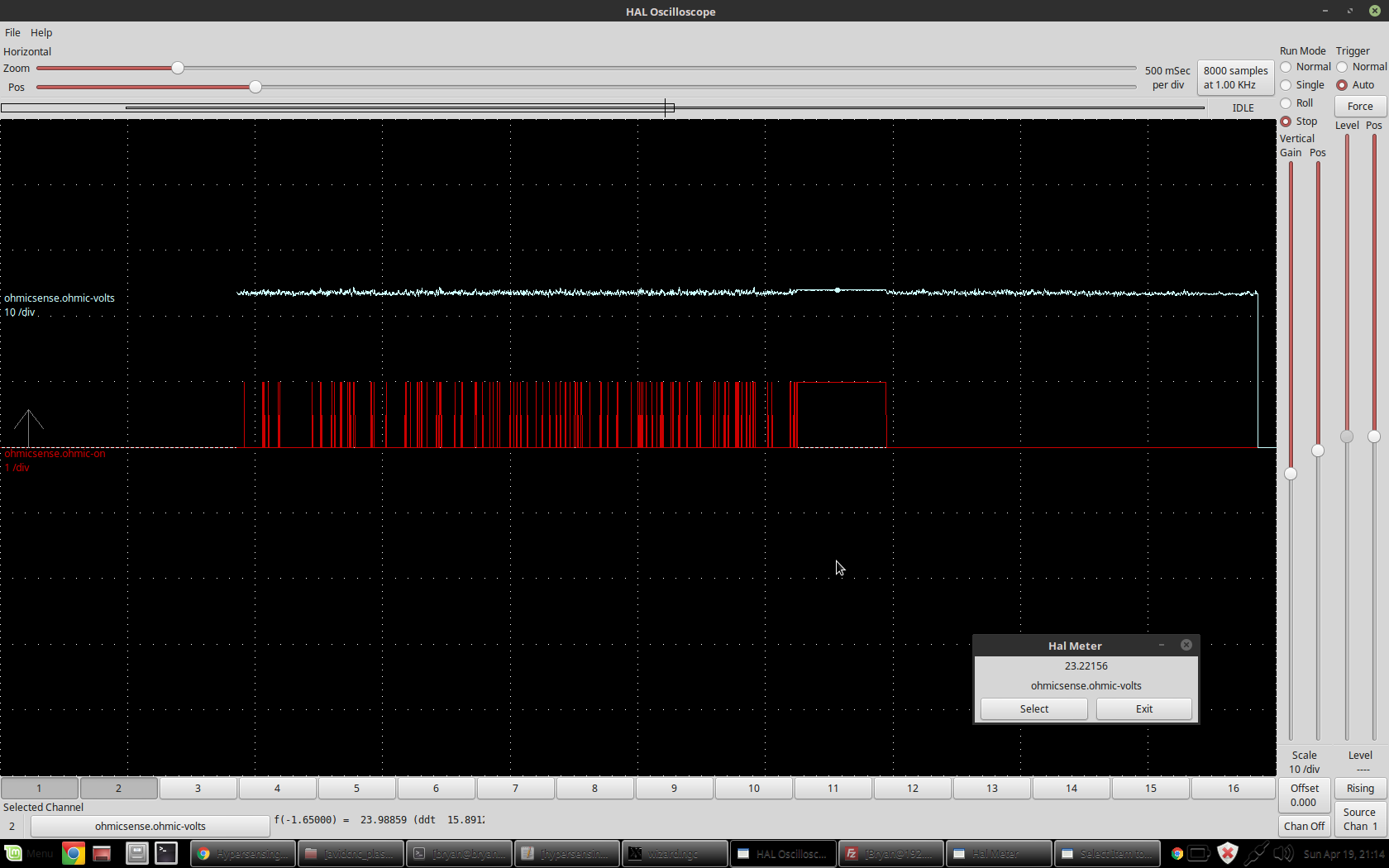
Before I test Rod's comp changes I figured I would add (temporarily) a 1/2W 22kOhm resistor and see what it does to the voltage when the torch is soaked. Proof is in the data
This is the baseline case. Lots of triggers. Using ohmic2.comp, but not quite the newest version with changing the ohmic threshold to look at argvolts.
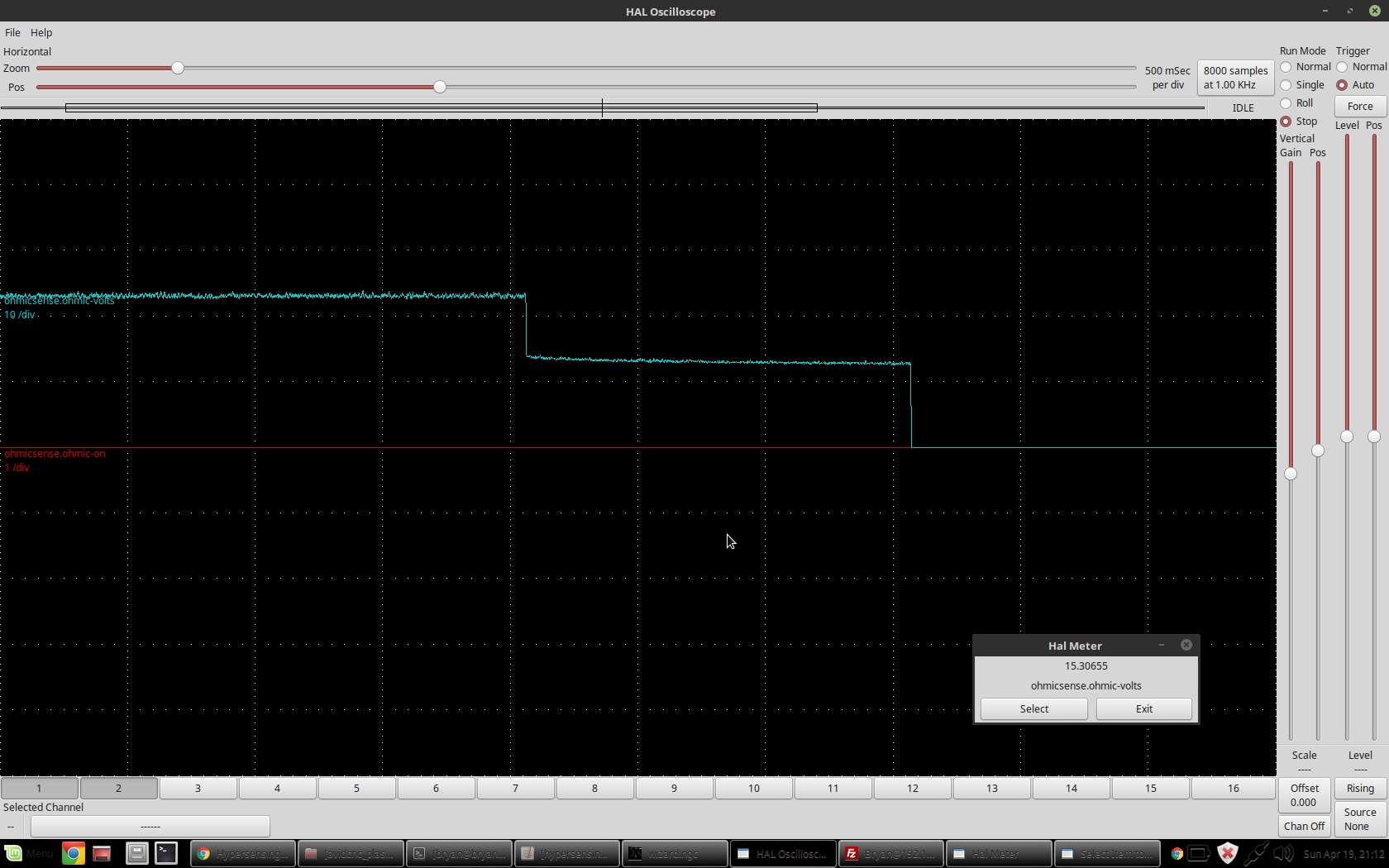
Then I added a 22kOhm 1/2W resistor between +24V and IN- (torch) and the voltage dropped quite significantly when not probing.
And here's a probe event with the 22kOhm resistor in place (torch was off the entire time!)
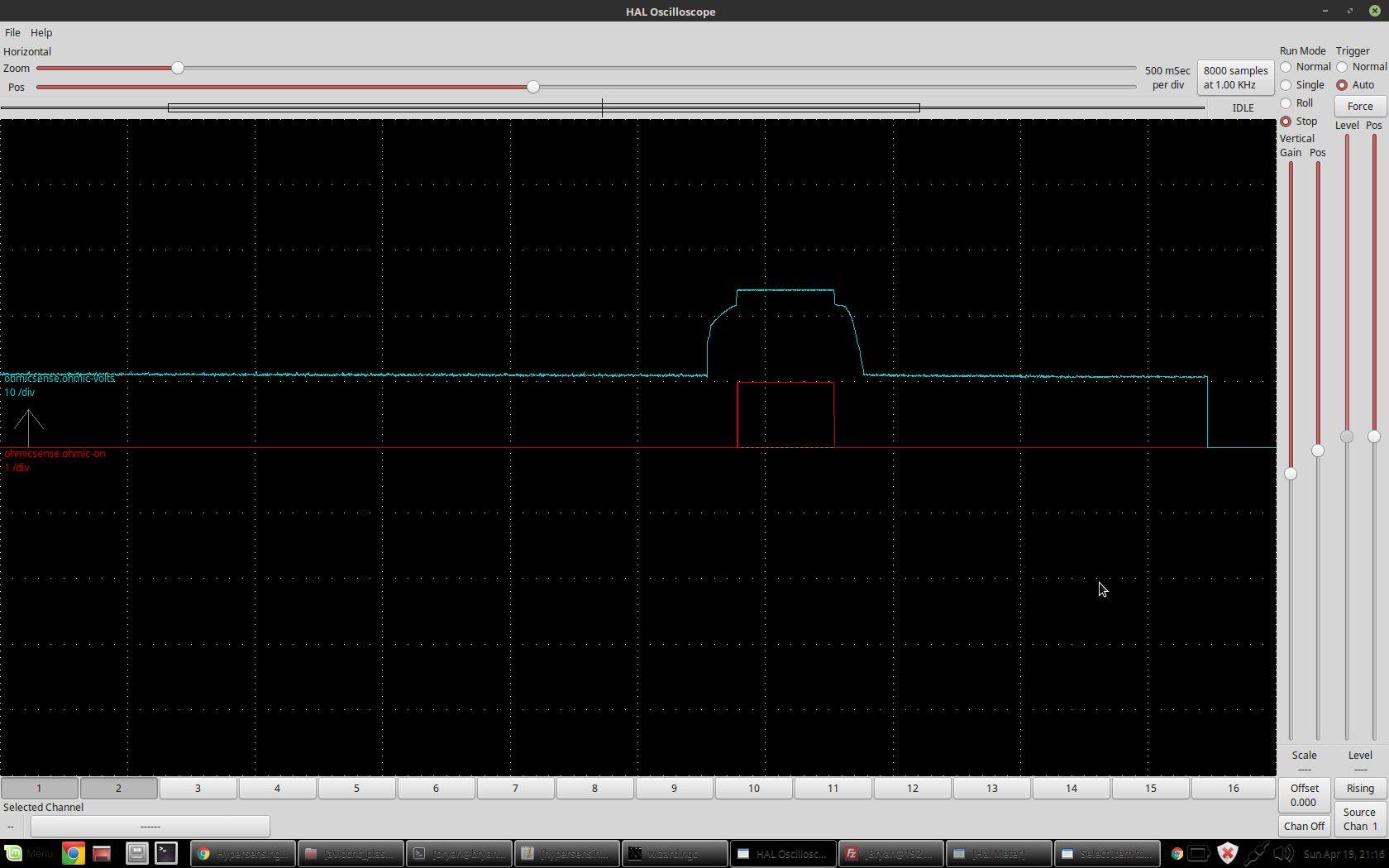
It seems as though the easiest fix is to add a 22kOhm 5W resistor between +24V and IN- as it still retains its ~24V sensitivity when contact is made, but drops to about 15-16V (from 23V) when the torch just has water in it. I obviously did not fire the torch in any of these cases as my resistor is not high enough wattage. We'll get to that in a few days.
I still plan on testing the comp changes that Rod suggested to see if a software fix works and is reliable. Should be able to post that data tomorrow.
Before I test Rod's comp changes I figured I would add (temporarily) a 1/2W 22kOhm resistor and see what it does to the voltage when the torch is soaked. Proof is in the data
This is the baseline case. Lots of triggers. Using ohmic2.comp, but not quite the newest version with changing the ohmic threshold to look at argvolts.
Then I added a 22kOhm 1/2W resistor between +24V and IN- (torch) and the voltage dropped quite significantly when not probing.
And here's a probe event with the 22kOhm resistor in place (torch was off the entire time!)
It seems as though the easiest fix is to add a 22kOhm 5W resistor between +24V and IN- as it still retains its ~24V sensitivity when contact is made, but drops to about 15-16V (from 23V) when the torch just has water in it. I obviously did not fire the torch in any of these cases as my resistor is not high enough wattage. We'll get to that in a few days.
I still plan on testing the comp changes that Rod suggested to see if a software fix works and is reliable. Should be able to post that data tomorrow.
Moderators: snowgoer540
Time to create page: 0.312 seconds