
- Posts: 4819
- Thank you received: 2177
Trajectory Planner using Ruckig Lib
- Aciera
- Offline
- Administrator
-

Less
More
2 years 3 months ago #305901
by Aciera
Replied by Aciera on topic Trajectory Planner using Ruckig Lib
I just tried the app-image on a new bookworm installation, Here is what I get;
Code:
user@debian:~$ ./Downloads/runtest_cnc-x86_64.AppImage
/bin/bash: /tmp/.mount_runteseQsZiS/usr/lib/libc.so.6: version `GLIBC_2.33' not found (required by /bin/bash)
/bin/bash: /tmp/.mount_runteseQsZiS/usr/lib/libc.so.6: version `GLIBC_2.36' not found (required by /bin/bash)
/bin/bash: /tmp/.mount_runteseQsZiS/usr/lib/libc.so.6: version `GLIBC_2.34' not found (required by /bin/bash)
The following user(s) said Thank You: Lcvette, Grotius
Please Log in or Create an account to join the conversation.
- Grotius
- Offline
- Platinum Member
-

Less
More
- Posts: 2419
- Thank you received: 2349
2 years 3 months ago #305908
by Grotius
Replied by Grotius on topic Trajectory Planner using Ruckig Lib
Hi Arciera,
On my pc : libc6 is already the newest version (2.31-13+deb11u10).
Thanks, and will it run after this:
On my pc : libc6 is already the newest version (2.31-13+deb11u10).
Thanks, and will it run after this:
Code:
sudo apt update
sudo apt install libc6
The following user(s) said Thank You: Lcvette
Please Log in or Create an account to join the conversation.
- Grotius
- Offline
- Platinum Member
-
Less
More
- Posts: 2419
- Thank you received: 2349
2 years 3 months ago #305912
by Grotius
Replied by Grotius on topic Trajectory Planner using Ruckig Lib
Hi,
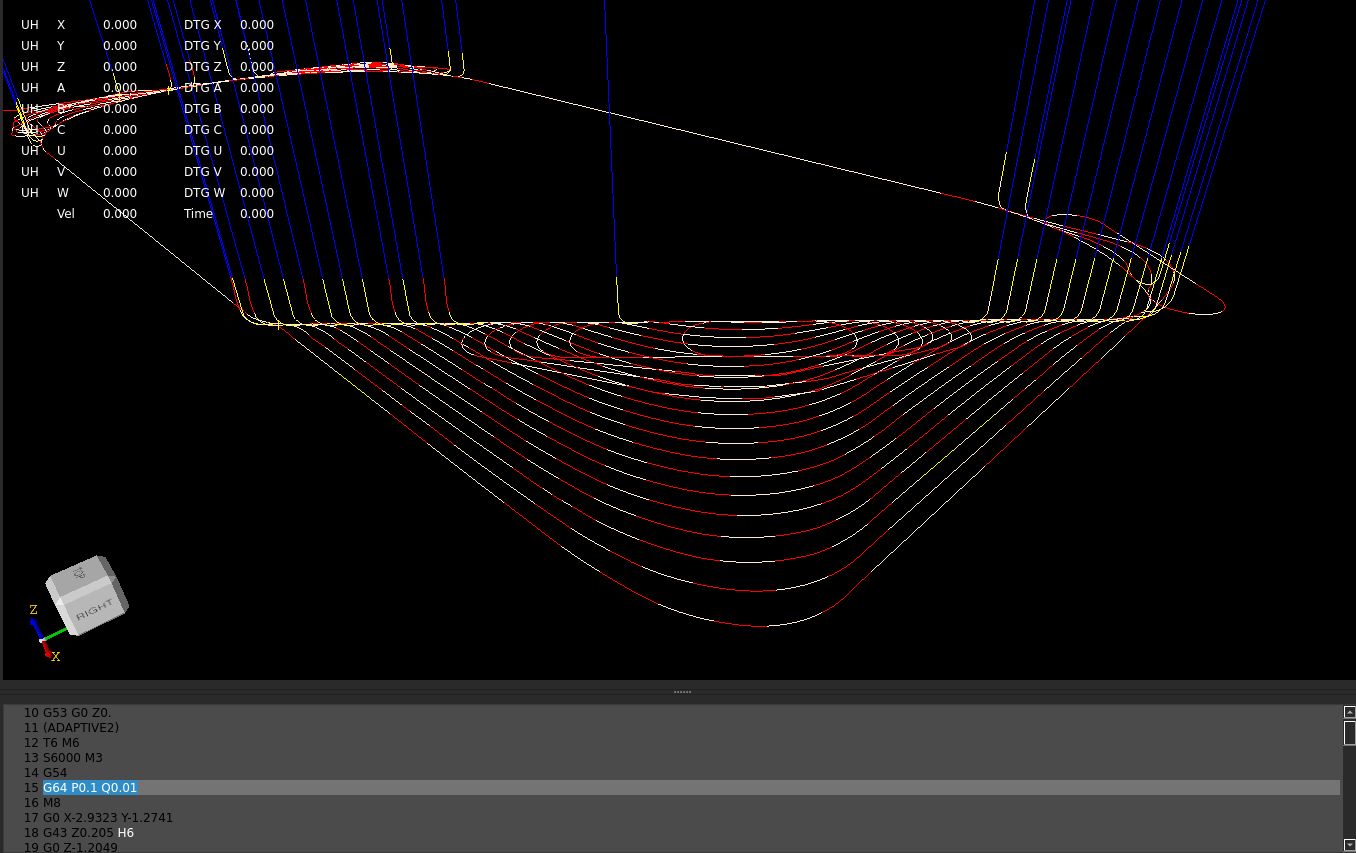
Working on the toolpath blending algoritme.
It's using the gcode G64 P.. Q.. values along the gcode file.
Red are the clothoids, valid in a 3d plane.
Yellow are lines, this are invalid clothoid solutions, out of plane, that we have to port to a spline fillet tomorrow, as
alternative fillet solution.
The settings for G64 used : P0.1 Q0.01
Where P=deviation, creates the fillet.
Where Q=tollerance, filters out only line segments.
// Results of this optimalisation test:
items before G64 P.. Q.. :1214 after:1330 diff:-116
Working on the toolpath blending algoritme.
It's using the gcode G64 P.. Q.. values along the gcode file.
Red are the clothoids, valid in a 3d plane.
Yellow are lines, this are invalid clothoid solutions, out of plane, that we have to port to a spline fillet tomorrow, as
alternative fillet solution.
The settings for G64 used : P0.1 Q0.01
Where P=deviation, creates the fillet.
Where Q=tollerance, filters out only line segments.
// Results of this optimalisation test:
items before G64 P.. Q.. :1214 after:1330 diff:-116
The following user(s) said Thank You: akb1212, Lcvette, Aciera, tiagounderground, Darium
Please Log in or Create an account to join the conversation.
- Grotius
- Offline
- Platinum Member
-
Less
More
- Posts: 2419
- Thank you received: 2349
2 years 3 months ago #305948
by Grotius
Replied by Grotius on topic Trajectory Planner using Ruckig Lib
Hi,
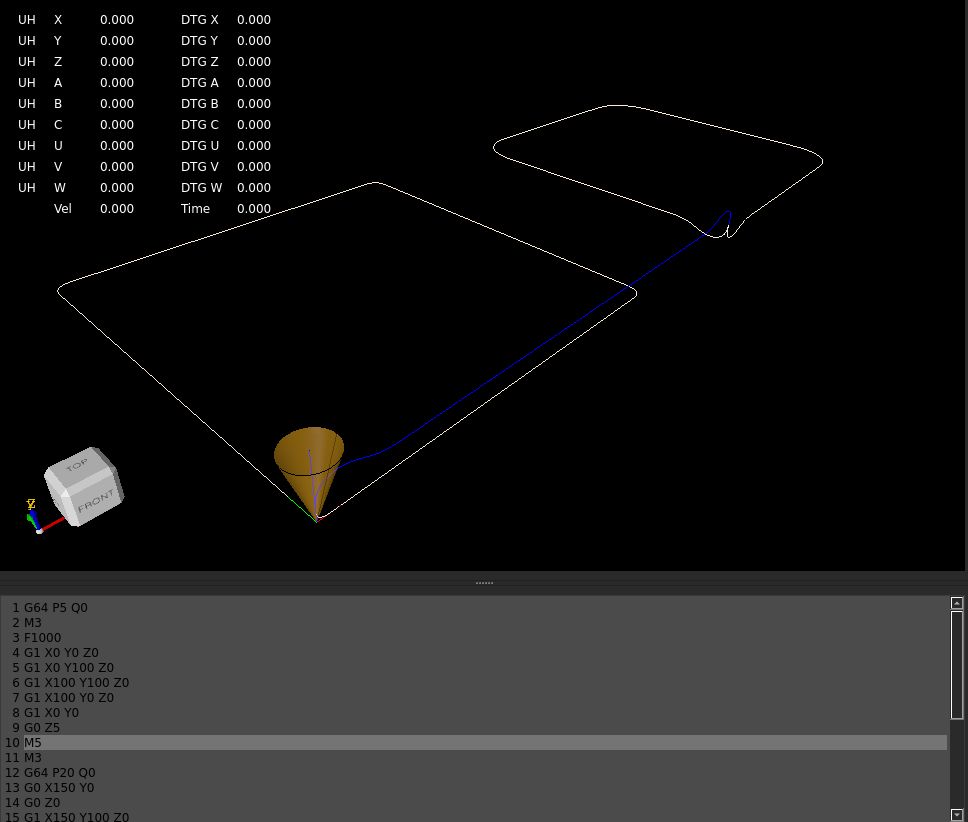
The spline fillets are working. These are used when clothoid fillet fails.
Tested multiple G64 P.. inputs along a gcode file.
The first square is original a G64 P0 with sharp edges.
The first G64 P5 creates ~5mm fillets along the path of the square shape.
Then the second square, the P20 creates ~20mm fillets along path of the second square shape.
The fillets are of type clothoid. Then there are rapid clothoids and feed clothoids, This is important to notice
to do look ahead and optimize speeds further on.
codeberg.org/skynet/hal-core
The spline fillets are working. These are used when clothoid fillet fails.
Tested multiple G64 P.. inputs along a gcode file.
The first square is original a G64 P0 with sharp edges.
The first G64 P5 creates ~5mm fillets along the path of the square shape.
Then the second square, the P20 creates ~20mm fillets along path of the second square shape.
The fillets are of type clothoid. Then there are rapid clothoids and feed clothoids, This is important to notice
to do look ahead and optimize speeds further on.
codeberg.org/skynet/hal-core
The following user(s) said Thank You: akb1212, Lcvette, Aciera, Darium
Please Log in or Create an account to join the conversation.
- Aciera
- Offline
- Administrator
-
Less
More
- Posts: 4819
- Thank you received: 2177
2 years 3 months ago #305949
by Aciera
Replied by Aciera on topic Trajectory Planner using Ruckig Lib
Seems my installation is already on the newest libc6 version:
Code:
user@debian:~$ sudo apt install libc6
Reading package lists... Done
Building dependency tree... Done
Reading state information... Done
libc6 is already the newest version (2.36-9+deb12u7).
0 upgraded, 0 newly installed, 0 to remove and 0 not upgraded.
The following user(s) said Thank You: Lcvette, Grotius
Please Log in or Create an account to join the conversation.
- Grotius
- Offline
- Platinum Member
-
Less
More
- Posts: 2419
- Thank you received: 2349
2 years 3 months ago #306015
by Grotius
Replied by Grotius on topic Trajectory Planner using Ruckig Lib
Hi Arciera,
Hmm, I will take a look when time comes.
Currently working on the look ahead function to calculate optimal trajectory speeds.
The trajectory consists of lines, arc's, helix, clothoids, & splines.
The max speeds depends on the min,max curvature value of the shape.
- For a clothoid we retrieved the clothoid curvature extrema. "kmin, kmax also know as a kappa value." from the library g2solve3arc.curvature_min_max(..)
- For a arc we can calculate the constant curvature "1/radius" as for a line the curvature=0.
- For the 3-degree spline we calculated curvature min,max using the opencascade GeomLProp_CLProps class.
Then using a optimal angular speed, we can calculate the max speeds for the shapes.
We use a forward sweep over the trajectory followed by a backward sweep over the trajectory between
the rapids. Then the vo, ve is calculated given by a max vm of that segment.
Then there might be a problem when one segment is very long and has high curvature value at one spot.
This then will reduce the overall segment speed. How to deal with this?
The following user(s) said Thank You: Lcvette, Aciera
Please Log in or Create an account to join the conversation.
Time to create page: 0.201 seconds