
- Posts: 10
- Thank you received: 2
LinuxCNC-RIO - RealtimeIO for LinuxCNC based on FPGA (ICE40 / ECP5)
- Oxbown
- Offline
- New Member
-

Less
More
2 months 1 week ago #348841
by Oxbown
Replied by Oxbown on topic LinuxCNC-RIO - RealtimeIO for LinuxCNC based on FPGA (ICE40 / ECP5)
Hi everyone,
First off, huge thanks to the @meister for the amazing work on RioCore and Rio Flow. It makes FPGA-based configurations for LinuxCNC much more accessible and structured!
I’m currently setting up a machine using RioCore with a Touchy interface and a physical control panel (hardware buttons, safety relays, etc.), and I have a couple of architectural questions regarding custom HAL management:
1. Loading Custom Real-Time Components in Main HAL (e.g., ClassicLadder)
Is there an intended workflow or plans to allow custom HAL code injection inside Rio Flow?
How should we best handle GUI-dependent nets across exports?
Thanks in advance for any insights or tips on how you guys are handling this!
First off, huge thanks to the @meister for the amazing work on RioCore and Rio Flow. It makes FPGA-based configurations for LinuxCNC much more accessible and structured!
I’m currently setting up a machine using RioCore with a Touchy interface and a physical control panel (hardware buttons, safety relays, etc.), and I have a couple of architectural questions regarding custom HAL management:
1. Loading Custom Real-Time Components in Main HAL (e.g., ClassicLadder)
Is there an intended workflow or plans to allow custom HAL code injection inside Rio Flow?
- Use Case: I need to load and thread ClassicLadder (
,Code:loadrt classicladder_rt ...) to handle auxiliary machine logic and map FPGA inputs/outputs directly toCode:loadusr -w classicladder my_logic.clpandCode:%Ipoints before the motion thread starts.Code:%Q
- Currently, modifying generated main HAL files requires re-editing them after each export. Would it be possible to have a persistent "User HAL Block" or a dedicated non-destructive include file in Rio Flow?
How should we best handle GUI-dependent nets across exports?
- Use Case: Connecting physical hardware inputs mapped in RioCore to GUI-specific pins like
,Code:touchy.cycle-start, orCode:touchy.single-block.Code:halui.machine.on
- Since these pins only instantiate after the display loads, they must live in the PostGUI phase. However, each time Rio Flow regenerates/exports the setup, the auto-generated PostGUI call chain (
/Code:postgui_call_list.hal) gets wiped/reset.Code:custom_postgui.hal
Thanks in advance for any insights or tips on how you guys are handling this!
Please Log in or Create an account to join the conversation.
- meister
- Offline
- Platinum Member
-

Less
More
- Posts: 806
- Thank you received: 502
2 months 1 week ago #348842
by meister
Replied by meister on topic LinuxCNC-RIO - RealtimeIO for LinuxCNC based on FPGA (ICE40 / ECP5)
Hi Oxbown,
thanks
you can add your own .hal files to the call_list's:
$ cat Output/Tangbob/LinuxCNC/pregui_call_list.hal
source my_own_pregui.hal
$ cat Output/Tangbob/LinuxCNC/postgui_call_list.hal
source custom_postgui.hal
source my_own_postgui.hal
these extra source entries are not removed during generation
i add the 'touchy' prefix to POSTGUI_COMPONENTS (riocore/generator/hal.py),
now, all generated HAL entries beginning with ‘touchy’ should end up in the PostGUI HAL (in main and dev branch / git pull)
Unfortunately, I haven’t used ClassicLadder yet, so I can’t be much help there,
but it’s a good opportunity to mention a specific feature in Rio again
When specifying a signal source, you can use various logic and functions.
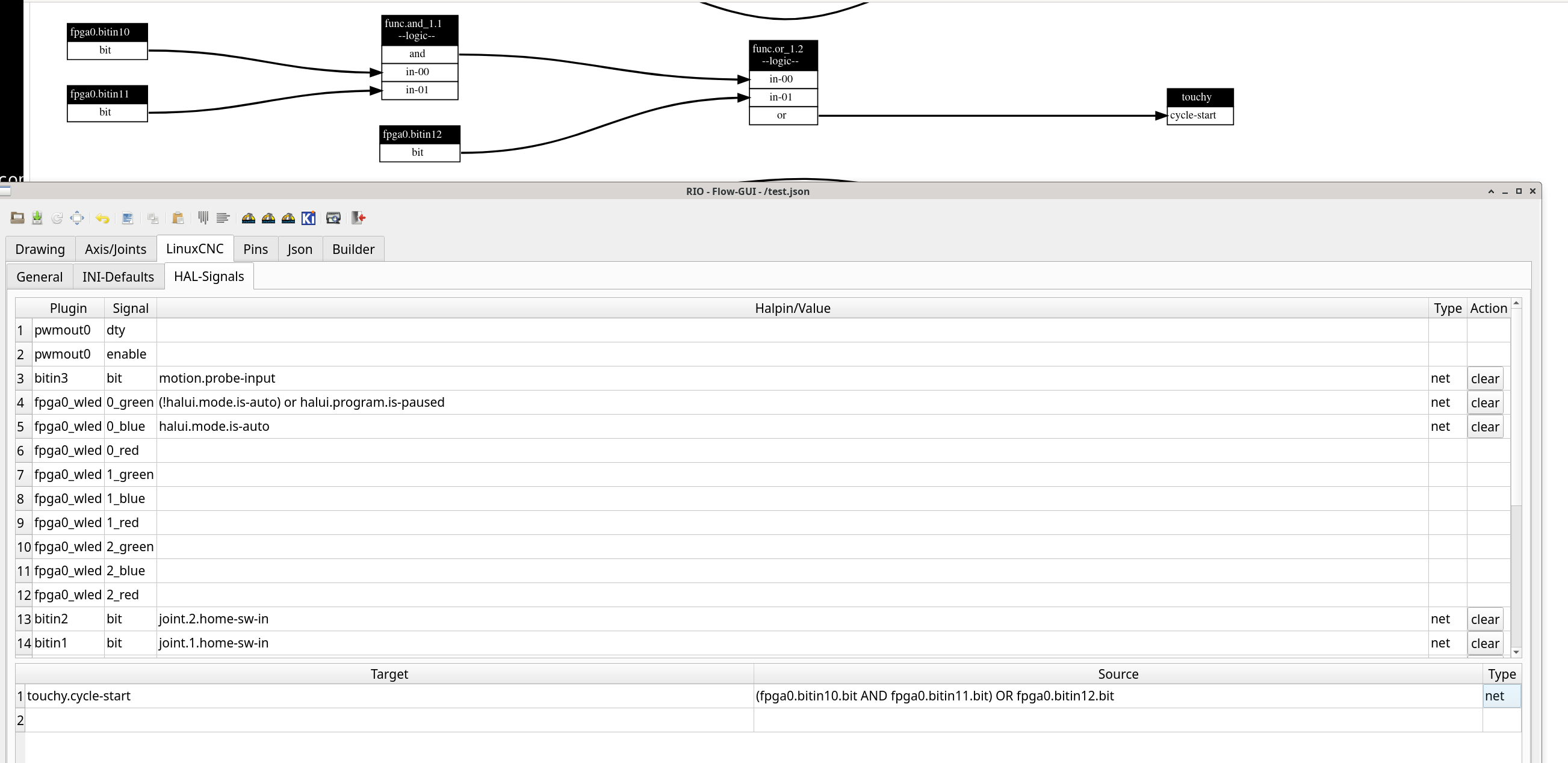
I think it’s a killer feature that doesn’t get nearly enough attention
you can start a demo configuration:
```
rio-generator -S riocore/configs/haldemo/virtual-signals-axis-pyvcp.json
```
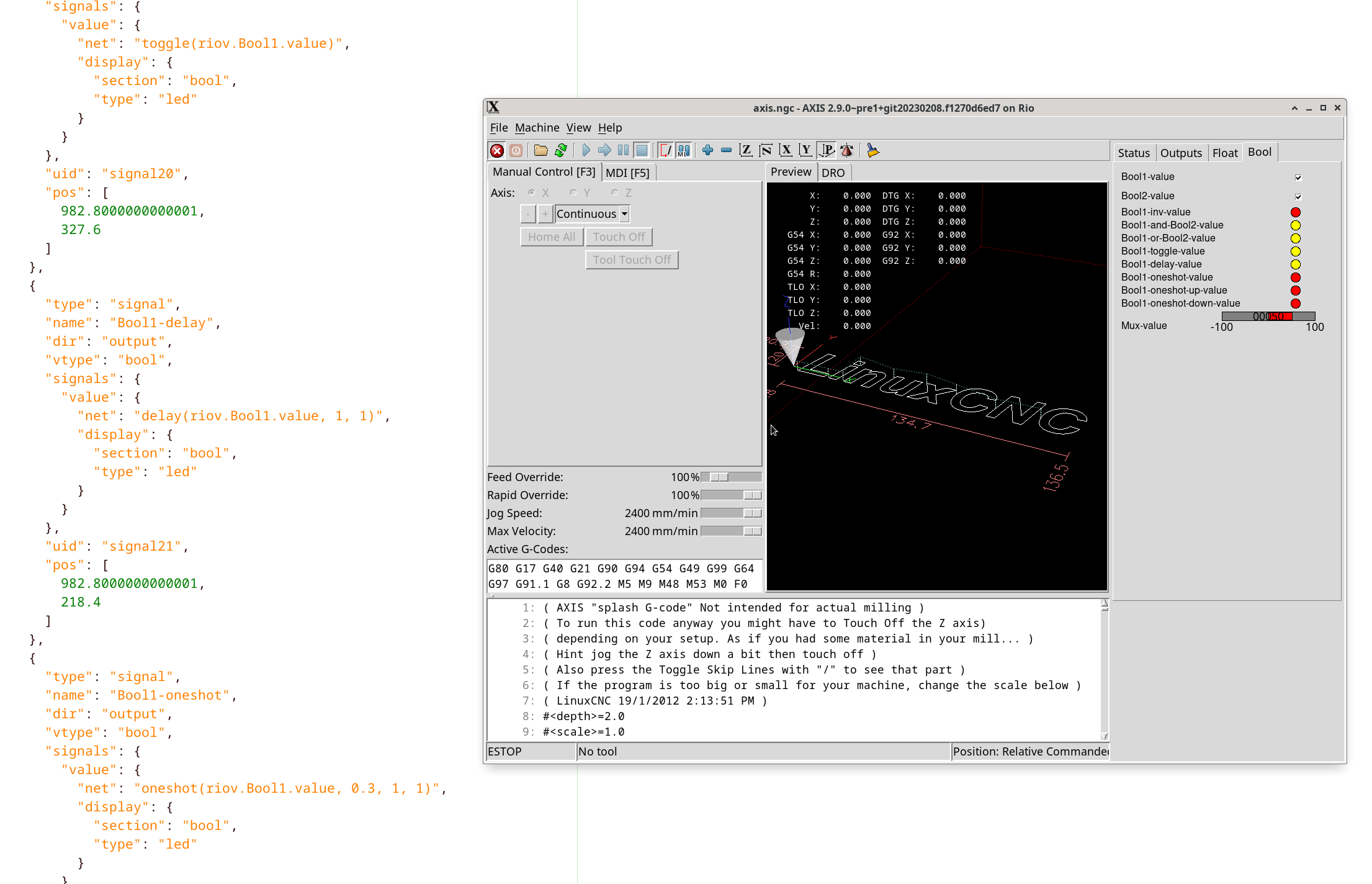
thanks
you can add your own .hal files to the call_list's:
$ cat Output/Tangbob/LinuxCNC/pregui_call_list.hal
source my_own_pregui.hal
$ cat Output/Tangbob/LinuxCNC/postgui_call_list.hal
source custom_postgui.hal
source my_own_postgui.hal
these extra source entries are not removed during generation
i add the 'touchy' prefix to POSTGUI_COMPONENTS (riocore/generator/hal.py),
now, all generated HAL entries beginning with ‘touchy’ should end up in the PostGUI HAL (in main and dev branch / git pull)
Unfortunately, I haven’t used ClassicLadder yet, so I can’t be much help there,
but it’s a good opportunity to mention a specific feature in Rio again
When specifying a signal source, you can use various logic and functions.
I think it’s a killer feature that doesn’t get nearly enough attention
you can start a demo configuration:
```
rio-generator -S riocore/configs/haldemo/virtual-signals-axis-pyvcp.json
```
The following user(s) said Thank You: Oxbown
Please Log in or Create an account to join the conversation.
- Oxbown
- Offline
- New Member
-
Less
More
- Posts: 10
- Thank you received: 2
2 months 1 week ago - 2 months 1 week ago #348843
by Oxbown
Replied by Oxbown on topic LinuxCNC-RIO - RealtimeIO for LinuxCNC based on FPGA (ICE40 / ECP5)
Hi,
Thank you so much for the quick fix on the touchy prefix and for explaining the call_list mechanism! That makes managing external custom files much cleaner. Also, the virtual signals logic feature looks very neat and powerful—I'll definitely look into the demo.
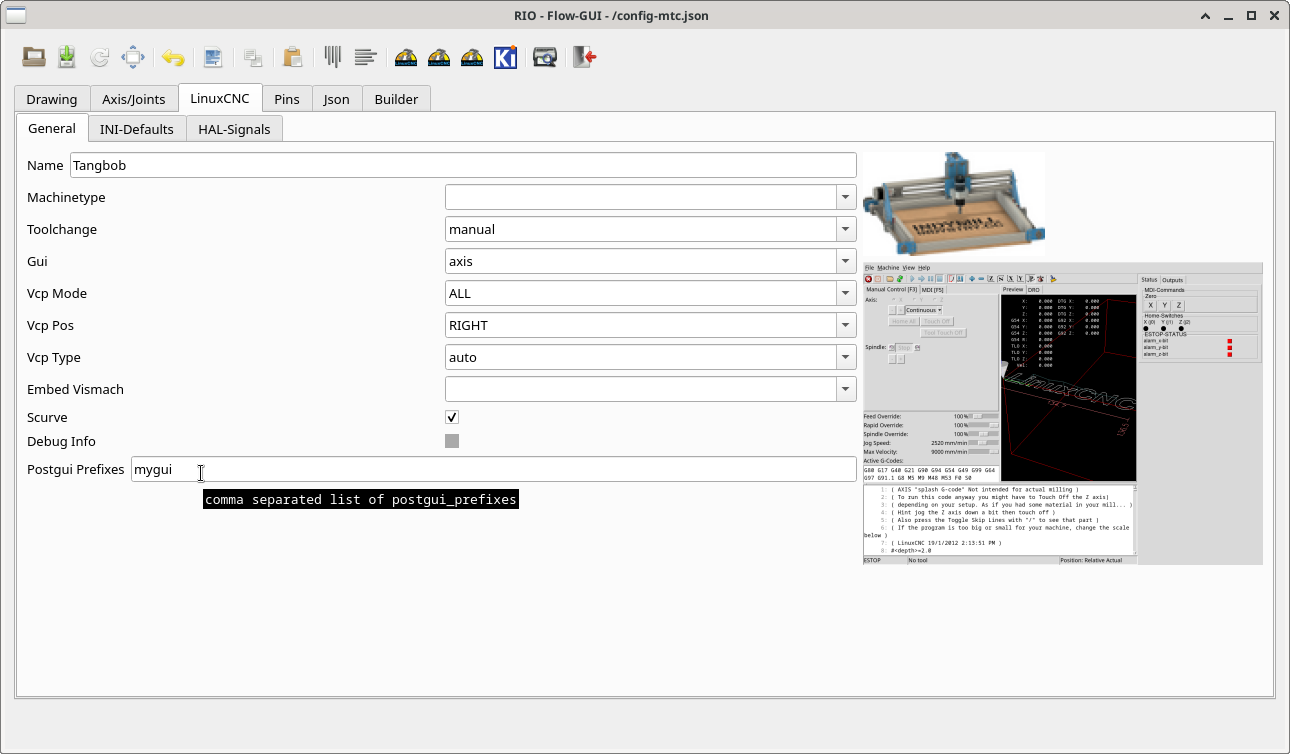
Regarding signal assignment in Rio Flow: while having auto-detection via POSTGUI_COMPONENTS works great for standard prefixes, would it be possible to add an explicit target selector in the UI (for example, a dropdown or toggle in the HAL-Signals section to choose whether a connection belongs to Main/PreGUI or PostGUI)?
Having this option directly in the GUI would give maximum flexibility:
- It prevents having to hardcode every possible GUI/component prefix inside POSTGUI_COMPONENTS.
- It handles custom user interfaces, custom PyVCP/GladeVCP panels, or non-standard naming schemes seamlessly.
- It allows users to decide explicitly where each net lives directly from the Rio Flow design environment.
Last edit: 2 months 1 week ago by Oxbown.
The following user(s) said Thank You: meister
Please Log in or Create an account to join the conversation.
- meister
- Offline
- Platinum Member
-
Less
More
- Posts: 806
- Thank you received: 502
2 months 1 week ago #348851
by meister
Replied by meister on topic LinuxCNC-RIO - RealtimeIO for LinuxCNC based on FPGA (ICE40 / ECP5)
only in dev branch:
The following user(s) said Thank You: NWE
Please Log in or Create an account to join the conversation.
- viewsat
- Offline
- Junior Member
-

Less
More
- Posts: 33
- Thank you received: 10
2 months 1 week ago #348852
by viewsat
Replied by viewsat on topic LinuxCNC-RIO - RealtimeIO for LinuxCNC based on FPGA (ICE40 / ECP5)
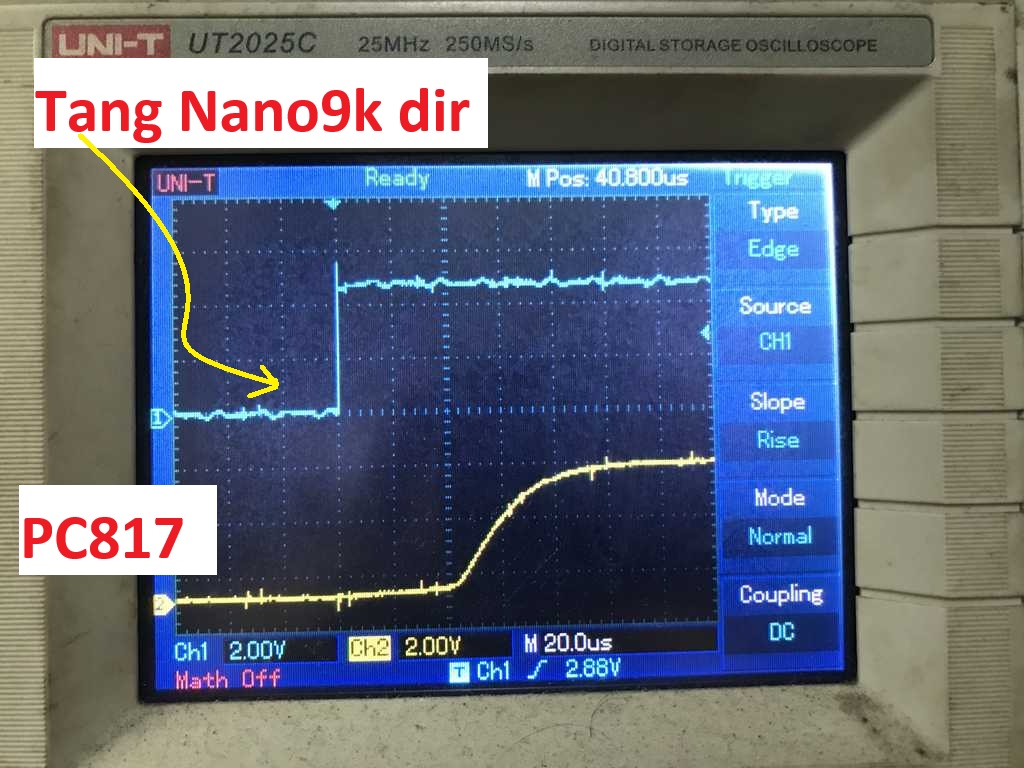
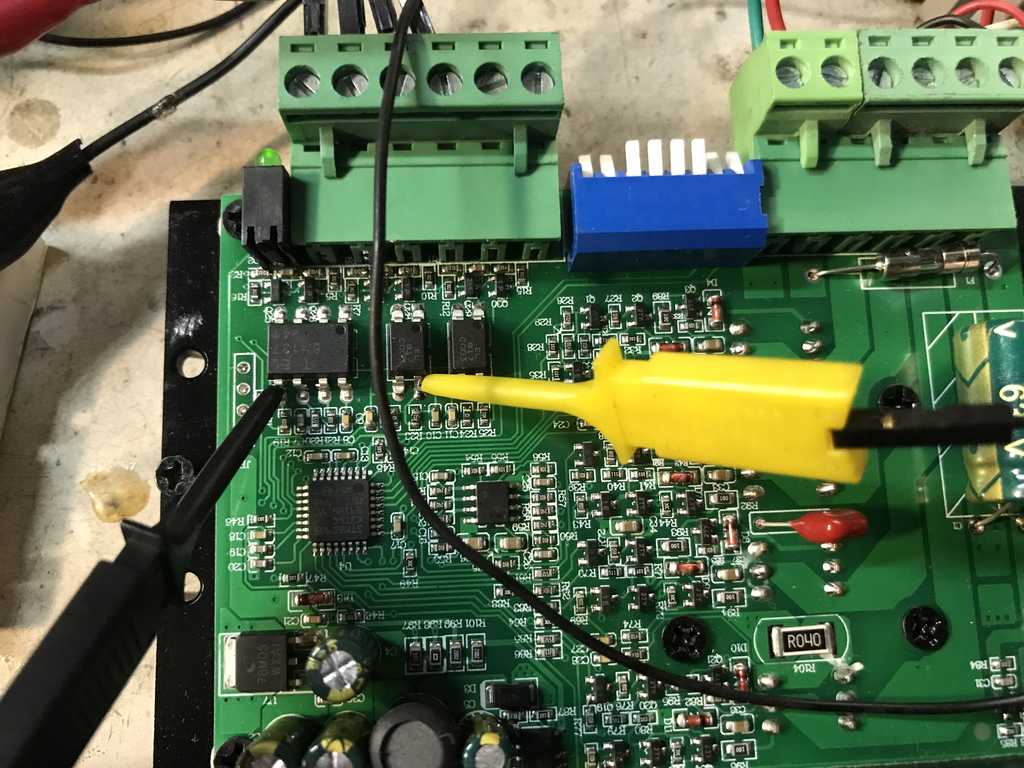
Dear meister, after adjusting the joint and pid values correctly, I observed the DIR circuit of the DM542 with an oscilloscope and found that the PC817 was delayed by more than 60 usec. Setting dir_delay to 80 usec allowed it to correctly return to the zero position. I apologize for asking some silly questions a few days ago.
The following user(s) said Thank You: meister
Please Log in or Create an account to join the conversation.
- meister
- Offline
- Platinum Member
-
Less
More
- Posts: 806
- Thank you received: 502
2 months 1 week ago #348853
by meister
Replied by meister on topic LinuxCNC-RIO - RealtimeIO for LinuxCNC based on FPGA (ICE40 / ECP5)
@viewsat you can tune the PC817 with lower resistance values on the transistor side, this produces a steeper slope
The following user(s) said Thank You: viewsat
Please Log in or Create an account to join the conversation.
Time to create page: 1.252 seconds