Starting over

More
10 years 2 weeks ago #81732 by Patrick Obrien
Replied by Patrick Obrien on topic Starting over
Rack and Pinion.

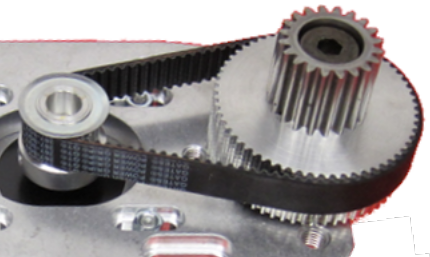
I'll be wordy so you can see if I dropped a step. The motor is 200 per revolution and the pinion is 1.0" driving a 3/1 reduction. So one revolution of a one inch pulley is 3.1416 inches of travel per revolution at the motor pulley. The G540 uses 10X micro steps so that equals 636.66 steps per inch, the result of 2000ms divided by 3.1416 inches. With a three to one belt/pulley reduction I should need 1909.86 steps to move the axis one inch, the result of 636.66x3.

1909.86 was a consistent 1.125 inches when rocking the axis through the MDI. I trimmed it back until it moved an inch to about 1750+/-. That is a red flag to me (1909 vs 1750) but unless it's the Gecko I am not sure where to look.

Please Log in or Create an account to join the conversation.

More
10 years 2 weeks ago #81733 by PCW
Replied by PCW on topic Starting over
The distance per pinion turn should be the rack pitch * pinion teeth
It would be a bit odd to have Pi on the equation unless the rack pitch has a factor or Pi
Please Log in or Create an account to join the conversation.

More
10 years 2 weeks ago #81734 by andypugh
Replied by andypugh on topic Starting over
Is this a rack-and-pinion drive? If not, what is it?

What comes after the 3:1 reduction?

Assuming that your 1" pulley is actually a 16-tooth XL pulley, that is actually 16 x 0.2" per revolution. So a scale of:
(10 x 200 x 3) / (16 x 0.2) = 1875. If it is a 17-tooth pulley then you would need 1764.7056 for the SCALE.

If the machine isn't going as fast as you want, but you have shown that it can go faster, you need to change the MAX_VELOCITY settings. (and check that feed-override is at 100%)

Please Log in or Create an account to join the conversation.

More
10 years 2 weeks ago #81735 by andypugh
Replied by andypugh on topic Starting over

PCW wrote: The distance per pinion turn should be the rack pitch * pinion teeth
It would be a bit odd to have Pi on the equation unless the rack pitch has a factor or Pi


Most gears do actually have a factor of pi built-in. The tooth sizes are normally in diametrical pitch, rather than circular pitch.
A 12DP gear moves 0.261799 inches per tooth.
This makes gearbox design fairly easy. The centre distance of a 30 tooth and a 65 tooth 12-DP gear pair will be half of 30/12 + 65/12.

Belts and chains, on the other hand, use a fixed circular pitch.

Please Log in or Create an account to join the conversation.

More
10 years 2 weeks ago #81737 by PCW
Replied by PCW on topic Starting over
Ahh I assumed racks were mostly in integer pitches
(I have seen several that are specified in 12,24, 36 TPI etc)

Please Log in or Create an account to join the conversation.

More
10 years 2 weeks ago #81739 by Patrick Obrien
Replied by Patrick Obrien on topic Starting over

PCW wrote: The distance per pinion turn should be the rack pitch * pinion teeth
It would be a bit odd to have Pi on the equation unless the rack pitch has a factor or Pi


Please correct me! My logic is the rack (20 pitch 20 degree pressure angle) has 20 teeth on a one inch pinion.

Were it 1 to 1 then 200 full steps would move it 3.1416 inches (63.66 steps per inch). Introducing a reduction gear makes the stepper require more steps to travel that same 3.1416 inches. What was 200 steps at the stepper is now 600 at the rack on a one to three reduction. So 600 steps equals 3.1416 inches or 190.985 steps per inch. If your drive has a 10X microstepping then you are at 1909.854 micro steps per inch.

Please Log in or Create an account to join the conversation.

Time to create page: 0.067 seconds
Powered by Kunena Forum
