
- Posts: 723
- Thank you received: 139
scurve trajectory planner
- smc.collins
- Offline
- Platinum Member
-

Less
More
1 year 8 months ago - 1 year 8 months ago #321396
by smc.collins
Replied by smc.collins on topic scurve trajectory planner
That kind of math isn't something i have worked with in years and years and years lol. My broader point was that, maybe it is worth looking to build a NN that's not super big , but it might be faster and more efficient. Particularly if it can be run in using a GPU compute model , but it needs to be a very small and tight NN, it can't be a huge model. Just a narrow implementation that can handle the calculations from the weights.
Last edit: 1 year 8 months ago by smc.collins.
The following user(s) said Thank You: Grotius
Please Log in or Create an account to join the conversation.
- FabianB
- Offline
- New Member
-

Less
More
- Posts: 14
- Thank you received: 19
1 year 8 months ago #321422
by FabianB
Replied by FabianB on topic scurve trajectory planner
The second derivative is not the curvature, the first one is.Then x~``traj(s0) for example :
- This is second derivate = curvature, given the ``
This means you need to enter the value of the already transformed trajectory. If we want to use eq. 30 for this we need to transform it first because there it is given before the transformation.- Is already transfomed, given the ~ above the x
yes- Is for startpoint s0.
- Is for x coordinate.
No, it is the second derivative with respect to curve length s, this is not the same thing as curvature (would be first derivative)- It is the curvature kappa value for the transformed startpos?
For the line all derivatives are 0. For the arc see above, ti is not the curvature but the second derivative, not sure if it has a name, "curvature of the curvature" basically.- I now get it, that a line has no curvature, so value is : 0
- So for a arc, we just put in the curvature value like : "1/Radius" normally. But they use eq.30 : -1/r*cos(s/r).....etc.... Why so difficult?
The following user(s) said Thank You: Grotius
Please Log in or Create an account to join the conversation.
- Aciera
- Offline
- Administrator
-

Less
More
- Posts: 4819
- Thank you received: 2177
1 year 8 months ago - 1 year 8 months ago #321427
by Aciera
Replied by Aciera on topic scurve trajectory planner
@FabianB
Now you are confusing me:
If I recall correctly the first derivative is the tangent angle (ie the slope) and the second derivative is curvature.
The first derivative of a line represents the slope which is a constant but not necessarily zero.
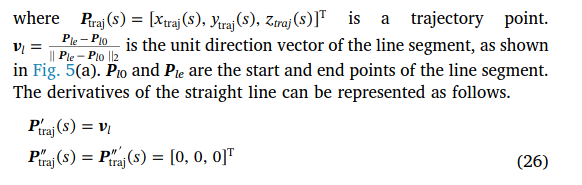
Now you are confusing me:
The second derivative is not the curvature, the first one is.
No, it is the second derivative with respect to curve length s, this is not the same thing as curvature (would be first derivative)
If I recall correctly the first derivative is the tangent angle (ie the slope) and the second derivative is curvature.
For the line all derivatives are 0
The first derivative of a line represents the slope which is a constant but not necessarily zero.
Last edit: 1 year 8 months ago by Aciera.
The following user(s) said Thank You: Grotius
Please Log in or Create an account to join the conversation.
- Aciera
- Offline
- Administrator
-
Less
More
- Posts: 4819
- Thank you received: 2177
1 year 8 months ago #321428
by Aciera
Replied by Aciera on topic scurve trajectory planner
@Grotius
In my opinion, yes.
First we do the coordinate transformation then we need to match the boundary conditions which are tangent angle (theta), curvature (kappa) and sharpness (c)
- It is the curvature kappa value for the transformed startpos?
In my opinion, yes.
First we do the coordinate transformation then we need to match the boundary conditions which are tangent angle (theta), curvature (kappa) and sharpness (c)
The following user(s) said Thank You: Grotius
Please Log in or Create an account to join the conversation.
- FabianB
- Offline
- New Member
-
Less
More
- Posts: 14
- Thank you received: 19
1 year 8 months ago #321430
by FabianB
Replied by FabianB on topic scurve trajectory planner
@Aciera, you are right it was probably to early this morning. I was thinking of the first derivative of the tangent vector (v_l) which makes it the second derivative. Sorry for the confusion.
But regardless I guess we can't simply take 1/R for the curvature because we need the components of it in x, y and z and these depend on the orientation of the arc etc.
But regardless I guess we can't simply take 1/R for the curvature because we need the components of it in x, y and z and these depend on the orientation of the arc etc.
The following user(s) said Thank You: Grotius, Aciera
Please Log in or Create an account to join the conversation.
- Grotius
- Offline
- Platinum Member
-
Less
More
- Posts: 2419
- Thank you received: 2349
1 year 8 months ago #321439
by Grotius
Replied by Grotius on topic scurve trajectory planner
Hi,
Thank's again Arciera & Fabian.
I was able to figur out Eq.29 & Eq.30.
This part includes the input of a line or arc from 3d space.
It includes calculating unit vector's.
It includes a arc interpolation given a arc circumfence lenght s.
It then includes calculating the first (theta), second (kappa) and third derivate (sharpness) given the lenght s.
For Eq.29 & Eq.30 it includes a proof function, given a example arc as input. This way we can verify the output.
There is terminal output visible for the proof functions, pasted as comment text.
Maybe you guy's can also verify the output.
Based on this work, i think best to restart with Eq.39 again.
The following user(s) said Thank You: Aciera
Please Log in or Create an account to join the conversation.
Time to create page: 0.724 seconds