
- Posts: 2419
- Thank you received: 2349
scurve trajectory planner
- Grotius
- Offline
- Platinum Member
-

Less
More
1 year 8 months ago - 1 year 8 months ago #322189
by Grotius
Replied by Grotius on topic scurve trajectory planner
@Arciera,
That's what i think we don't need. If the dogleg solver is able to find the endpoint in 3d space. Why do the tranformations
as used in the abstract?
We have already a case where the helix tail or start from a G2, G3 is used as end vector.
I see you have splitted up the gaus interpolation into x, y, z.

Edit:
Did a mayor update on the infrastructure.
- Use struct for clothoid data.
- Use seperate plot function.
- Use enum to choose a solver from the list.
- Use a central residual function used by all solvers. Where the objective function can cast types.
That's what i think we don't need. If the dogleg solver is able to find the endpoint in 3d space. Why do the tranformations
as used in the abstract?
We have already a case where the helix tail or start from a G2, G3 is used as end vector.
I see you have splitted up the gaus interpolation into x, y, z.
Edit:
Did a mayor update on the infrastructure.
- Use struct for clothoid data.
- Use seperate plot function.
- Use enum to choose a solver from the list.
- Use a central residual function used by all solvers. Where the objective function can cast types.
Last edit: 1 year 8 months ago by Grotius.
The following user(s) said Thank You: akb1212, Aciera
Please Log in or Create an account to join the conversation.
- Aciera
- Offline
- Administrator
-

Less
More
- Posts: 4819
- Thank you received: 2177
1 year 8 months ago - 1 year 8 months ago #322202
by Aciera
Well that's just a rough hack really that would need some streamlining but as long as nothing converges there is no point in polishing.
[edit]
And it looks like I have done it wrong having set ltot to 0
Replied by Aciera on topic scurve trajectory planner
Can't give you a definite answer to that but as long as we can't do it as described in the paper is seems a bit premature to want to modify the described method.Why do the tranformations as used in the abstract?
I see you have splitted up the gaus interpolation into x, y, z.
Well that's just a rough hack really that would need some streamlining but as long as nothing converges there is no point in polishing.
[edit]
And it looks like I have done it wrong having set ltot to 0
Last edit: 1 year 8 months ago by Aciera.
The following user(s) said Thank You: akb1212, Grotius
Please Log in or Create an account to join the conversation.
- FabianB
- Offline
- New Member
-

Less
More
- Posts: 14
- Thank you received: 19
1 year 8 months ago #322203
by FabianB
Replied by FabianB on topic scurve trajectory planner
Hi guys,
looks like you are making good progress. Short question regarding the single_clothoid_fit() are you only fitting the start and endpoint or are you also trying to match the curvature etc.?
looks like you are making good progress. Short question regarding the single_clothoid_fit() are you only fitting the start and endpoint or are you also trying to match the curvature etc.?
The following user(s) said Thank You: Grotius
Please Log in or Create an account to join the conversation.
- Grotius
- Offline
- Platinum Member
-
Less
More
- Posts: 2419
- Thank you received: 2349
1 year 8 months ago #322207
by Grotius
Replied by Grotius on topic scurve trajectory planner
@Arciera,
The only motivation in the abstract is to align the normal n with the positive z axis direction.
The equatations for the math are already there.
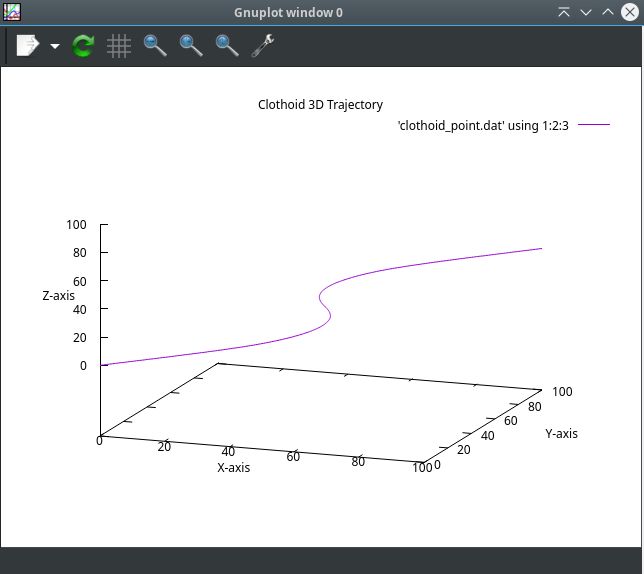
- Added clothoid interpolation
- Added dynamic plot size
@Fabian,
looks like you are making good progress.
Yes. To be honest. I did not know we could do this at all. My math level is not that good.
The progress is fenominal. We now have at least a working solution.
We can now refine, polish code and add different solvers to the codebase. Arciera is hard
working to try out new non-linear solvers, wich are kind off trickie to set up.
The result is a G3 solution between previous and next gcode segment.
Indeed, it matches curvature.
Later on we can test more graphical in opencascade. Wich has also a great codebase
to do forward & inverse transformations.
And maybe, maybe i will code a bi-clothoid in the future. As a 4-clothoid can cause overfitting,
wich is inherent to higher degree curves.
The only motivation in the abstract is to align the normal n with the positive z axis direction.
The equatations for the math are already there.
- Added clothoid interpolation
- Added dynamic plot size
@Fabian,
looks like you are making good progress.
Yes. To be honest. I did not know we could do this at all. My math level is not that good.
The progress is fenominal. We now have at least a working solution.
We can now refine, polish code and add different solvers to the codebase. Arciera is hard
working to try out new non-linear solvers, wich are kind off trickie to set up.
The result is a G3 solution between previous and next gcode segment.
Indeed, it matches curvature.
Later on we can test more graphical in opencascade. Wich has also a great codebase
to do forward & inverse transformations.
And maybe, maybe i will code a bi-clothoid in the future. As a 4-clothoid can cause overfitting,
wich is inherent to higher degree curves.
The following user(s) said Thank You: akb1212
Please Log in or Create an account to join the conversation.
- Aciera
- Offline
- Administrator
-
Less
More
- Posts: 4819
- Thank you received: 2177
1 year 8 months ago - 1 year 8 months ago #322215
by Aciera
I'm afraid that is a bit of an overstatement, I have no experience with this and also not really the time to poke around in dark any longer. This requires somebody who actually knows what they are doing, at least somewhat.
What is needed is a robust numerical solver and then the next step is the max error fitting described in the paper.
Replied by Aciera on topic scurve trajectory planner
Arciera is hard working to try out new non-linear solvers
I'm afraid that is a bit of an overstatement, I have no experience with this and also not really the time to poke around in dark any longer. This requires somebody who actually knows what they are doing, at least somewhat.
What is needed is a robust numerical solver and then the next step is the max error fitting described in the paper.
Last edit: 1 year 8 months ago by Aciera.
The following user(s) said Thank You: tommylight, Grotius, Darium
Please Log in or Create an account to join the conversation.
- Grotius
- Offline
- Platinum Member
-
Less
More
- Posts: 2419
- Thank you received: 2349
1 year 8 months ago #322241
by Grotius
Replied by Grotius on topic scurve trajectory planner
The following user(s) said Thank You: wellingtoncsouza
Please Log in or Create an account to join the conversation.
Time to create page: 0.139 seconds